Also, sick season is definitely here early: flu is increasing, and the common cold is surging. And another synthetic opioid may be spreading in our drug supplies.
Here’s what’s going on in the world of health and, most importantly, what it means for you.
Disease “weather” report Flu continues to increase
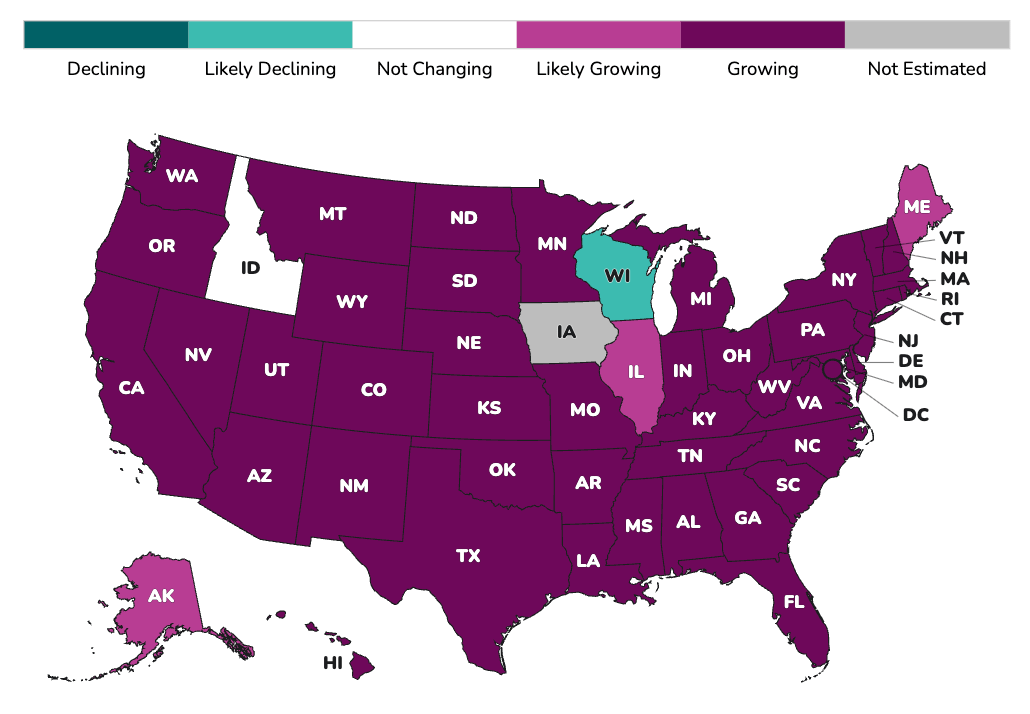
Flu is still low nationally but is increasing in almost every state (purple on the map below). This is true for many metrics, including test positivity rate, emergency department visits, and even (if you squint closely) hospitalizations, which are ticking up.
It’s so weird how early this flu season is, but as I said last week, flu is doing what it does best: being unpredictable.
The strain that is driving this flu wave right now is H1N1pdm09. H1N1 is in the flu vaccine, which is great news! But the circulating strain has a mutation that has drifted slightly from the vaccine. Early lab data suggest the mutation is most often found among teens and young adults, people whose first flu exposure was the 2009 H1N1 pandemic strain. This means the vaccine may not be as effective in young people.
BUT the flu vaccine is still very important. In that same study, the vaccine boosted antibodies against every current strain, including the mutated ones. Every year, multiple flu strains circulate, and the vaccine will likely protect kiddos from other strains!
What this means for you: It’s time to get your flu vaccine for optimal protection.
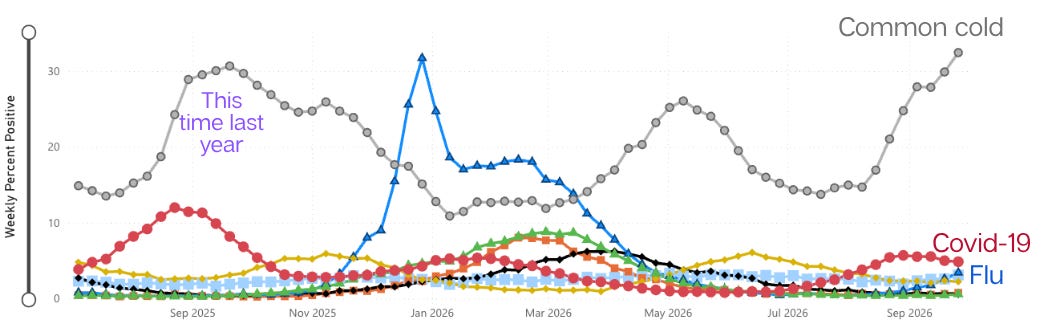
The other culprit: Common cold Most other viruses are still at bay or decreasing (like Covid-19), with one exception: the common cold. It’s surging right now (gray line below), with 32% of physician tests coming back positive for rhinovirus/enterovirus, the main viruses behind colds. This is higher than any rate since 2019 (last season on record on the CDC website). A fall rise is expected, but this one is big.
What this means for you: If you’re sick right now, it’s most likely the common cold or may be the flu. This means a lot of runny noses, sore throats, and feeling crummy. Unfortunately, there's not much you can do for a cold, other than sleep, lots of water, and staying home while you’re sick.
Cychlorphine has entered the scene Cychlorphine is an ultra-potent synthetic opioid that’s getting a lot of attention after several high-profile cases. According to the Center for Forensic Science Research & Education (CSFRE), test tube data estimates it to be up to 10 times stronger than fentanyl. It belongs to a different chemical family called orphines.
At least 24 states have now identified cyclorphine-related overdoses or deaths. One Tennessee county alone has reported 50 deaths.
We don’t know how widespread it really is in the drug supply. That’s partly because our surveillance system for substance use is fragmented and lagged. Toxicology reports take weeks, and it often takes months for the data to show up in official reports. And it doesn’t really happen unless someone dies. Fentanyl test strips don’t detect cychlorphine.
What this means for you: Opioid deaths are still a big deal in the U.S. Narcan still works. Call 911 and give a dose if you see an overdose. If there’s no response after two to three minutes, give another, and keep going, since cychlorphine may take several.
Last week, the Moscow Times (a non-state-controlled news organization) reported that a 28-year-old civilian anti-plague lab worker in Siberia died on October 1 after being exposed to the plague. Nearly 200 of her contacts are quarantined. Beyond that, the story gets very murky. Independent verification is not readily available in Russia, and there are all sorts of conflicts of interest here.
Plague? Like the Black Death? Kind of. Plague is a rare but serious disease caused by the bacterium Yersinia pestis, the same bacterium behind the Black Death in the 1300s. It lives in wild rodents and their fleas. Thankfully, it's much less of a problem today because of improved hygiene and living conditions. There are three forms: bubonic (the most common, which causes painful swollen lymph nodes), septicemic (in the bloodstream), and pneumonic (in the lungs). Pneumonic plague is the most dangerous and the only form that spreads person to person.
If early accounts are correct, this story is about the pneumonic plague. It’s concerning, as any lab accident/leak is, but the risk of this becoming a Covid-19 pandemic is very, very low for a few reasons:
Pneumonic plague is not traditionally efficient at spreading. While it does spread person to person through respiratory droplets, in previous outbreaks, one infected person typically infected one to three other people. Transmission occurs in close, sustained, face-to-face contact (like household caregiving, crowded sleeping quarters, or unprotected clinical workers). This isn’t like measles, which can linger in the air for hours and hours.
We have antibiotics. They work really well. In fact, a few cases of pneumonic plague pop up randomly in the U.S. The last case was in July 2025 in Arizona after a man was exposed to sick cats. Forty-six of his contacts received antibiotic prophylaxis, and none became sick. Outbreaks with person-to-person spread still happen in places where plague is endemic, like Madagascar. In 2021 in Madagascar, for example, 22 cases were confirmed, and eight people died. But antibiotics stopped the outbreak.
The response seems very rapid. Nearly 200 of the deceased Russian woman’s contacts were in quarantine and under close medical monitoring. Some reports say five hospitals are also under quarantine.
This didn’t happen in a crowded megacity. The institute is in a small town, not Moscow, which means less contact between people and less potential for spread.
Two things would raise concern, and many biosecurity analysts and epidemiologists will be trying to wade through the noise (and political chatter) to ensure these aren’t happening:
More cases. There isn’t reported spread yet. The good news is that the pneumonic plague has a short incubation period (usually one to four days), which means that if it does spread, it will happen this week. We don’t have to wait weeks and weeks as we did with hantavirus, for example. We probably can’t rely on the country reporting it, though, so epidemiologists will be watching other metrics like hospitalizations.
If the pathogen she died from was altered. This bacterium occurs naturally in wildlife in parts of Russia. Russia also has a long history of plague research and public health institutes that study and monitor it. So the fact that someone was working with plague is not, by itself, a cause for concern. But Russia has engaged in biologic weapons development and the possibility of modifying infectious diseases to make them more transmissible or resistant to common antibiotics is real. Experts are keeping a close eye on a range of possibilities here.
All of this underscores something so important: Biosecurity and public health are essential infrastructure investments, not “nice to haves.” And this is why. Without them, we won’t have rapid responses, resources for immediate action, or early detection. It’s that simple.
What this means for you: There are still many unknowns, but for now, this is an interesting situation that epidemiologists and biosecurity experts will continue to follow. The risk of a pandemic is very, very low. We know plague very well. We have treatments.
I will be back if anything changes.
A big thanks to Dr. Claire Dillavou—epidemiologist, biosecurity expert, and friend—who jumped on this with me over the weekend.
Good news
Teen suicide risk is at its lowest point in a decade. According to CDC data, 14% of high school students seriously considered suicide in 2025, compared to 20% in 2023. It also decreased among LGBTQ+ students (from 41% to 30%).
Nobel Prize awarded for creating a way to turn brain cells on and off using light. The technique, called optogenetics, lets researchers see exactly which brain circuits control things like movement, mood, and memory. This can help explain what goes wrong in conditions like Parkinson’s, depression, epilepsy, and some kinds of blindness. Treatments for patients are still in the early stages, but the discovery is already speeding up research into new ways to treat the brain.
Question grab bag
Re: Health equity piece. That was great! But isn’t that image of the people on the boxes with a fence outdated?
Thanks for raising this, and you’re right. Like many others, we were familiar with this graphic because it’s so widely used in equity vs. equality conversations. But thanks to readers who have pointed out its real limitations, we now understand we should leave it in the past. It frames advantage as an inborn trait like height rather than the result of social structures. It leaves women out and treats the fence as a given, so equity becomes handing out boxes instead of removing the barriers themselves. Since learning more, we’ve replaced it in the post. These visualizations better reflect how equity relates to many kinds of people and issues.
Bottom line
Get your flu vaccine early. If you’re sniffly, it’s probably the cold. The Russia story is worth watching as something interesting (not a top 10 worry in my mind today). As always, we will be back with more updates if/when they arise.
Love, YLE
Your Local Epidemiologist (YLE) is a team of experts, from physicians to immunologists to epidemiologists to nutritionists, working together with one goal: to “translate” ever-evolving public health science so people are well-equipped to make evidence-based decisions. The YLE suite of newsletters reaches over 475,000 people across more than 132 countries. This newsletter is free to everyone, thanks to the generous support of fellow YLE community members.


No comments:
Post a Comment