--------------------------------------------------
Top 10 Cyclospora questions
The cyclosporiasis foodborne outbreak continues to grow, and individuals are left to figure out how to weather this storm until government systems catch up. So we are getting flooded with questions! The YLE team compiled answers to the top 10 to bring the nuance you may be looking for.
Note: This post builds on a previous YLE post that explained what’s going on. If you missed that, start here.
1. Can you just tell me what not to eat?
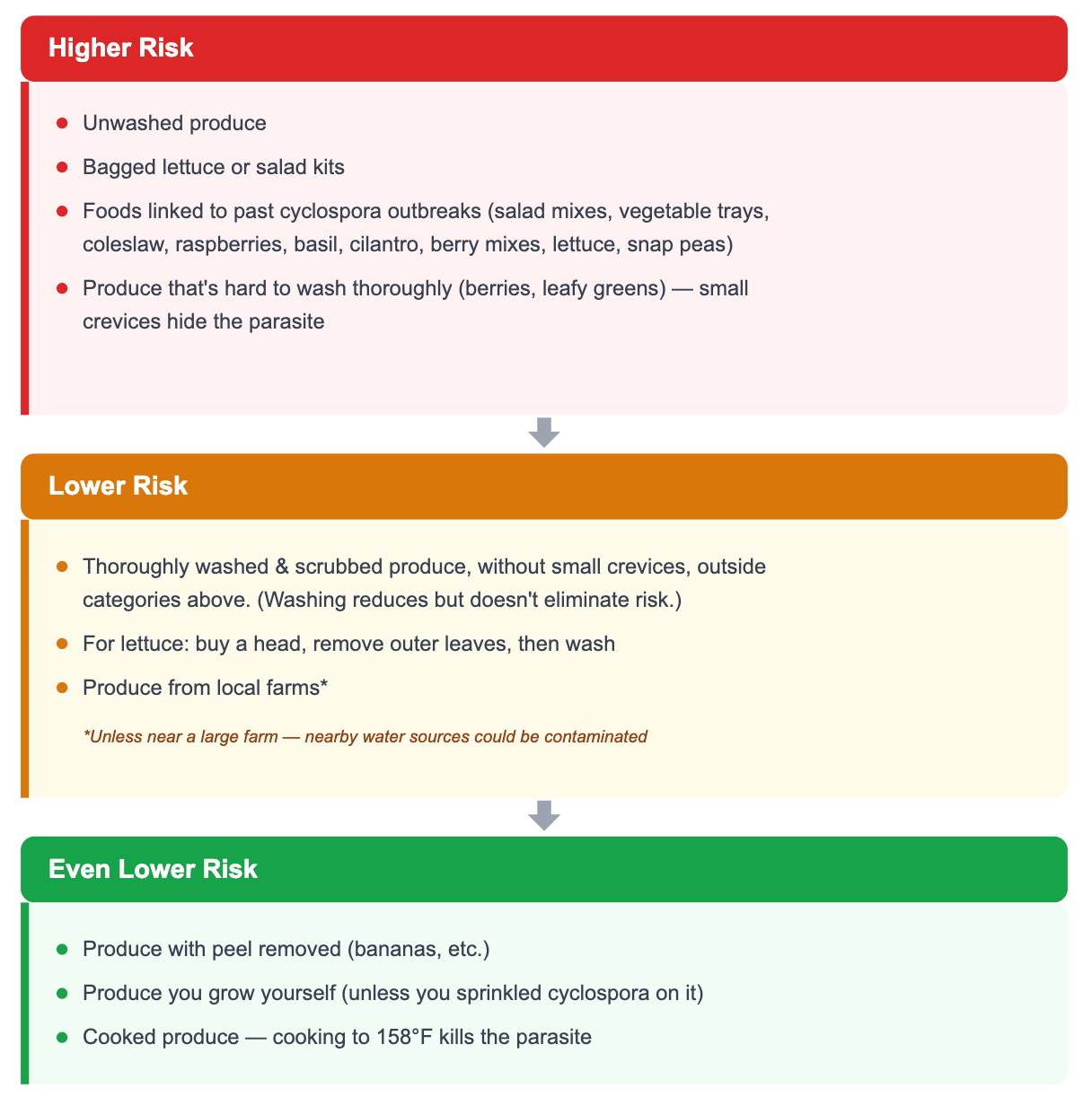
Unfortunately, it’s not that easy, because a source hasn’t been confirmed. So risk falls on a spectrum and risk tolerance varies.
This is how I’m thinking about it:
Skip bagged salads, salad kits, and boxed salads from the grocery store, and avoid them at restaurants and fast food places, too. Michigan’s warning on Monday (unusual to go public before the FDA) is a strong signal of what they’re seeing. Whole heads of lettuce are fine if you strip the outer 2-3 layers, since that’s where contamination is most likely to sit.
Michigan’s investigation has yet to pinpoint a company or rule out other foods. Two dozen other states are still under active investigation. So avoiding other foods is reasonable. In previous outbreaks, the culprits were raspberries, fresh herbs (basil, cilantro), onions, and snap/snow peas. I would still avoid these, especially if you’re high risk (pregnant, older, or immunocompromised).
Stick to produce you can peel or cook. (If you have frozen berries from January, you should be in the clear as this outbreak likely started in May.)
2. How long do I need to cook produce for? Does freezing work?
Cooking food to an internal temperature of 158°F is the only thing known to kill Cyclospora. This means sautéing raw spinach for about 1.5 minutes. (Turn your salad into a stir fry!)
Microwaving doesn’t work as well because heat spreads unevenly; research shows 45 seconds wasn’t enough to kill Cyclospora, so go longer and check that every part, not just the surface, is steaming hot.
Freezing isn’t reliable because a typical home freezer isn’t cold enough to kill the parasite. Research shows you’d need -20°C (-4°F) for at least 2 days, or a commercial deep freeze at -70°C for an hour, well below what most kitchen freezers hit.
Washing helps a little, but not entirely, because these microscopic parasites love to hide in the grooves and crevices. They also hide from home remedies people suggest, like lemon juice.
3. Is local produce better than big distributors?
The risk is much lower. In fact, there has never been a documented cyclosporiasis outbreak linked to a local farm.
That said, Cyclospora lives in soil and contaminated water, so a local farm could be affected if it shares a water source with a large commercial farm. Cyclospora can also enter the food supply at a packing, processing, or distribution facility, where outbreaks get amplified—a local farm would be safer on this front, too. My hunch is that the real culprit here isn't the farm itself, but distribution, but we don't yet know yet.
4. How much precaution should we be taking in California (or other states), where very few cases have been reported?
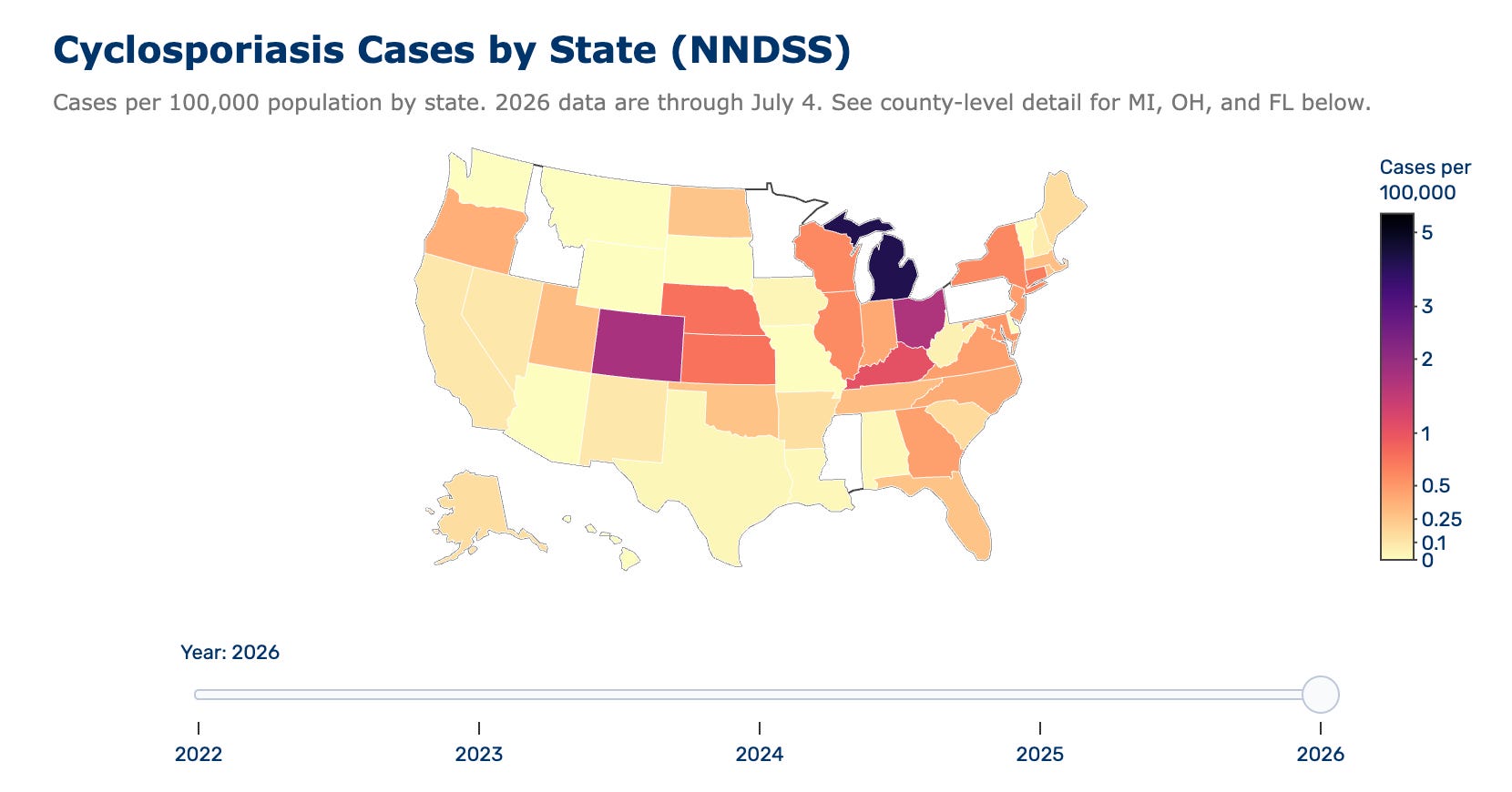
Distribution networks are complex, but all states are now actively looking for cases. That makes me more confident that states with low case counts (that stay low) aren’t linked to whatever is driving the outbreaks in Michigan, Ohio, New York, and elsewhere.
All states have some cyclosporiasis cases, but that’s expected: it reflects multiple outbreaks happening at once. California, for example, has cases, but not more than in past years—actually fewer. About 95% of California’s cases have involved people who picked up the parasite while traveling outside the U.S.
For what it’s worth, I live in California, and I’m not eating lettuce but being liberal with the other foods. I don’t have time for weeks of exploding diarrhea, but my guard is a little more down than it would be if I lived in Michigan or New York.
5. How do I know what bug I have?
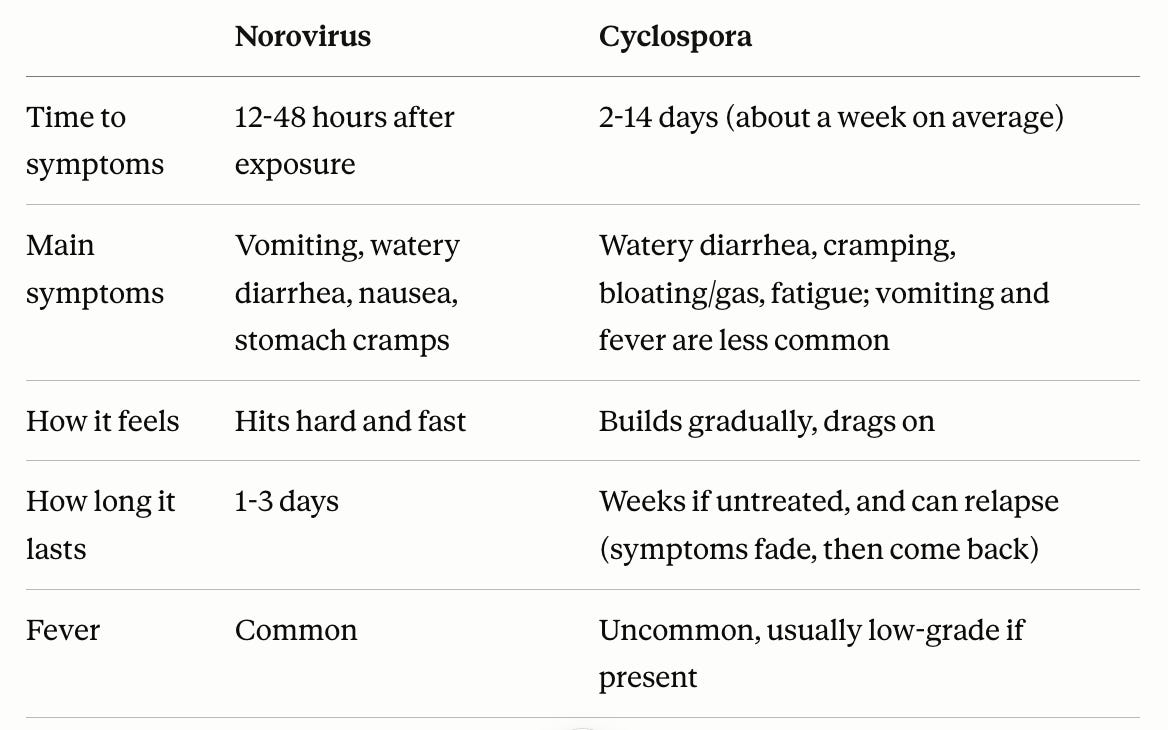
Many bugs can cause diarrhea. Norovirus is a common virus that spreads year-round and causes similar symptoms, but is highly contagious, while Cyclospora is a parasite that is not contagious from person to person.
To differentiate between the two at home, it really comes down to symptoms and timing. If symptoms show up within a day or two and pass quickly, think norovirus. If it lasts more than a week and then it comes and goes for weeks, that’s likely cyclosporiasis. Antibiotics help with cyclosporiasis, so it’s worth getting tested (although I hear the test is expensive).
6. How does this end?
Once the product is out of circulation. That can happen naturally (e.g., clean salad gradually replaces infected salad), through intervention (stores pull it), or as the season shifts toward fall, since cooler, drier conditions make it harder for the parasite to mature.
I don’t know how long it will take to end. No one does. But the Cyclo season typically ends in September when the parasites can no longer mature as efficiently.
7. There is no federal guidance for us physicians. When am I supposed to test and how?
It’s absolutely insane how long the federal Health Alert Network (HAN) notice was delayed, but it finally came out yesterday. Michigan’s provider bulletin is absolutely fantastic. If you’re a clinician, read that.
8. Can our animals get this?
No. Cyclospora only infects humans and spreads solely through the fecal-oral route. Researchers have tried to infect chickens, dogs, mice, rabbits, monkeys, and several other species in lab studies, and it hasn’t taken. So feeding your salad to your chickens is fine.
9.
How easily is it transferred within a restaurant kitchen, like if a
cook has unknowingly handled contaminated lettuce or something for
someone else’s order and then touches your food? Or via cooking
utensils/equipment/shared prep surfaces?
If the produce arrives at a restaurant already contaminated and is infectious (which takes about 2 weeks on a head of lettuce, for example), and then that lettuce touches a cutting board, knife, or bin used for other food, the parasite can be transferred. It was great news to see Taco Bell move quickly last week.
10.
Is there any hope of CDC or any of our government agencies tracking
down the source of this outbreak? Does the EIS have the resources to
find the source?
I’m confident that the federal scientists are doing the best job they can do with what they have. Cyclo is difficult to investigate because it takes so long to cause symptoms (do you remember what you ate 10 days ago), it takes an enormous amount of resources to pinpoint; some foods, like at Mexican restaurants, have many ingredients; making it challenging to pinpoint a single ingredient; and testing options are limited. There were definitely outbreaks in the past where no source was found.
Local and state public health departments are also working their tails off. But public health, and specifically parasitic teams, have been chronically underfunded. They are holding on by scotch tape, and now, with the largest cyclosporiasis outbreak in history, they are overwhelmed. While resources can be pulled from elsewhere, public health departments are also dealing with record cases of measles and whooping cough on top of travel-related Ebola and the World Cup, and everything else. It’s a lot.
Communication, guidance, timeliness, and transparency are what the federal government is falling short on. There has been very little communication, and what has been said is that these outbreaks happen all the time. This is not normal, and saying so without communicating what the public should actually do is unhelpful to the point of gaslighting.
Bottom line
There are steps you can take to reduce your risk during this big foodborne outbreak while the systems around us catch up. I will be back when we know more. Keep your questions coming!
Love, YLE


.jpg)
No comments:
Post a Comment