This article is by Rong-Gong Lin II at the Los Angeles Times:
‘Playing COVID roulette’: Some infected by FLiRT variants report their most unpleasant symptoms yet
As
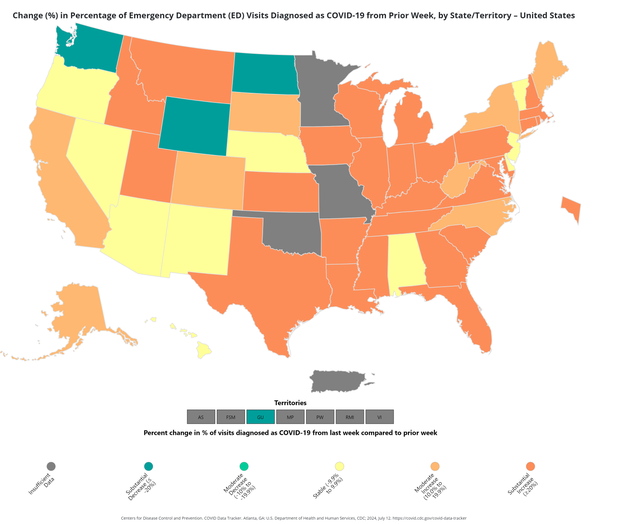
the summer travel season picks up, COVID cases and hospitalizations are
rising in Los Angeles County — and some of those recently reinfected
are finding their latest bout to be the worst yet.
There are no
signs at this point that the latest coronavirus variants are producing
more severe illness, either nationally or in California.
But some
doctors say this latest COVID rise challenges a long-held myth:
Although new COVID infections are often mild compared with a first
brush with the disease, they still can cause severe illness. Even if someone doesn’t need to visit the emergency room or be hospitalized, people sometimes describe agonizing symptoms.
“The
dogma is that every time you get COVID, it’s milder. But I think we
need to keep our minds open to the possibility that some people have
worse symptoms,” said Dr. Peter Chin-Hong, a UC San Francisco infectious
diseases expert.
Each time you get COVID, he said, is “kind of like playing COVID roulette.”
This underscores the need for caution during summer travel and activities, even though the overall risk remains relatively mild.
Since everyone’s experience with COVID is different and influenced by a
number of factors, it’s difficult to quantify how many are experiencing
more acute symptoms now compared with previous infections. But
anecdotally, including on social media sites, people are expressing
shock at how sick they’ve become from the latest subvariants, which have
been collectively nicknamed FLiRT.
“I’ve had COVID a few times but this is the worst I’ve had it,” wrote one person on Reddit.
The person reported recurring fever, being so congested they couldn’t
breathe out of their nose, “terrible sinus pressure and headache ... and
I can’t stand up for too long without feeling like I’m about to pass
out.”
“Previously COVID just felt like the common cold, but this
strain is [wreaking] havoc,” the person wrote. “I don’t like to complain
like this, but I’m shocked at how much it’s taking me out.”
Another person wrote that their “throat feels like razor blades” and that they feel like they’re “in living misery.”
“I have so much phlegm, but it hurts so bad to cough because my throat is on literal fire!!” the person wrote. “This is my 4th time having Covid and I swear I feel like this is the worst it’s ever been!!”
Others who eluded COVID for more than four years got infected this summer.
One person fell ill and tested positive for the first time after hosting a Father’s Day gathering for 12 people. The person described “uncontrollable body-shaking chills so bad I couldn’t feel most of my fingertips.”
A 42-year-old nurse, who has had COVID four times, said their
latest illness has been “intense with fevers, cough, head pressure and
pain. It’s attacking my throat and ability to swallow.”
Others, though, have said each subsequent COVID illness has been easier to recover from. And one first-time infected person wrote that they had “super mild symptoms [that] just feels like a seasonal allergy” flare-up.
Some studies back up the idea that subsequent COVID infections pose additional risks. A 2022 report
in the journal Nature Medicine, focused on veterans, found that,
“Compared to noninfected [people], cumulative risks and burdens of
repeat infection increased according to the number of infections,”
heightening the risk of medical problems, hospitalization and death.
And while the prevalence of long COVID appears to be declining, doctors note there is risk of developing the syndrome with each infection. A report published
by the U.S. Centers for Disease Control and Prevention last summer said
the prevalence of long COVID among U.S. adults was 7.5% in early June
2022, but had decreased as of mid-June 2023 to 6% — still a notable
share of the population.
There are a number of potential reasons why a subsequent COVID illness might feel worse than the first.
Say a person who was vaccinated and last boosted in 2021 got infected
in 2022 and then again in 2024. The relatively long gap of not being
exposed to infection, or a booster, “maybe led to [their body] not
having as much immune memory. And the variants have changed so much
anyway, it’s like getting exposed to something relatively different from
what virus the immune system had seen earlier,” Chin-Hong said.
Without
staying up-to-date on COVID vaccinations, which “remind the immune
system of what the more current variants look like,” a recent infection
may cause the body to act relatively surprised to the FLiRT subvariants
that are now dominant nationwide.
“It’s evolved so much, and the body is, like, ‘O-M-G, what is this thing that I’m seeing?’ ” Chin-Hong said.
The
logic is much the same for annual flu shots, which are formulated each
year in hopes of priming the immune system against the dominant
circulating versions of that virus.
For the week ending Saturday, an estimated 70.5% of COVID specimens
nationwide were of the FLiRT subvariants — officially known as KP.3,
KP.2 and KP.1.1 — up from 54.9% a month earlier. Another closely related
subvariant, LB.1, is estimated to comprise 14.9% of specimens, up from
10% a month earlier.
Prior immunity from old vaccinations can
still do a decent job of protecting many people against getting
seriously ill. But without the refresher that comes with an updated
vaccine, Chin-Hong said the immune system “probably won’t be able to
stop the virus in its tracks, or neutralize the virus as soon as it
comes in, because it looks so different, before kicking in memory
immunity.”
“In the meantime,” he added, “this virus is infecting
cells happily, while the body is trying to use its current memory to
make new immune cells.”
It’s also notable that, even for younger
adults who are considered up-to-date on their COVID immunizations, it’s
been nearly a year since their last vaccination, and the effectiveness
of the vaccine weakens over time.
A report
published by the CDC in February found that getting the updated 2023–24
COVID vaccine provided about 54% increased protection against
symptomatic illness compared with not getting the shot. Vaccine
effectiveness against symptomatic infection is higher in the first few
months after getting the updated shot.
The vaccines continued to provide good protection against hospitalization and death.
In
L.A. County, COVID cases and hospitalizations continue to rise. For the
week ending June 30, there were an average of 229 coronavirus cases a
day reported, up from 106 a month earlier. And for the week ending June
29, there were an average of 197 coronavirus-infected people in
hospitals per day, up from 117 a month earlier. And while COVID
hospitalizations are now higher than they were at this same point last
year, they remain below the relatively mild peak seen in summer 2023.
Officially
reported cases are an undercount, as they only factor in tests done at
medical facilities, and don’t account for at-home tests or those who
don’t test. In L.A. County, last summer’s COVID spike peaked in late
August at 571 cases a day, and hit a maximum of 620 coronavirus-infected
people per day in hospitals in early September.
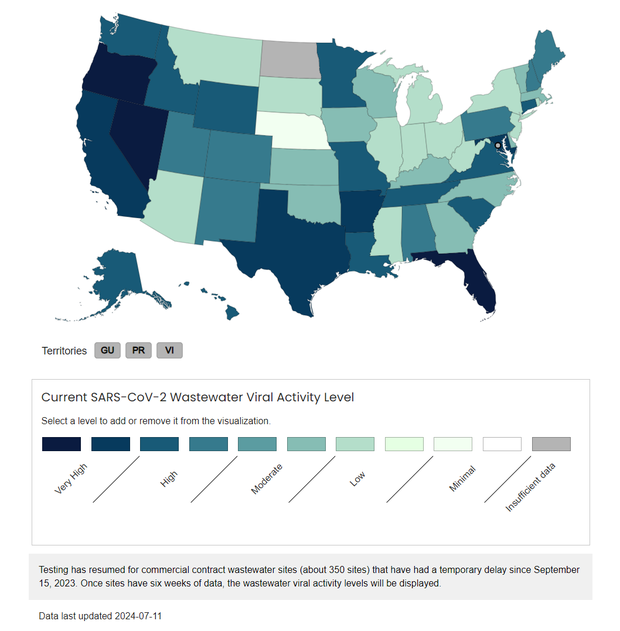
Viral levels in
L.A. County wastewater have been relatively stable. For the week that
ended June 22, the most recent available, viral levels in sewage were at
17% of the peak from the winter of 2022–23, the same as the prior week.
Last summer peaked in early September, where viral levels in sewage
were at 38% of the prior winter’s peak.
The rate at which
coronavirus tests are coming back with positive results continues to
climb across California. For the week ending July 1, 10.6% of
coronavirus tests statewide came back positive, up from 4.1% a month
earlier. Last summer’s positive test rate peaked at 13.1%, toward the
end of August.
There has been relatively low uptake of the updated COVID vaccine,
which became available in September. Since then, 36.7% of California’s
seniors age 65 and up have received at least one dose of the updated vaccine, as have 18.5% of adults age 50 to 64, and 10% of the youngest adults, up to age 49.
For
people who haven’t gotten an updated vaccine within the last year, “you
should think about getting it, especially if you’re older and immune
compromised,” Chin-Hong said. There continue to be hundreds of COVID
deaths reported nationally every week, with seniors and
immune-compromised people most at risk.
Even getting the 2023-24
vaccine now will still allow you to get the updated COVID vaccination
that is on track to become available this fall. The CDC will recommend everyone 6 months and older get the updated 2024-25 version of the vaccine.
A good time to get the 2024-25 COVID vaccination is in October, Chin-Hong said.
“It’s
like everybody seems to be thinking COVID is just like normal now,”
Chin-Hong said. But taking sensible measures — like coworkers deciding
to not go into work when sick, and testing themselves when symptomatic —
can make a world of difference in keeping COVID limited to a smaller
number of people.
And with COVID rising, it’s also a reminder
that it’s sensible to keep a mask in your pocket to don if you happen to
be near an ill person, Chin-Hong said.
===========
If the above severe symptoms reported by people on social media are considered "relatively mild", I'll eat my hat. And I'll keep hoping that being fully vaccinated, boosted, and masked will help me avoid this latest "mild" surge!




.jpg)