----------------------------------
By Benyamin Cohen, 8-10-26, The Forward

"ATLANTA — Hilbert “Hibby” Margol wears two watches.
"It is the kind of detail that seems small until you can’t stop noticing it. One watch is ordinary. It has hands, numbers, the plain mechanics of telling time. The other is a Life Alert, the sort of device sold to people who live alone, or to the people who love them and can’t stand the thought of them living alone.
"Together the two watches say something about a man before he’s said a word himself: that he has outlived the need for almost everything, except the people determined to make sure he’s still here.
"He is 102. He lives by himself in the same two-story house in suburban Atlanta he shared with his wife of 77 years, Betty Ann, who died at 96 last September. The house still carries the warmth of her memory. Family photographs cover every surface that will hold them: the mantel, the end tables, the walls, climbing toward the ceiling like something that grew there on its own.
"There will soon be one more: Hibby’s fourth great-granddaughter, Callie Rose, was born two weeks ago.
"A framed photograph of French President Emmanuel Macron pinning the Legion d’Honneur to Margol’s chest — taken in 2024, when Margol was one of dozens of American veterans Delta Airlines chartered to Normandy for the 80th anniversary of D-Day — leans against the fireplace, not yet hung, as if the house has simply run out of room to keep up with the life still happening inside it.
"The coffee table has disappeared beneath medals and ephemera and the accumulated evidence of a hundred years, and it occurs to you, sitting across from him, that you are not in the home of a man winding down. You are in the home of a man still arriving.

"His iPhone buzzed. Then again. He glanced at it and rolled his eyes.
“That’s my daughter,” he said. “Checking on me.”
"His daughter is, herself, a senior citizen. The phone had no case — hadn’t needed one, he doesn’t drop things — which felt like its own kind of answer to a question I hadn’t yet asked: What does it look like to move through a century without ever quite losing your grip?
"On the day I visited this June, he had just returned from yet another trip to Normandy, marking another anniversary of a war he’d fought in as a young man and had spent most of the rest of his life not talking about. A week before that, the Atlanta Braves had honored him on the field on Memorial Day for the second year in a row.

"For six decades, Margol said almost nothing about what he had seen at the end of that war — not to his wife, not to his three children, not to anyone. And then, in his 80s, he started to talk about it, and he has not really stopped since.
"Margol is sharing his experience as one of a dwindling number of U.S. Army veterans alive today who helped liberate the Dachau concentration camp.
Inside the camp
"He and his identical twin brother, Howard — younger by ten minutes — served together in the war. That alone took some doing: the military generally kept siblings apart, a policy hardened after five Sullivan brothers died together when their ship sank in 1942. (It’s loosely the premise behind Saving Private Ryan.) It took a letter from the Margols’ mother to President Franklin D. Roosevelt to get an exception made.
"On the morning of April 29, 1945, the brothers were on the outskirts of Munich when they caught a strange, powerful smell drifting out of the woods.

"Howard was the one who placed it. It reminded him of an unpleasant odor he would sometimes catch a whiff of in their mother’s kosher kitchen back home in Jacksonville, Florida — the way she would hold a freshly killed chicken over the gas flame of the stove to singe off the last of its pin feathers. Only this stench was much, much stronger.
"The brothers went to find the source. What they came to first was a line of boxcars. The first one they reached had its sliding door open. A dead man’s leg was dangling out of it. They opened the cars and found them packed with dead bodies in striped prisoner uniforms “like sardines,” Hibby would say.
"They had a small camera, liberated from a dead German officer a few weeks earlier, and they used it to take a photograph of one of the cars — a copy of which hangs in the United States Holocaust Memorial Museum in Washington, D.C.
"They pressed further into the woods and came out at another clearing. Above the entrance was a sign: ARBEIT MACHT FREI. Work will set you free.
"They had found Dachau.
"Beyond the gate was a wide-open yard ringed by low barracks buildings — and, in several places, bodies stacked the way you’d stack cordwood. The arrangement of them is the part that refused to make sense. Somebody had piled them, neatly, as routine.
"Neither brother had ever seen anything like it. “We didn’t understand what we were looking at,” Margol said. “It sort of reminded us of a movie set.”
"They learned only later that the camp’s ovens had run out of coal months earlier, and without coal, there was no way to cremate the bodies. So the corpses had simply been left where they lay.
"It took a moment to register that not everyone in the yard was dead. Off to one side, against a barracks wall, were four or five prisoners — some squatting, some just standing, none of them well. But alive.
"The camp’s roughly 32,000 prisoners walked free later that same day, once a Swiss Red Cross negotiator talked the SS commander into a peaceful surrender rather than a last stand.

"Years later, at a visit to mark the liberation’s 70th anniversary, an elderly survivor found Margol after a memorial service. She told him she’d been too sick with typhus that morning to understand what was happening around her. Then she leaned over and kissed him on both cheeks. “If you guys were two or three days later,” she told him, “I wouldn’t have made it.”
One family, two branches
"I’ve spent much of the past year following a different story: a family of cattle farmers in rural Illinois, building a synagogue in a two-acre cornfield out of the remains of closing synagogues — a Torah rescued from one congregation, an ark from another, stained-glass windows carried out of buildings that no longer exist. The building will also include a museum of tolerance, sharing the stories of the family’s ancestors — some who died in concentration camps, others who survived by being hidden in the homes of Christian families.
"The family is named Jakobs. You’ve met the 41-year-old farmer, Nik, in stories I’ve written about the Pennsylvania synagogue he dismantled, piece by piece, to save it; the groundbreaking of the new one rising in a field; and the family’s roots in the Netherlands, where his grandmother, Edith, spent nearly three years hidden in a farmhouse. This spring, I flew with the family to Stadskanaal, the small Dutch town that was her family’s refuge, to watch a local theater troupe stage a play about her survival.
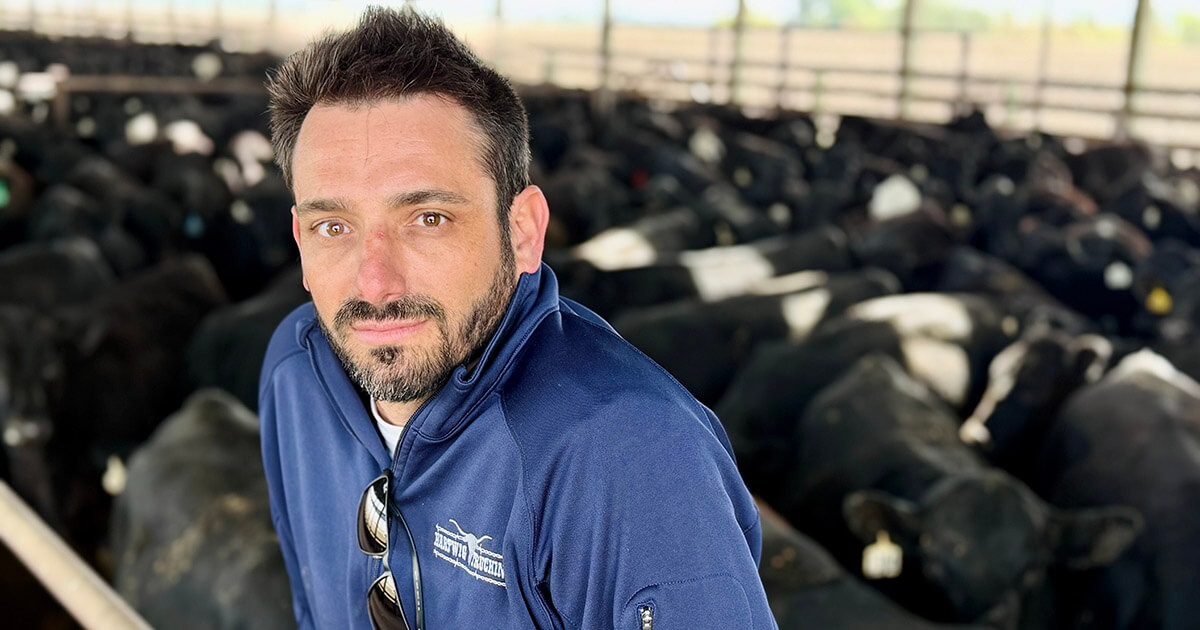
"It was in the Netherlands, reporting Jakobs’ story, that he first mentioned a name: Hibby. Jakob’s brother Bryce who left the farm for a career of his own, is married to one of Margol’s granddaughters. Margol’s great-granddaughters carry both halves of this history. On one side: relatives murdered in the Holocaust, and ancestors who survived it in hiding. On the other: a soldier who helped liberate one of the camps.
"I asked Margol what he made of it. He didn’t reach for anything grand. “Well,” he said, “it’s quite a story.”
The silence
"For decades, Margol said almost nothing about Dachau to his family. “We had written letters,” he said of the war years. “We figured that was sufficient.”
"Life moved on. Margol built a business selling furniture and appliances. He raised a family. The war became something that had happened to a younger man.
"Then came an invitation.
"In 2012, at 88, Margol joined about a dozen other American liberators on the International March of the Living, traveling to Poland with Holocaust survivors and thousands of Jewish teenagers. For the first time since the war, he wasn’t simply remembering what he’d witnessed. He was walking beside people whose lives had continued because soldiers like him had arrived when they did.
“It was such an emotional experience,” he later recalled of walking from Auschwitz to Birkenau, “that when I got home I said, now I have to start talking about it.”
"His first talk was at the public library near his home. More than 90 people showed up, on word of mouth alone. Then came another invitation. And another. Synagogues. Churches. High schools. A World War II roundtable. Adult education classes at Emory University. He stopped counting after 200 presentations. Today, he estimates he’s given close to 300.

"But talking about Dachau and reliving it are not the same thing. Years ago, touring the United States Holocaust Memorial Museum in Washington, D.C., with a small group, he had to walk through a boxcar on exhibit to continue the tour — cleaner and newer-looking than the one he remembered, but a boxcar all the same. “Emotionally,” he said, “I broke down.”
"For most of his life, Margol had carried the story alone. Now he worried what would happen if no one carried it after him.
"In September, Margol is returning to Germany with his son Jerry, 74 — this trip courtesy of the Best Defense Foundation, the veterans organization that has taken the two of them to battlefields around Europe, and which is now making a documentary about Margol and another veteran. The itinerary is still coming together, but it includes a stop that father and son have made together twice before: Dachau.
The next generation
"Long before Margol began speaking publicly about the Holocaust, he had already spent years building Jewish life closer to home.
"Rabbi Mark Zimmerman saw it firsthand. Zimmerman retired this summer after leading Congregation Beth Shalom in Atlanta for 38 years. He met Margol in 1988, when the rabbi arrived and Margol was, as he put it, “a young man of sixty-something.”
“He still comes to synagogue,” Zimmerman said. “He’s still sharp as a tack.”
"But what Zimmerman remembers most isn’t Margol’s longevity. It’s what he built.
"In the late 1990s, Beth Shalom needed an educational wing. Before the congregation had raised a dollar toward the project, Margol quietly wrote a $100,000 check so the synagogue could hire a professional fundraiser and launch the campaign. He and fellow congregant Stephen Klein later donated roughly $350,000 each to complete the building.
"Today the Klein-Margol Educational Wing houses the congregation’s preschool, administrative offices, chapel, library and youth lounge.
“In many ways,” Zimmerman said, “I owe my staying at Beth Shalom to Hibby and his vision. We still have a tremendous preschool because of that original vision.”
"Only years later did Zimmerman learn another part of Margol’s legacy, about liberating Dachau. Margol recently gave Zimmerman a copy of the memoir he and his son self-published, becoming one of the congregation’s living links to the Holocaust.
“His firsthand account is such a rare commodity,” Zimmerman said, “in a world where primary witnesses, for the most part, are dying out.”
"Nearly 800 miles away, in Sterling, Illinois, the other side of Margol’s family is at work on a version of the same project. Jakobs is building a synagogue, with a museum inside so his grandmother’s story outlives her. Margol has already seen how it turns out — his wing has held preschoolers for a quarter century. Jakobs broke ground this spring.
A hat, a promise
"I asked Margol if I could take his picture before I left. “Let me get my baseball hat,” he said, and disappeared into another part of the house.
"It’s the one with the patch of the 42nd Infantry Division — the Rainbow Division, one of the liberating forces at Dachau. The nickname dates to 1917, coined by a young Col. Douglas MacArthur because the division’s ranks were drawn from National Guard units in 27 different states.
"Room by room, the 102-year-old wandered through his home looking for the hat. He checked the kitchen. He looked at the hook by the door, where another cap was hanging, then shook his head and kept going.
"There was something almost unbearably ordinary about it, set against everything he’d just spent hours telling me. The boxcars. The smell. The gate. And now: Where did I put that hat?
"He found it, and came back into the room wearing it — the same hat, more or less, that has sat on his head in front of hundreds of audiences by now. He still says yes to the invitations. He still boards planes to Europe. When I asked what all of it was for, he didn’t hesitate.
“I hope and pray,” he said, “that the offspring of all the Holocaust survivors outlive the offspring of the deniers.”


.jpg)
No comments:
Post a Comment