------------------------------------------
Your guide to fall 2026 vaccines
Katelyn Jetelina and Edward Nirenberg, Aug 26, 2026
Respiratory vaccines—for flu, RSV, and Covid-19—will be available at no cost this fall. This may be surprising to hear, given the eerie silence. (There will be no fall federal vaccine campaign.) But it’s happening, and keeping track of them isn’t easy. So here are the what, who, and when for each, informed by the most up-to-date science and policy.
Bottom line upfront: There are nuances to consider for those seeking maximum protection, but ultimately, the best vaccine is the one you receive.
Seasonal influenza (flu)
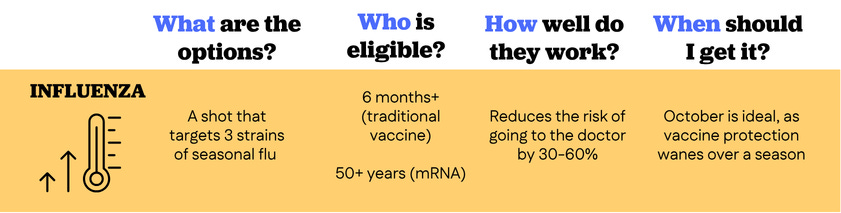
What: This fall’s vaccine covers three strains of seasonal flu and is offered by five manufacturers. All three strains were updated for 2026-2027, which is pretty unusual but should mean good protection. Selecting vaccine strains for rapidly changing viruses, like flu, is both an art and a science, so the vaccine formula doesn’t always align perfectly with the circulating virus. On average, flu vaccines reduce the risk of needing to go to the doctor by 30% to 60%.
The vaccines are all very similar, and you won’t gain much from shopping around. But for those looking for nuances:
Kids: The nasal spray flu vaccine may be a bit more effective. FluMist can now be taken at home.
Older adults: A study suggested that the adjuvanted flu vaccine (Fluad) might be more effective. The new mRNA flu vaccine, mFlusvia, may be more effective, but has more side effects. (See the YLE spotlight for more). The latter should be available for adults aged 50 and older (but will definitely be avaliable for 65+).
Who: Everyone 6 months and older. Special formulations provide added protection for older adults. Children under 9 years old should receive two doses, one month apart, for their first flu vaccination (but only one dose per season is needed after this).
When: Protection wanes throughout the season, so October is the best time to get vaccinated. The complete list of timing recommendations for specific populations (pregnant people, older adults, young children) is available here.
RSV vaccine for older adults
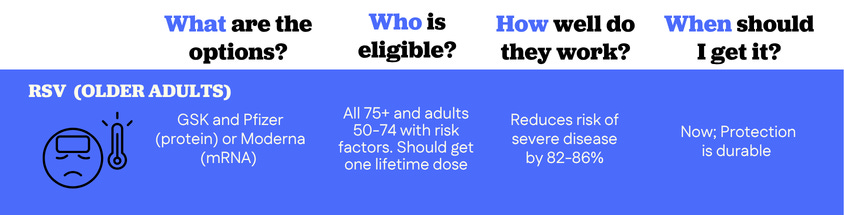
What: This season, there are three RSV vaccines: GSK, Pfizer, and Moderna. There are pros and cons to each:
GSK and Pfizer use traditional biotechnology (protein-based), which was available last year, so we have lots of “real world” data confirming safety and effectiveness. There is a small (but real) risk of Guillain-Barre syndrome—the risk is about the same as with flu vaccines.
Moderna’s is an mRNA vaccine. It did not have a Guillain-Barre syndrome safety signal, but protection wanes more quickly.
Who: This is not an annual vaccine—if you got one before, you do not need one this year. Studies have shown that getting a second dose doesn’t meaningfully enhance protection so far (although scientists are following this in real time and it may change in the future). People aged 50 and older with high-risk conditions and everyone over 75 years should get one dose.
When: Getting one now should protect you throughout the entire season (and then some).
RSV vaccine for pregnancy
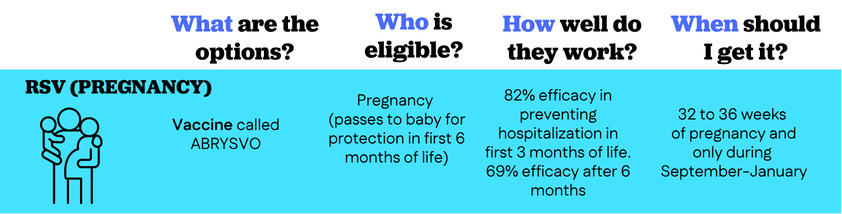
What: One vaccine is available: Pfizer’s ABRYSVO. Protection is passed from the mother to the baby, so the baby is protected in the first 6 months of life, which is the riskiest time for severe RSV. Thousands of pregnant women got it last year, confirming the safety and high effectiveness (75-89%).
Who: Pregnant women during weeks 32-36.
When: September to January. This vaccine can be given simultaneously with other routine vaccines for pregnancy (Tdap, Covid-19, and flu). Some data show that getting an RSV vaccine at the same time as Tdap may reduce the antibody response to pertussis. So it may be worth considering getting the Tdap vaccine a few weeks before, but there is no formal recommendation.
RSV monoclonal antibody for infants
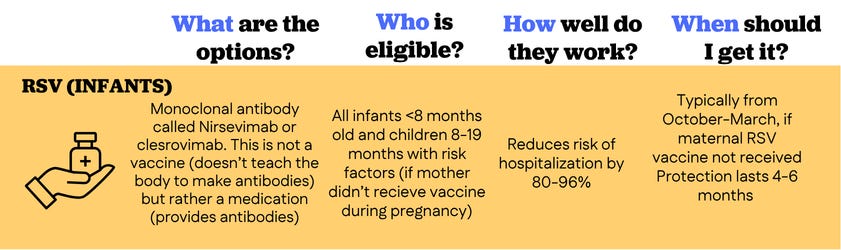
What: Monoclonal antibodies are not a vaccine (i.e., they don’t teach the body to make an immune response)—they are a preventive medication, providing antibodies directly and proactively. Real-world data continue to show that severe RSV in infants who received monoclonal antibodies was drastically reduced; one study achieved 90% effectiveness. This year, there are two options: nirsevimab or clesrovimab.
Who: All infants under 8 months should get it for their first RSV season, unless the mother received the RSV vaccine during pregnancy. High-risk children between 8 months and 19 months should also get it. If the mother got the RSV vaccine during pregnancy, getting a monoclonal antibody is not recommended unless the infant is at very high risk.
When: Generally as close to RSV season as possible, which is typically between October and March. Protection holds up for at least 5 months.
Covid-19 vaccine
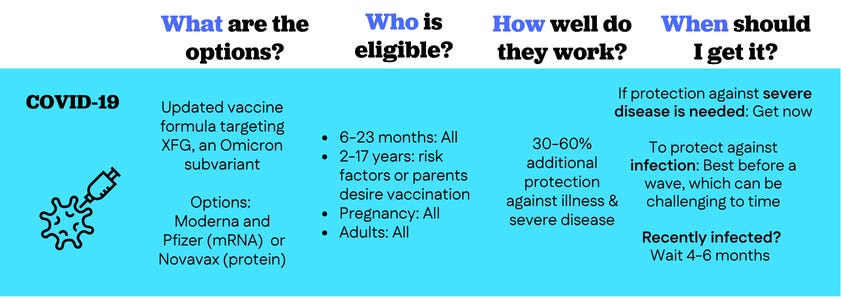
What: The fall Covid-19 vaccines have an updated formula targeting XFG, an Omicron subvariant. Updated vaccines have consistently provided people 30-60% additional protection against urgent care visits or hospitalization compared to people who didn’t get the vaccine.
Three vaccines are on the market:
Pfizer’s COMIRNATY Covid-19 vaccine for those 5 years and older
Moderna’s SPIKEVAX for those 6 months and older or mNEXSPIKE for those 12 years and older
Novavax’s NUVAXOVID for those 12 years and older
Who: Professional organizations recommended the following last year, and I would be surprised if it changed this year. (But we will get a formal update at the beginning of September. I will update you if it has changed.)
Kids: Last year, the American Academy of Pediatrics (AAP) recommended that all children under 2 years old get vaccinated, as well as high-risk children or those living with someone who is high-risk.
Pregnant women: The American College of Obstetricians and Gynecologists (ACOG) recommended that pregnant women receive the vaccine at any point during pregnancy, when planning to become pregnant, in the postpartum period, or while lactating.
Adults: The American College of Physicians (ACP) and the Infectious Diseases Society of America (IDSA) recommended the vaccine for adults and immunocompromised patients.
When: If you were recently infected, wait 4-6 months. It doesn’t hurt if you get it earlier, but some research shows that waiting allows our antibody factories to update more effectively. If you were not recently infected, the timing is a tough call. Either get it now—we are in the middle of a wave—or wait to increase protection against the winter wave (which may be closer to November).
FAQs
Can I get the vaccines at the same time? Yes, this is called co-administration, and it’s recommended for convenience (you don’t have to visit the pharmacy or doctor twice). Studies have been conducted on the safety and effectiveness of co-administration. In one database, about 454,000 people got the flu and Covid-19 vaccines. Both worked great. The rate of side effects was the same or a little higher among those who co-administered; however, no specific safety concerns were identified. It’s unclear if there’s data for co-administration of two mRNA vaccines.
Will vaccines be free for patients? Yes. Historically, insurance companies rely on ACIP—an external committee to CDC that determines vaccine policy in the U.S.—but there won’t be an ACIP for fall due to a legal battle between AAP and RFK Jr. Regardless, private insurance companies said these vaccines will be covered without cost sharing. Medicare shouldn’t differ either; neither should the Vaccines for Children federal program.
Will all vaccines be available in all states? Yes. In some states, it may be harder to get a Covid-19 vaccine at a pharmacy due to linkage to ACIP for pharmacists’ scope of practice, but a lot of pharmacies and states are working hard so this doesn’t happen. Be patient.
Will Covid-19 vaccines be available to children? Yes, and parents should continue to request them from their child’s pediatrician. We are hearing that fewer pediatric offices are ordering these vaccines in bulk because of decreased demand.
Who will release guidance on fall vaccines? This is typically the federal government’s job, but the Vaccine Integrity Project, in collaboration with professional organizations, will review the evidence instead. This should be out in early September (but I don’t expect any big changes from last year).
Does the new executive order impact access to these vaccines? No—the EO was specifically about childhood vaccinations. Regardless, at this time, there are no changes yet to which vaccines are covered or available. Families can still access all vaccines, pediatricians should continue offering vaccines, and these vaccines remain covered without cost sharing under current law.
Bottom line
Getting vaccines is one of the best things you can do this fall and winter to stay healthy and minimize disruption to school, work, and travel. As always, for specific questions or guidance, be sure to talk with your healthcare provider.
Love, YLE
Your Local Epidemiologist (YLE) comprises a team of experts, ranging from physicians to immunologists to epidemiologists to nutritionists, working together with one goal: to “translate” ever-evolving public health science so that people are well-equipped to make evidence-based decisions. The YLE suite of newsletters reaches over 475,000 people across more than 132 countries. This newsletter is free to everyone, thanks to the generous support of fellow YLE community members.


.jpg)
No comments:
Post a Comment