-----------------------------------
The Dose (August 25)
School is coming into session, and with it come the cute photos (my youngest is now a kindergartener!) and the transformation into walking petri dishes. We are already seeing the common cold start to increase. Meanwhile, the Covid-19 wave and the season of foodborne illnesses continue to march on. Are we having an unusual year for foodborne outbreaks? I dig into the data.
Also, there may soon be an incredibly cool mRNA treatment for skin cancer, and other good news.
Here’s what’s going on in the world of health and, most importantly, what it means for you.
Disease weather report
Common colds are increasing again
This past week, we saw a large increase in the number of people testing positive for the common cold. This is typical for this time of year as school ramps up. Runny noses should peak by mid-September, then decline, allowing other viruses, like the flu and RSV, to take over.
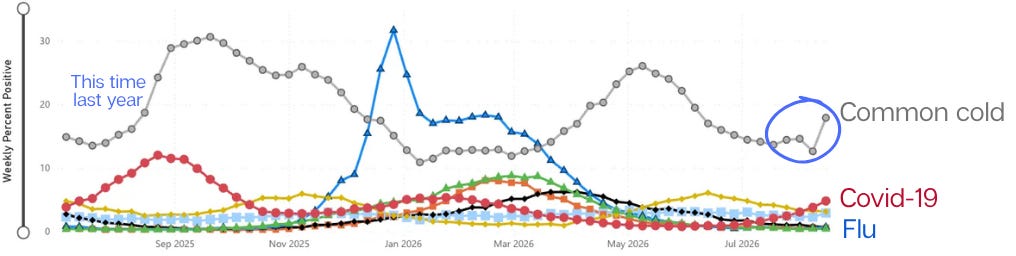
What this means for you: If you’re sick, it’s most likely the common cold. Rest and fluids really do help boost your immune system.
Covid-19 summer wave continues to grow
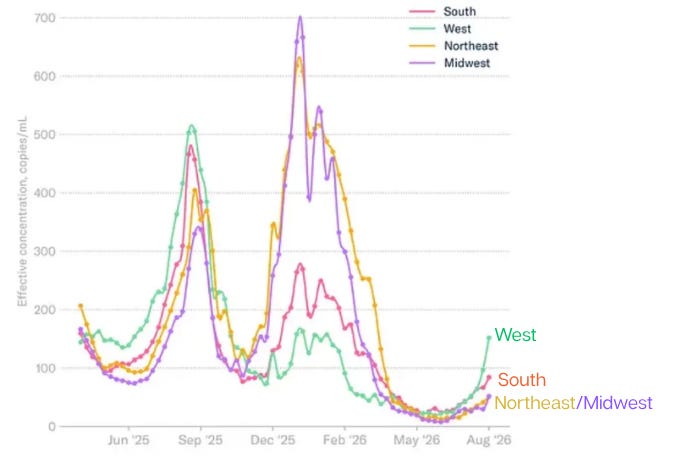
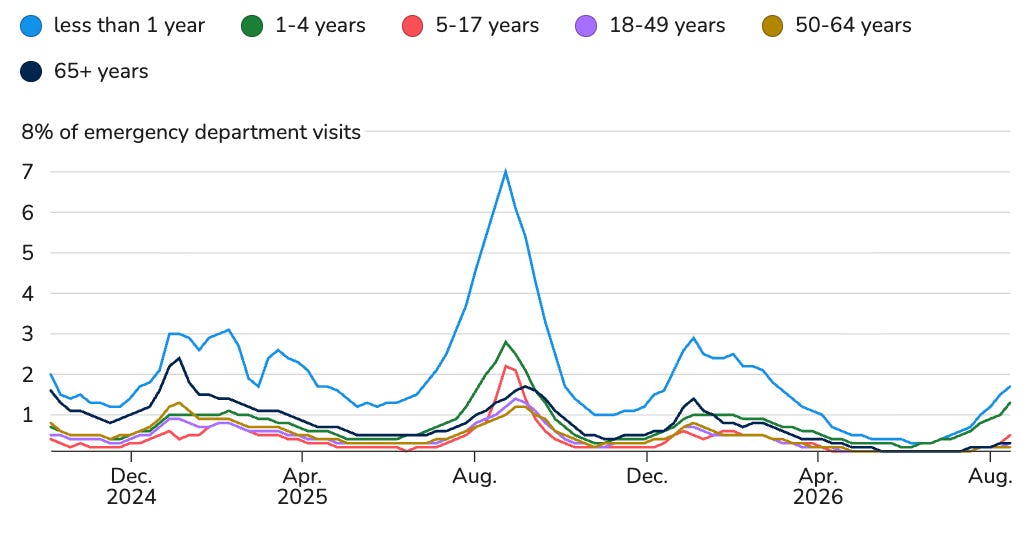
Covid-19 in wastewater—one measure of community transmission—is low nationally but sharply increasing in the West and South. Other metrics, such as emergency department visits, show the same trend, with numbers increasing across all states. There’s no doubt we are in a summer wave.
The group most impacted in the emergency department is kiddos under 5 years old. However, those don’t necessarily result in hospitalizations—the group with the highest Covid-19 hospitalization rate remains those over 65 years old.
What this means for you: If you’re high risk, it’s worth seeing if you can get a Covid-19 vaccine. Unfortunately, I’m hearing from many of you that availability is limited, as pharmacies and clinical offices are waiting for the updated fall vaccine formula. This should be available in September. (Our systems not matching up with the optimal protection window seems like a big policy failure.)
Wearing a mask in crowded indoor areas can help prevent illness.
Food recalls list
A new food recall seems to be coming every week, which is overwhelming to keep track of. So, I tried to summarize the recalls below, organizing them by risk to bring you some clarity on what to pay attention to and what not to.
Red = check your fridge; yellow = check, but less risky because there are no illnesses yet; footnote = FYI: recalls, because they are one-offs.
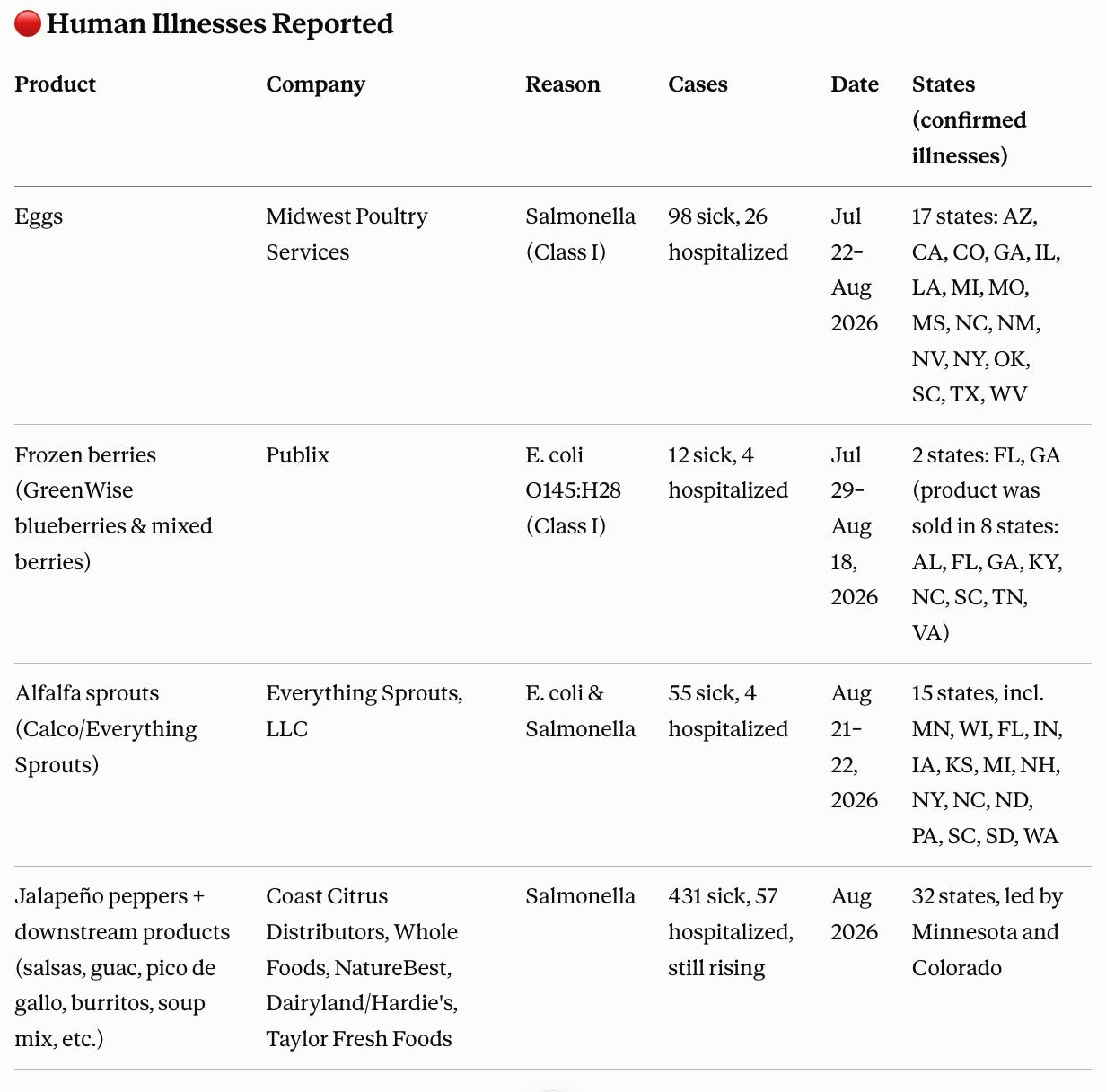
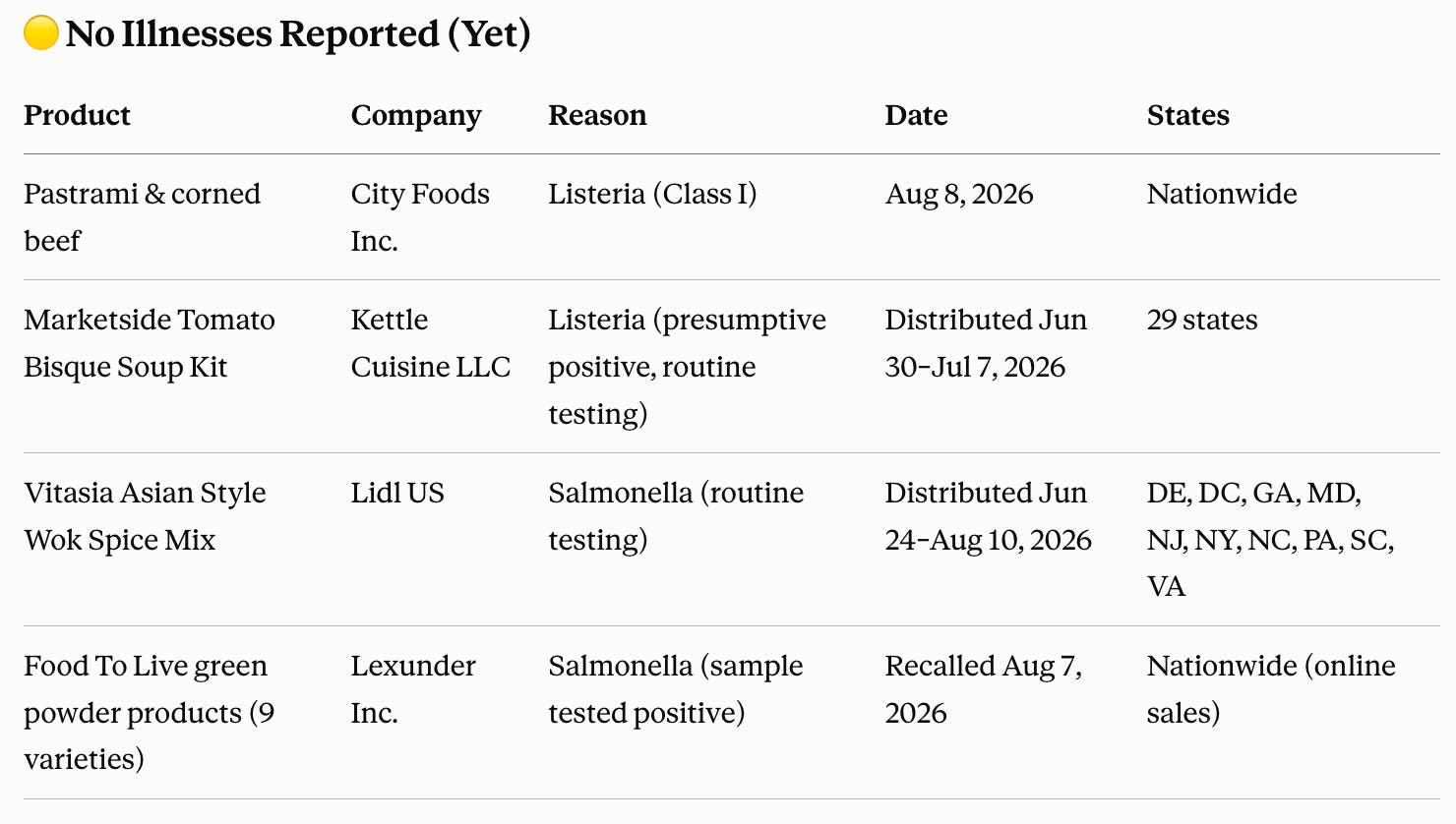
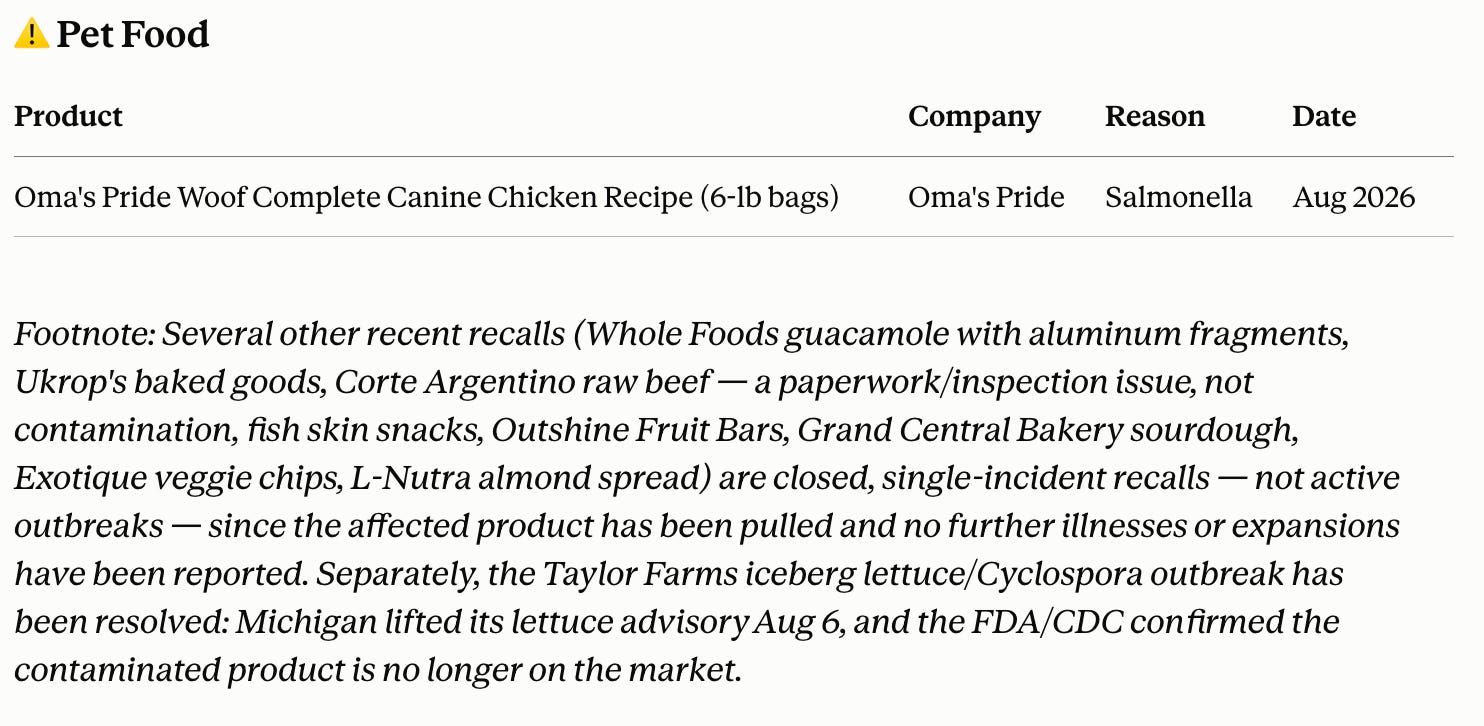
What this means for you: When you see news of another food recall, keep in mind that they can vary substantially:
Severity. Some recalls are based on sick people; others are just routine testing catching contamination.
Scope. One state vs. nationwide. The scariest-sounding details (like glass in a fruit bar) are usually isolated, one-time incidents.
This means how much you should worry and specifically what you should do varies, too.
Spotlight: Are we having a higher rate of foodborne outbreaks?
It sure feels like it. Everywhere you look, there is a viral social media post or a news headline about another contaminated food.
An increased rate of foodborne outbreaks is certainly not out of the realm of possibilities. When the public health systems meant to catch and stop this stuff are cut (less funding, less staff, less historical knowledge, and less leadership), outbreaks can, and will, emerge between the cracks. And people need to know if those cracks are making them less healthy and safe.
So, I turned to the data. This is the data story that I’m seeing:
We have a lot of foodborne illnesses each year.
This is a constant, background feature of our food systems. CDC estimates that 1 in 6 people get sick each year. Many people wait it out at home, thinking it’s a stomach bug, and are fine a few days later, but this does result in over 130,000 hospitalizations a year.
Recall counts are average this year, but that’s ambiguous.
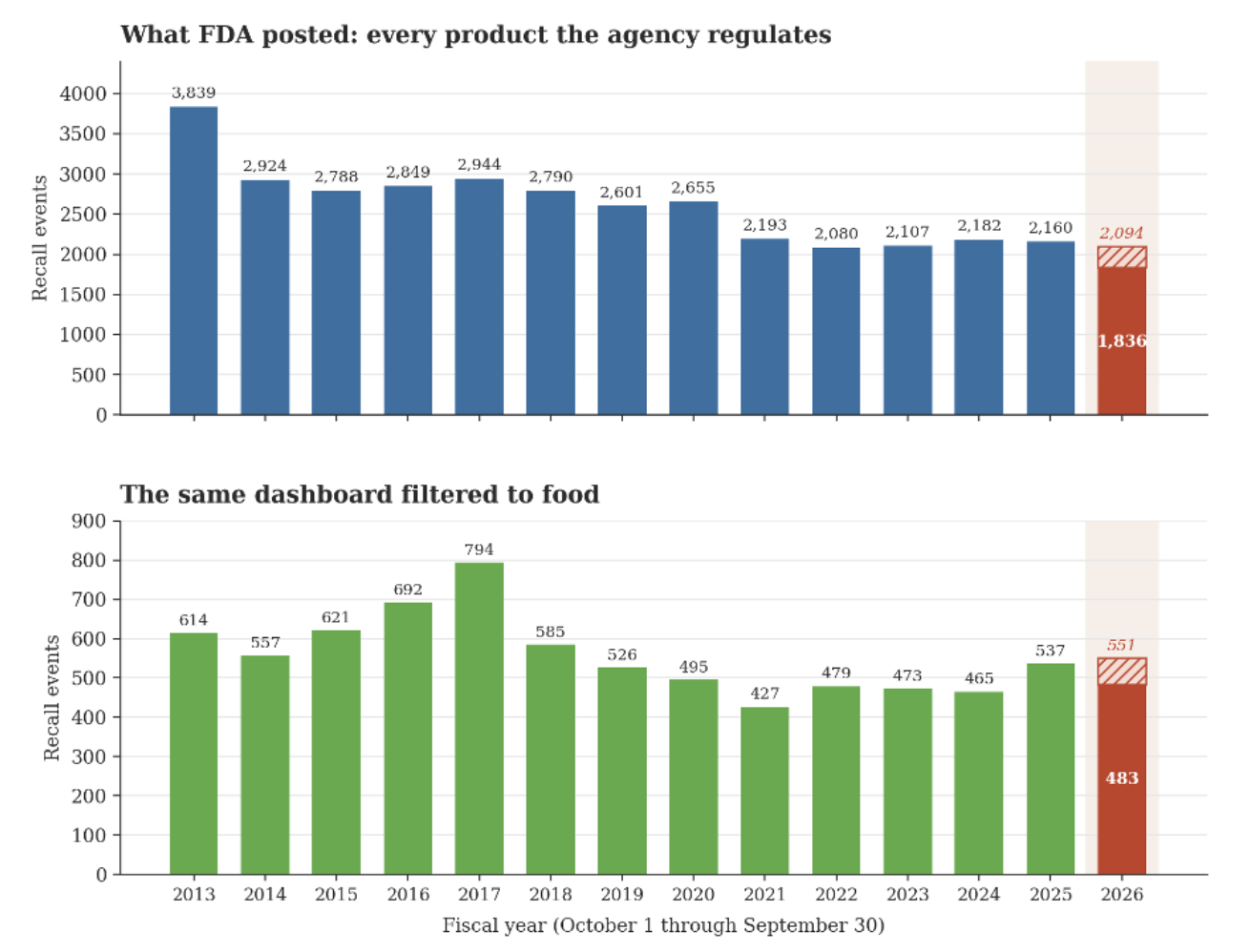
The number of food recalls this year is, surprisingly, average. In the past 10 years, we have 400-800 annual recalls. This year we have had 483. This is not the lowest year, as the FDA touted. (They counted drugs, devices, and food recalls, not just food.)
The problem is that “number of recalls” is a terrible metric because we don’t know what we don’t know. We could truly be having more foodborne illnesses, but just not catching them (and thus not recalling them).
Severity classification is too early to tell.
Recalls are categorized on a scale from Class I (very severe) to Class III (less severe). So if this is a bad year, we would have more severe classifications. But classifications are delayed, and so this data is incomplete. So far, the classification rates are no more severe than in previous years.
Size of recalls are very hard to ignore.
Cyclospora was likely the largest foodborne outbreak in history, after accounting for undercounting. In the first half of this year, 37.18 million lbs of food were recalled, the highest in the past 10 years (a 2,432% increase over the previous year).
This is not normal.
The environment is loud and complex.
Low trust in government, viral algorithms, an increasingly political and polarized world, and mass media barely surviving off of clicks. All of this increases anxiety, frustration, questions, and confusion, all at once. This could certainly be contributing to the feeling that there are more outbreaks than normal.
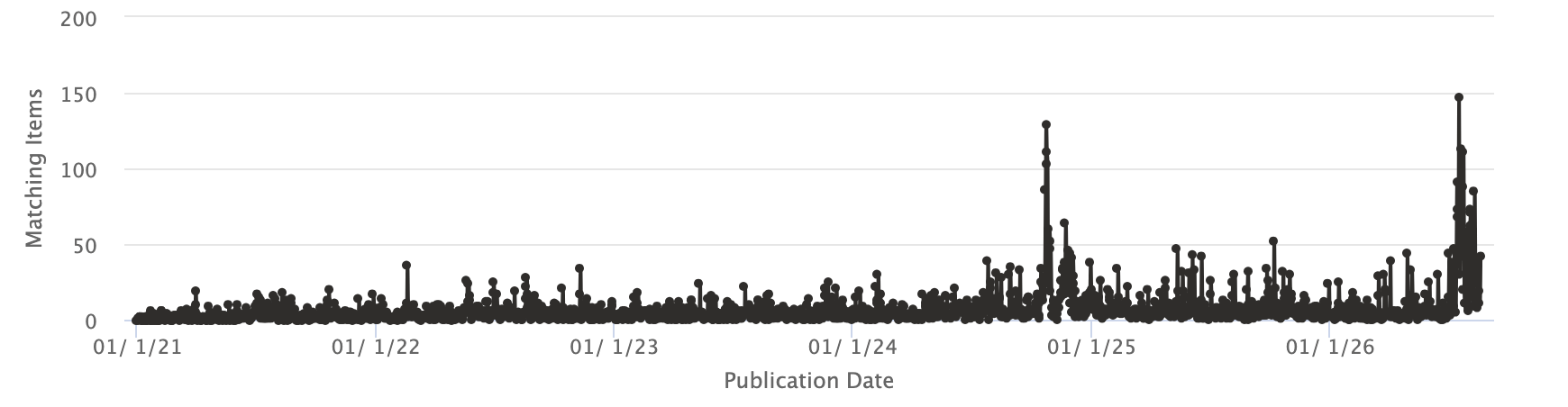
So are we seeing more foodborne outbreaks right now? The answer is complicated and hard to pin down, but recent data doesn’t look great.
I’m most concerned about how the whole picture is affecting healthy eating behavior. People are eating less produce, which is also a massive public health problem.
What this means for you: Keep buying produce, but make sure you continue to wash it (and scrub it if it has rivets). Watch for symptoms and, if you’re high risk (pregnant, older, immunocompromised), be sure not to tough it out at home if symptoms develop; call your clinical care team, as there may be a treatment available.
Good news
mRNA biotechnology for melanoma cancer. This treatment (not a preventive vaccine) is insanely cool. It’s customized for every patient. Scientists take a sample of the tumor, sequence its DNA by reading its exact mutation fingerprint, and then create an mRNA vaccine that teaches the immune system to attack up to 34 targets on that tumor. It was also combined with another drug that helps stop cancer from hiding in the immune system. In the clinical trial, patients who got the new treatment had markedly lower risk of recurrence, metastasis, or death. This is just the topline data, and full results will come soon.
Extra good news: The treatment is also in nine clinical trials for lung, bladder, pancreatic, and kidney cancers.
U.S. death rate fell. According to new and very preliminary data from CDC, the age-adjusted death rate fell by 4.6% in 2025 compared to 2024. It decreased across almost all sociodemographic groups, except among American Indians and Alaska Natives. There is still a lot of work to do.
Bottom line
School is in session, and the bugs will be too. In the meantime, stay on top of recalls and vaccines while we all navigate this really confusing time in our country.
Love, YLE
Your Local Epidemiologist (YLE) comprises a team of experts, ranging from physicians to immunologists to epidemiologists to nutritionists, working together with one goal: to “translate” ever-evolving public health science so that people are well-equipped to make evidence-based decisions. The YLE suite of newsletters reaches over 475,000 people across more than 132 countries. This newsletter is free to everyone, thanks to the generous support of fellow YLE community members.


.jpg)
No comments:
Post a Comment