========================
Viral proteins and vascular inflammation, Stanford ME/CFS symposium, preventing dysautonomia after COVID, Long COVID claims show 2 to 3 weeks after ER surges, and more.
As we head into fall, the COVID wave may have peaked, but levels remain very high in parts of the US, especially the West and the Gulf states. According to Mike Hoerger, about 1 in 91 Americans had COVID nationally on 9/21/26. In the burgundy counties on the map below, more than 1 in 30 people are infected.
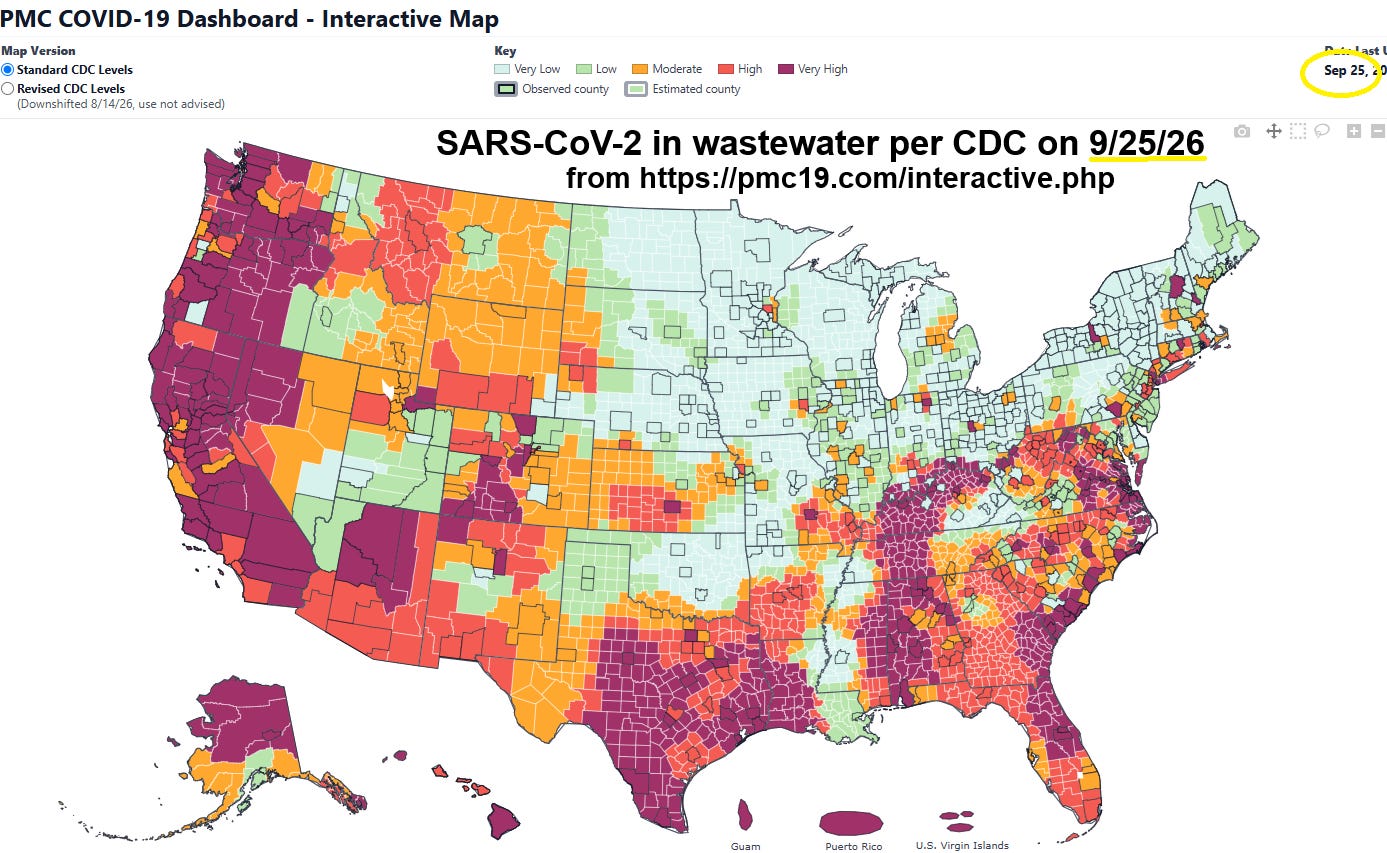
NBC news reported this week about what Mike Hoerger had been saying about changes in CDC reporting. The CDC quietly raised its benchmark for wastewater COVID levels last month, so a reading that once counted as high transmission may now register as moderate instead. COVID infections are still rising in more than half of US states, even though the recalibrated metric makes the picture look milder. Hoerger shows the difference in this tweet and notes that “This really makes a difference for early warning in the middle categories.”
The new COVID vaccines are available and many people qualify, including those who are physically inactive or who have asthma. Fortunately, the federal Vaccines for Children program, which covers more than half of American children, has finally allowed states to order updated COVID vaccines for kids. The FDA approved these shots on August 27th.
This week has a lot of non-COVID news, so I’ll be sending it as a separate email to keep things easy to read. That separate post covers multiple sclerosis, the gut microbiome, heart failure, early cancer detection tests, menopause, SIDS, “pink slime”, and much more.
COVID Variants
According to WastewaterSCAN on 9/24/26, the XFG variant represents 53.4% of variants, followed by LF.7 (21.7%) and BA.3.2 (8.6%).
Olfactory dysfunction after COVID
Localized SARS-CoV-2 Infection Triggers a Tissue-Wide Antiviral Response and Functional Impairment of Olfactory Sensory Neurons | BioRxiV 9/21/26
In a small UC Davis study of mice, a localized SARS-CoV-2 infection in olfactory tissue triggered tissue-wide interferon signaling and dampened the metabolism of smell neurons. Even uninfected neurons responded poorly to odors, suggesting that the immune response, not viral damage, drives smell loss.
Vaccines
CDC Greenlights COVID Vaccines for Vulnerable Children After Nearly 1 Month Delay | CIDRAP 9/24/26
The CDC has finally let states order updated COVID shots through the Vaccines for Children program, which covers more than half of US kids including those on Medicaid. Privately insured children had weeks of access before low income and uninsured kids could get them.
Booster dose of COVID-19 vaccine and its effectiveness against post COVID-19 condition in individuals with pre-existing immunity: a sequential propensity score-matched cohort study | eClinicalMedicine 9/25/26
Researchers at the University of Gothenburg studied 1.39 million adults and found that receiving a fourth COVID vaccine dose was associated with a 31% lower risk of a Long COVID diagnosis over six months compared to three doses. Among high risk individuals the protective association was even stronger, reaching 38%, though the absolute risk reduction was small. Preventing COVID infections prevents Long COVID too.
Jeff Gilchrist and Paul Seaman made this Google doc about the Novavax COVID vaccine.
Long COVID
Remnant virus proteins sustain vascular inflammation post coronavirus infection in mice and humans | Clinical Science 9/26/26
Medical University of Vienna researchers found that SARS-CoV-2 spike (S) and nucleocapsid (N) proteins persist in the circulation and in organs for months after infection, even when specific antibodies were present. These viral fragment proteins directly trigger endothelial inflammation through TLR4 signaling. A high-N-protein patient subgroup (28 of 95 patients) showed elevated markers of endothelial activation and vascular inflammation. Prednisolone reduced this effect in mice.
The gut-lung axis in respiratory diseases: Mechanisms, microbiome dysbiosis, and therapeutic implications. A comprehensive review | Respiratory Medicine 9/25/26 (November 2026 issue)
Researchers from Malaysia reviewed 146 studies on the gut-lung axis and how intestinal microbiota and metabolites regulate pulmonary immunity across asthma, COPD, pulmonary fibrosis, respiratory infections, COVID, sleep apnea, and lung cancer. “SARS-CoV-2 infection is associated with profound gut microbiome disruption, which can last for at least six months, with ongoing depletion of beneficial bacteria like B. pseudocatenulatum and F. prausnitzii linked to persistent respiratory symptoms.”
The 10th Annual Stanford Community Symposium on the Molecular Basis of ME/CFS presentations are available now online. So far, I have really enjoyed listening to talks from Bill Robinson and David Kaufman, but I look forward to catching up on the other presentations soon. Other speakers include Ron Davis, Rob Phair, Brayden Yellman, Rob Wurst, Nancy Klimas and others.
RECOVER-TLC Biomarker Studies | FNIH RECOVER-TLC 9/25/26
Foundation for the National Institutes of Health (FNIH) RECOVER-TLC scientists selected 82 blood based biomarkers spanning immune, vascular, inflammatory, metabolic, and neurological systems for inclusion in upcoming clinical trials. Hannah Davis commented on Twitter about the suggested Long COVID biomarker list saying that she was “happy to see: ptau-181, ET-1, NF-kB, OSM, DPP-4, S100B.” However, she has concerns that a 3-month symptom-duration threshold may be too short, that the list includes several biomarkers (D-dimer, P-selectin, CD14, CXCL10, CRP) known to normalize by 6-12 months, and that the proposed list includes 7 tests that RECOVER has tested already and found no difference. She also states, “Most importantly, so many known areas of study are missing: gut/gut integrity, coagulation/endothelial damage, complement, herpesvirus panels, persistent antigen, IFN-β, cortisol & testosterone, kynurenine/tryptophan, T cell exhaustion.”
An Open-Label Feasibility Study of Remdesivir in Long COVID: Results from the ERASE LC Trial | Oxford Open Immunology 9/16/26
A group in the UK gave 73 people with Long COVID five days of IV remdesivir in a safety and feasibility study. The treatment was safe and almost all participants completed the treatment. Although the study was not designed to prove efficacy, there was improvement in patient reported outcomes and for physical tests like the 6 minute walk test.
Long COVID: The Problem Society Wants to Forget | JAMA 9/24/26
In a podcast, JAMA Senior Editor Derek Angus spoke with Dr. Wes Ely on how millions of people continue to live with Long COVID even as public attention has largely shifted away from the condition. They examine the persistent challenges in defining the illness and delivering effective care, as well as emerging Long COVID research.
Dynamic changes in cardiac autonomic function persist in the postacute phase after SARS-CoV-2 infection in a hamster model of COVID-19 | Heart Rhythm Open 9/24/26
Johns Hopkins University scientists found that “cardiac dysautonomia after SARS-CoV-2 infection is phase dependent” in hamsters. Early intervention during acute infection either by blocking innate immune signaling with the JAK/STAT inhibitor Ruxolitinib, or by blocking mitochondrial oxidative stress with 2,2,6,6-tetramethylpiperidine-1-oxyl was sufficient to prevent postacute autonomic dysfunction and ANS remodeling.
Post-infection increases in Cardiometabolic Disease Staging (CMDS) scores are associated with increased odds of long COVID in a longitudinal retrospective cohort | Diabetes Research and Clinical Practice 9/22/26
Researchers at the University of Alabama at Birmingham studied 6,364 patients and found that worse cardiometabolic health following COVID infection was associated with 36% greater odds of developing Long COVID. Increases in BMI, blood glucose, and triglyceride levels each contributed independently to this risk.
Temporal, demographic, and geographic patterns of long COVID incidence in relation to SARS-CoV-2 variant emergence: Insights from the Texas all-payer claims database (TX-APCD) | International Journal of Infectious Diseases 9/24/26
UTHealth Houston researchers analyzed data from 15.3 million insured Texans and found that Long COVID claims consistently emerged 2 to 3 weeks after surges in COVID related emergency department visits, with adults over 70, Medicare enrollees, and rural Texans bearing disproportionately higher documented rates. Long COVID affects 10 to 30% of people infected with COVID, representing approximately 400 million people worldwide.
Sex-specific patterns of symptom burden, psychological distress, and work productivity impairment in post-acute sequelae of COVID-19: a 10-month dynamic cohort study | BMC Pulmonary Medicine 9/21/26
Hannover Medical School in Germany tracked 433 Long COVID patients over 10 months and found that women reported greater fatigue, anxiety, and workplace impairment and a lower quality of life than men even after statistical adjustment for other factors. “Females also had higher percent-predicted (pp) total lung capacity (p < 0.0001) and lower pCO2 (p < 0.0001), whereas males had higher pp diffusion capacity (p = 0.001). Headache (p < 0.001) and chest tightness (p = 0.011) were reported more frequently by females.”
Single-cell multi-omics show disruption of blood and airway T-cells in pulmonary long COVID | European Respiratory Journal 8/27/26
Pulmonary Long COVID (PLC) refers to residual respiratory symptoms after COVID infection. University of British Columbia researchers found elevated CD4+ T-cells in the lungs and blood of PLC patients. “In PBMCs, T cells expressing both CD4 and CD8 were elevated in PLC participants.” Upregulated antiviral and interferon signaling and increased autoantibodies to DNA, collagen II, and TIF1-gamma, point to T-cell driven autoimmunity.
Measles
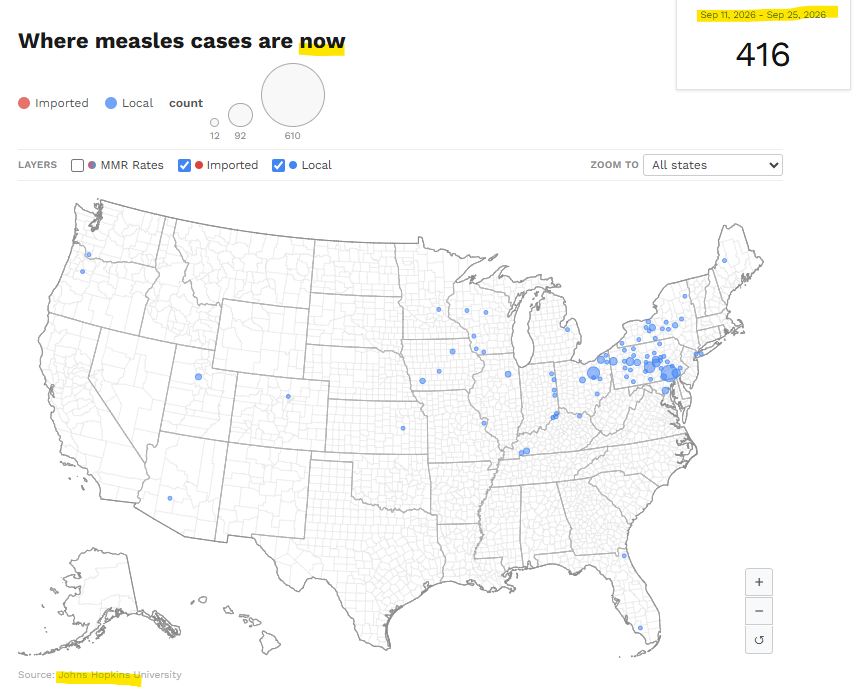
As of September 24, 2026, 3,659 confirmed measles cases were reported in the United States in 2026.
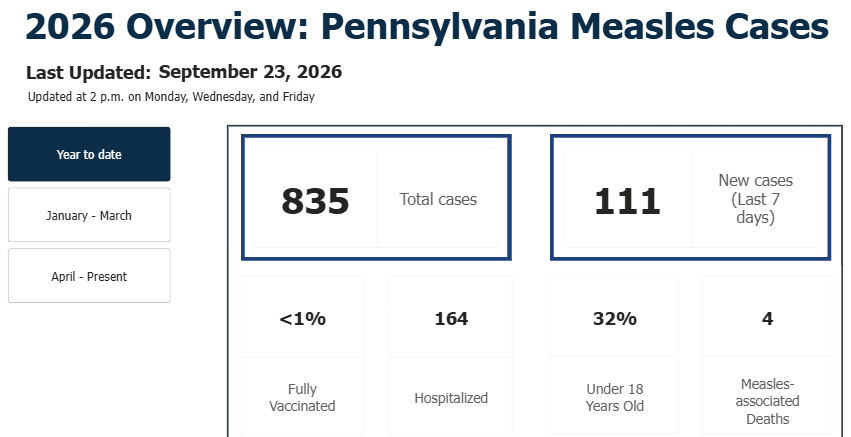
The CDC now reports only 1 measles death in 2026 on their website although in reality, there have been 4 measles deaths in the last 2 months reported by Pennsylvania.
Pennsylvania Department of Health Measles Dashboard:
Johns Hopkins US Measles Tracker for the last 2 weeks (9/11/26 to 9/25/26):
Ebola in Democratic Republic of Congo (DRC)
WHO: As of 9/23/26, there have been 7,890 Ebola cases in the DRC, with 3,799 deaths, and case fatality rate of 48%.
Other news
Because there are so many interesting other medical articles this week, I’ve put them into a separate email so that it is easier to read. Please look for Part II of this newsletter.
Have a great week,
Ruth Ann Crystal MD


.jpg)
No comments:
Post a Comment