Flu is here early. Plus Covid, mosquitoes, and more.
The Dose (Sept 29)
Katelyn Jetelina, 8 hours ago
Happy fall, y’all!
Here come the pathogens: flu is coming in hot and early, Covid-19 is peaking, and mosquito-borne diseases are having a bad year in the Southwest. And with the wave of diseases, come more falsehoods and rumors. I answer a reader question: Do the benefits still outweigh the risks of the Covid-19 vaccine?
Here’s what’s going on in the world of health and, most importantly, what it means for you.
Disease “weather” report
Flu is here unusually early
While levels are still low nationally, flu metrics are ticking up, including emergency department visits. This is especially true in the West.
Two things are unusual about this:
It is early (see graph below). Typically, we see metrics start to increase in October or November.
Flu activity usually starts in the Southeast (Florida and Texas) and then slowly spreads across the country. It doesn’t usually start in the West.
But flu is doing what it does best: being unpredictable.
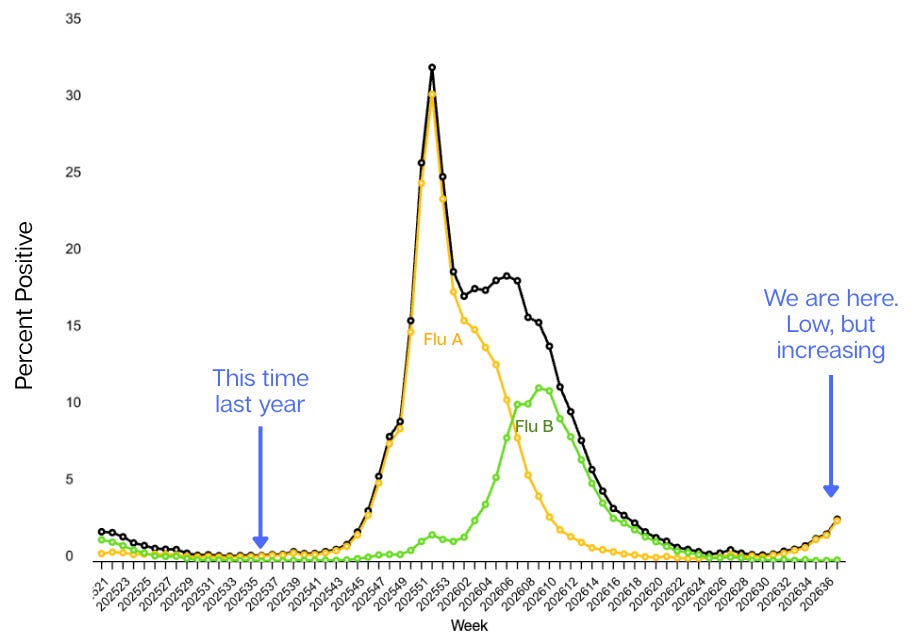
Number of tests that are coming back positive for flu. Source: CDC; Annotated by Your Local Epidemiologist
The U.S. doesn’t seem to be alone. Flu is also increasing early in the U.K., Japan, and other Northern Hemisphere countries. We don’t know why it’s coming early.
The Southern Hemisphere’s viral season occurs a few months before the Northern Hemisphere’s, since their winter is our summer, and vice versa. This flips the weather and how and when viruses thrive, allowing epidemiologists to look south for clues about what to expect for flu in the north.
What happened in the Southern Hemisphere this summer?
The flu starting line was a mixed bag. Argentina’s season started about three weeks early. Chile and South Africa were on schedule, while Australia, New Zealand, and Fiji were unusually quiet through their usual window, then surged unexpectedly in August through September.
The flu’s later arrival to the Pacific region may be related to the new strain (subclade K) that circulated last year, which really skewed some patterns. In Australia, for example, 2025 was their worst flu season on record, and it ended late, peaking just before Christmas. So flu immunity waned late, causing a later season this year.
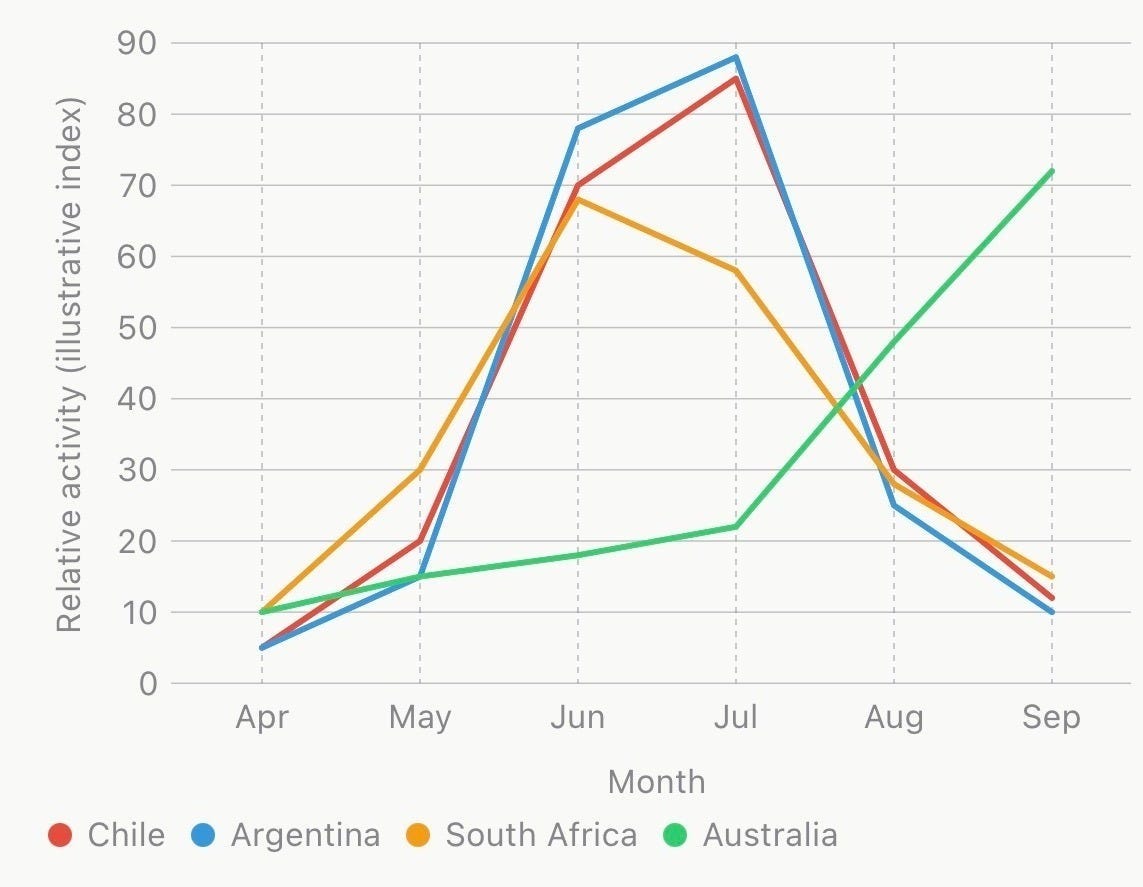
2026 flu activity across countries. Source: PAHO. Figure created by Your Local Epidemiologist using Claude.
Flu season was severe in many places this summer. In parts of South America, the flu hit hard. Argentina recorded its highest number of flu-like illness cases in a decade, partly due to its early start, with flu test positivity among outpatients peaking above 45% in late May.
So, the flu is having a weird year across much of the globe. Will it mean that we will have a bad season? Not necessarily. But epidemiologists will be keeping a close eye on it.
What this means for you: Now is the time to get your flu vaccine. Usually, advice is in October (the common saying is “flu before boo”), but for maximum protection, I think that advice will be late this year. Schedule your flu vaccine appointment this week. I am.
Covid-19 is peaking nationally
Wastewater—a strong indicator of how many people are spreading Covid-19—has clearly peaked at the national level. A few states in the Midwest are still increasing, but they will soon begin to decrease as well.
If this pattern continues, this summer’s peak will be as high as winter’s, but not as high as last summer’s.
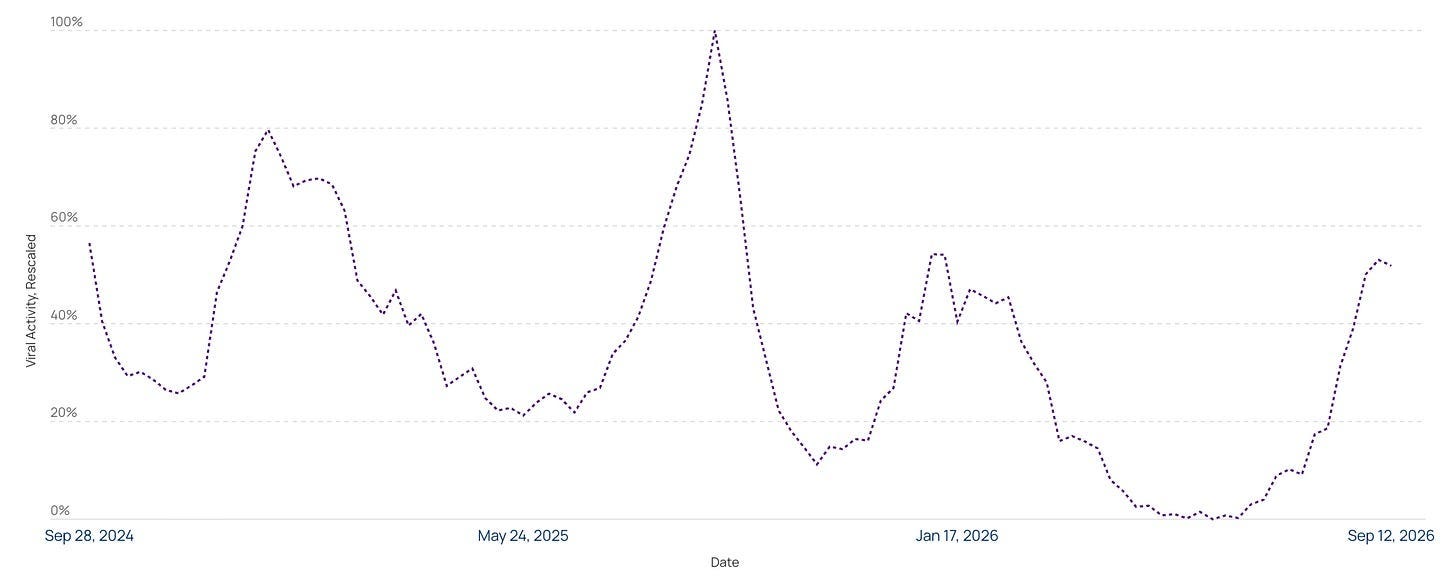
Wastewater levels for Covid-19. Source: CDC via PopHIVE.
With reduced spread and increased immunity, we continue to see deaths plummet, falling about 54% each year. (See figure below.) This year, if the trend continues, Covid-19 will have contributed to ~9,100 deaths, which is less than half of the deaths caused by the flu each year.
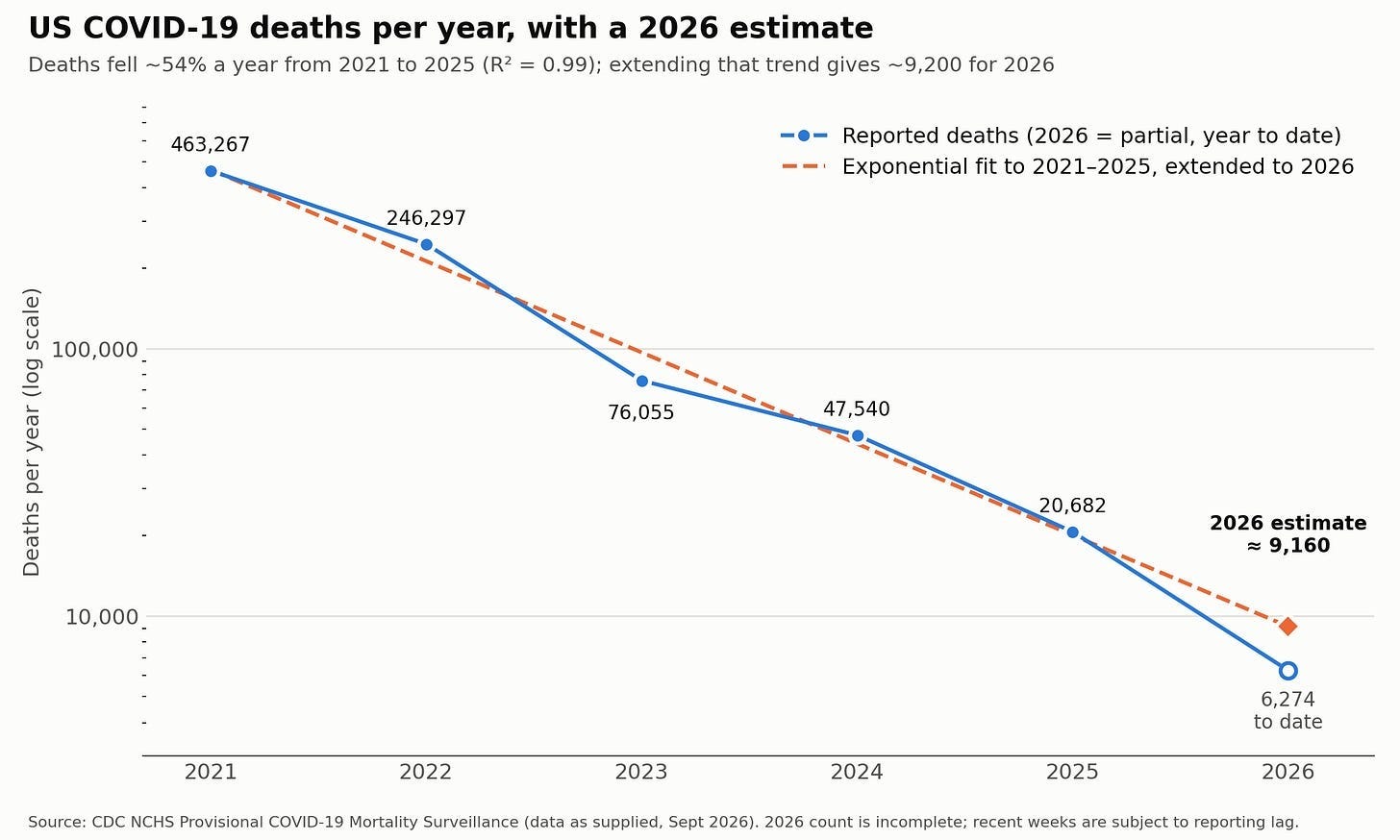
Figure source: Gideon M-K: Health Nerd.
What this means for you: The population-level impact of Covid-19 continues to decline this season and overall, which is fantastic news. However, the vaccine is still important, especially for high-risk folks. After some bumps in the road (covered in YLE last week), the vaccine should now be widely available.
Mosquito season isn’t done yet
Nationally, this year has been quieter than last year for mosquito-borne diseases, even though the West Nile season started earlier than any year since 2004. The one exception is for those of us in the Southwest: Phoenix and California are well above last year. (Matt over at YLE California has been keeping close tabs on this.)
Thankfully, mosquito activity peaks in August, so it’s now trending downward. But those boogers are definitely still out there until they go dormant or die off because of weather changes.
Human West Nile cases in California. Source: CDPH.
West Nile disease is local by nature: heat, standing water, and how many animals (i.e., hosts) are already immune determine where it flares up. (Hotspots were in Colorado and Illinois last year.)
What this means for you: The end of the mosquito season isn’t here yet, but it’s close. Expect activity until the first sustained cold snap. Until then, use repellent at dusk and dump standing water weekly.
Flu vaccine spotlight: Common falsehoods
With the flu season comes an increase in falsehoods and rumors on social media, and in our daily conversations with family and friends. Here are some of the top ones in case you find yourself in a conversation with someone in line at the grocery store (like I did just recently):
“The flu shot can give me the flu.”
A lot of people believe this from personal experience, but it’s biologically impossible: the shot doesn’t contain live virus. (The nasal spray uses a weakened live virus that can't cause flu illness, though it may cause a mild runny nose.)
Side effects aren’t the explanation either. In randomized controlled studies, the only differences between people who received the flu shot and those who received a placebo were increased arm soreness and redness at the injection site.
The more likely reason is bad luck: getting exposed to the flu after vaccination but before the shot kicks in, which takes about two weeks.
“I do not need the vaccination.”
Humans have certainly normalized the flu, but it’s a big deal. About 8% of the U.S. population (anywhere from 3% to 11%, depending on the season) can expect to get the flu each year. Since 2010, that has meant between 120,000 and 710,000 hospitalizations and 6,300 to 52,000 deaths every year.
“I don’t think the flu vaccine works.”
They aren’t perfect, but they do help. They don’t always prevent infection, but they are especially good at preventing severe illness and hospitalization. The effectiveness is generally around 40 to 60% when the vaccine is well matched. In the 2019–2020 season, for example, flu vaccines prevented an estimated 7.5 million illnesses, 3.7 million medical visits, 105,000 hospitalizations, and 6,300 deaths.
Among children, a 2017 study found that flu vaccination halved a child’s risk of death.
“I got the flu shot last year, so I am protected.”
Unfortunately, you should get a flu vaccine every year. Because flu viruses change fast, the flu vaccine is updated annually to target the strains research predicts will be most common this season. Vaccine and/or natural immunity also wanes over time, so you need to get a vaccine annually for optimal protection.
Question grab bag
“I recently sat in on a doctor visit with a friend who is being treated for cancer. When the subject of vaccines came up, her cancer doctor told her to get her flu shot in October and said that he didn’t recommend the Covid-19 vaccine. I was surprised to hear that. Are blood clots, heart inflammation, long Covid, and other complications still an issue?”
Obviously, I am not part of her clinical care team, and many factors could influence this decision. But, broadly speaking, this is how I would think about it:
If she received a stem cell transplant or CAR T-cell therapy, this is the right call. It is advised to delay vaccination for at least 3 months. During that time, her immune system is heavily suppressed, so the vaccine is less likely to work well.
If she wasn’t getting this treatment, I am disappointed that he didn’t recommend the Covid-19 vaccine for her. People receiving cancer treatments that weaken the immune system have a high risk of severe disease from Covid-19.
This comes down to a very simple question: do the benefits outweigh the risks? I went searching for numbers, given that we haven’t had a CDC ACIP meeting in a long time. These are estimates, but they still make clear that the benefits continue to outweigh the risks, especially for those over 65 years old.
Benefits: The number of hospitalizations prevented among those over 65 years old is about 1,200 per 1 million doses. For people 65 and older, the updated vaccine also lowers the risk of Covid-related blood clots, including strokes, heart attacks, and blood clots in the legs or lungs.
Risks: A myocarditis complication isn’t a thing anymore with the Covid-19 vaccine. This is due to increased immunity (from infections and spaced-out vaccines). Allergic reactions and Guillain-Barré (maybe) are really the only vaccine-related risks in the data, and they are very, very small. There is no risk of blood clots from the vaccine. (This was associated with the J&J vaccine early in the pandemic, which is no longer available.)
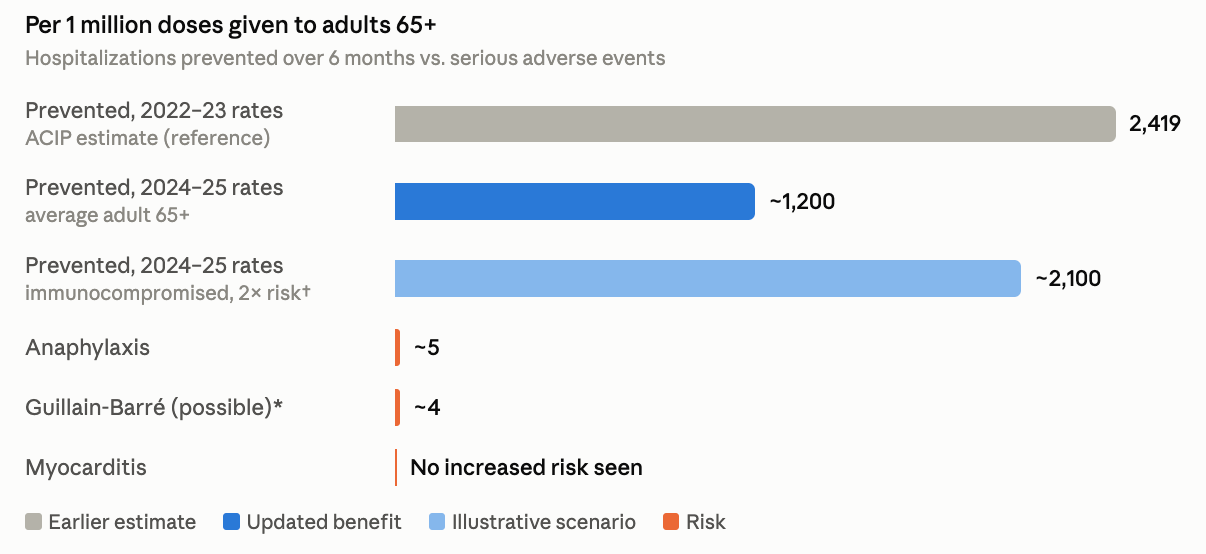
Figure created by Your Local Epidemiologist using CDC data and Claude, which happens to be much faster than Excel these days!
Bottom line
Flu is here, while Covid-19 and mosquito-borne diseases are decreasing. Thankfully, we do have vaccines that are, yes, beneficial; the benefits still greatly outweigh the risks. Stay healthy out there!
Love, YLE
Your Local Epidemiologist (YLE) comprises a team of experts, ranging from physicians to immunologists to epidemiologists to nutritionists, working together with one goal: to “translate” ever-evolving public health science so that people are well-equipped to make evidence-based decisions. The YLE suite of newsletters reaches over 475,000 people across more than 132 countries. This newsletter is free to everyone, thanks to the generous support of fellow YLE community members.


.jpg)
No comments:
Post a Comment