----------------------------------
Your Local Epidemiologist 9-22-26
I practically live at the airport these days, so for better or worse, I can tell when behaviors shift. Yesterday, it was obvious: More coughing, mask wearing, kids wiping noses on whatever was closest.
Fall sick season isn’t officially here (although Covid definitely is) but its stirring. There is a problem, though: federal disarray is slowing the rollout of fall vaccines and monoclonal antibodies. So access to protection is tougher than it should be right now. The good news is there are things we can do, including a resource below.
Here’s what’s going on in the world of health and what it may mean to you.
Disease “weather” report
Is Covid-19 peaking? Yes and no
The data story for Covid-19 right now is definitely region-specific. The magnitude and direction of the wave differ depending on where you live:
The West is definitely having a wave right now, and it’s not letting up.
The Midwest and Northeast are also still growing, but the wave’s height is lower than it was last winter and last summer.
The South seems to have peaked, after having a mild summer wave.
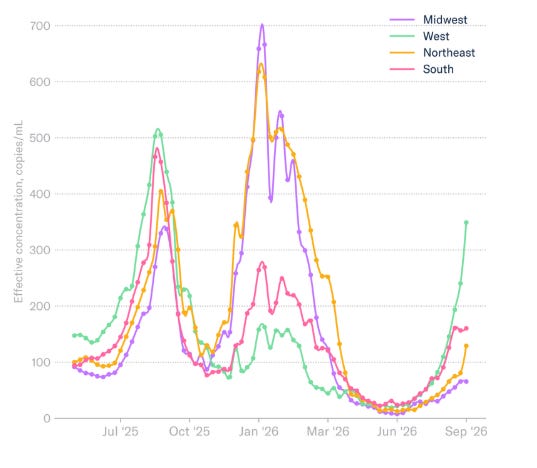
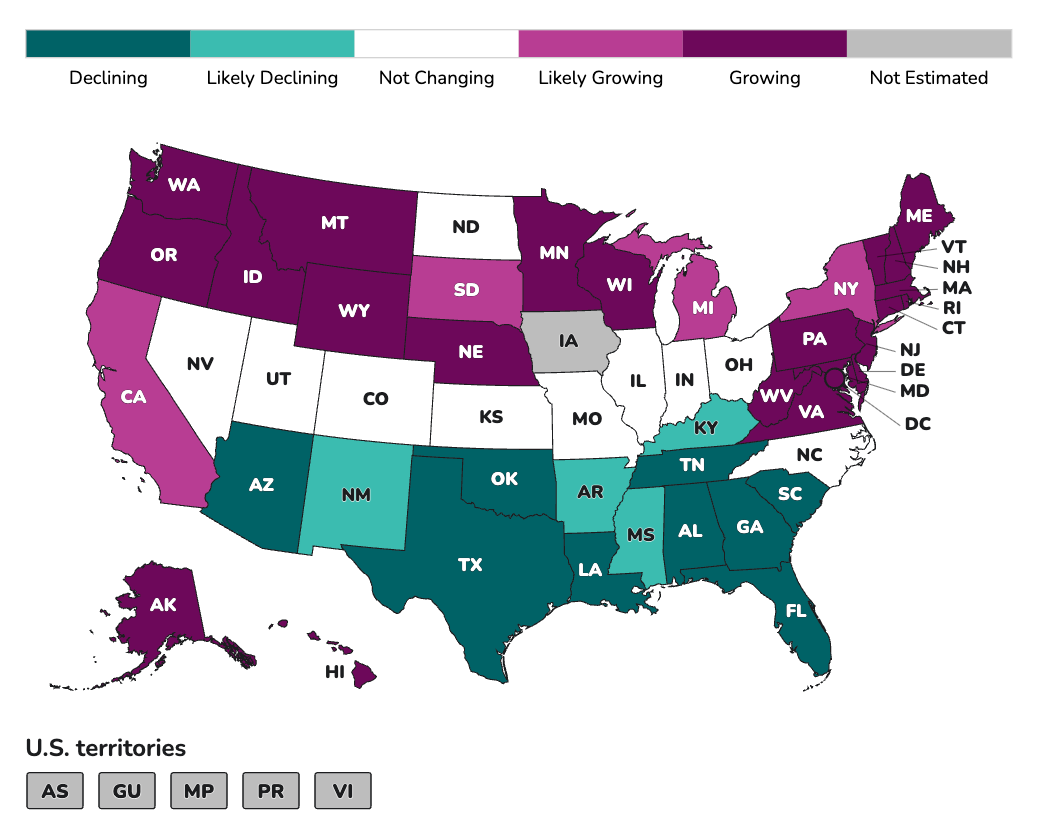
What this means for you: We are in the middle of a Covid-19 wave and it’s still worth getting vaccinated, especially if you’re high risk.
Norovirus: Starting to increase again
Norovirus—think puking, diarrhea, and misery—is starting to increase again, and right on schedule. Norovirus season is pretty long, so we should expect illness to peak in early spring.
This pathogen is a booger: it is very contagious, primarily spreads through contaminated surfaces, such as doorknobs and toys, and it’s also really hard to kill with cleaning products because it has a protective membrane.
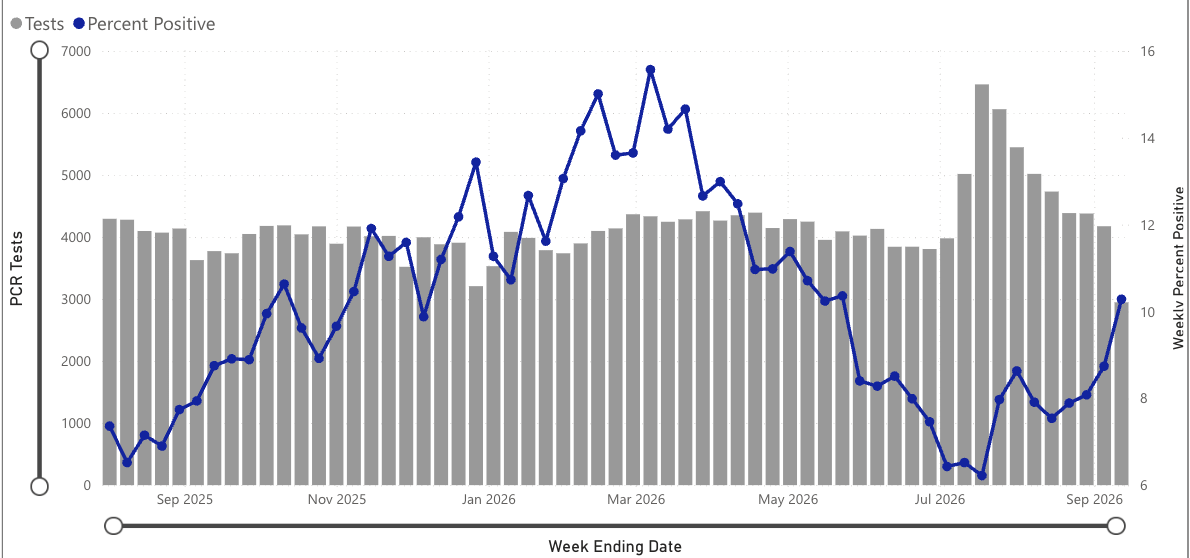
What this means for you: If you have the stomach bug, use a separate bathroom in your house and wear a mask if possible. Hand sanitizer doesn’t kill it—soap and water are your best bet.
Measles: The PA outbreak is much bigger than you think
In pretty astounding and depressing news, Pennsylvania reported its fourth measles-associated death in its outbreak. This marks the most measles deaths in the U.S. since 1992. (No, the CDC still hasn’t acknowledged a single death on its website, which is astounding in and of itself.)
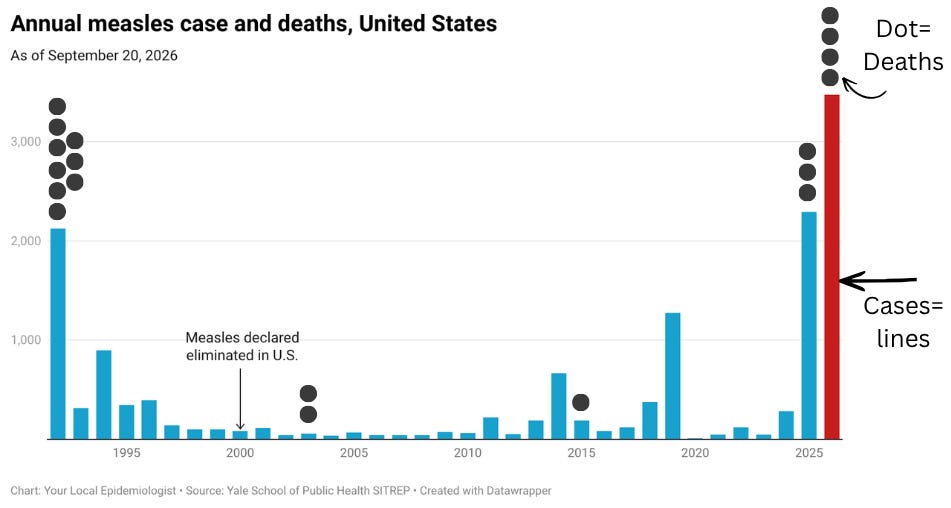
The state has reported nearly 800 cases, but measles typically causes 1 to 3 deaths per 1,000 unvaccinated cases. So… how does that math make sense?
It comes down to the denominator. Confirmed cases are the cases we know about; there are a whole lot of cases that are never recorded. In fact, for every reported case, there are about 10 cases not reported. This is especially true when community members are hesitant to engage with public health and health care systems, making case investigation and testing difficult.
So, the “true” PA outbreak is likely 1,300-4,000 cases.
Of course, there’s another possibility: this could simply be a statistical anomaly. Three deaths among a few hundred cases isn’t impossible—it’s just extremely rare. We’ve seen similar situations before. In 1991, for example, an outbreak in Philadelphia caused 1,400 cases and 9 pediatric deaths. In that case, religious leaders discouraged medical care, relying on prayer instead.
What this means for you: Whether this is an undercount or an outlier, one thing is clear: we are in new, unsettling territory. Here is a YLE deep dive on 10 FAQs on MMR and Measles Protection. No, you likely don’t need an MMR booster.
Spotlight: Why you may be having a hard time finding fall vaccines
Respiratory vaccines—for flu, RSV, and Covid-19—should be available at no cost this fall. But the federal government has created snags, so you may not be able to access them yet.
Here’s what’s going on.
RSV monoclonal antibodies: Low stock
RSV is a big deal for kiddos; just ask any mom who has had to sit with their baby in the hospital. In fact, it’s the leading cause of hospitalizations for kiddos (see graph below).
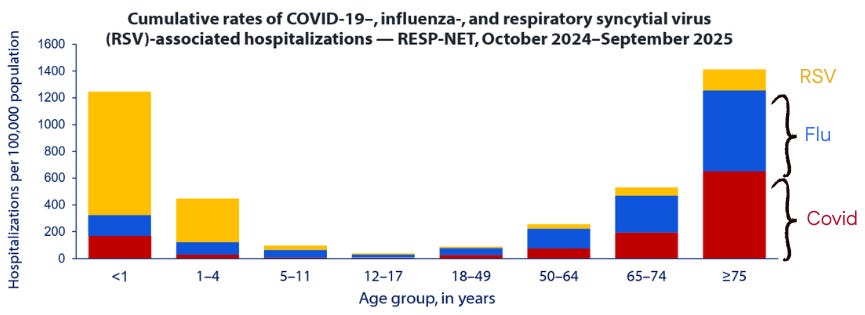
But this year, clinics and hospitals are ordering fewer doses of monoclonal antibodies—shots that protect babies under 8 months from RSV—than needed. They’re worried they’ll get stuck with the bill if insurance doesn’t cover it.
Why? CDC’s vaccine advisory group (ACIP) normally updates its recommendations as medical evidence evolves, but under RFK Jr., that process has completely stalled. Meanwhile, new science shows more high-risk babies should get this shot, so AAP updated its recommendation, but CDC recommendations are still stuck in last year. Since insurance follows the CDC, not the AAP, physicians aren’t sure whether insurance will cover the extra babies.
Covid-19 vaccines: Delays and access problems
Two things are happening on the Covid-19 front:
Adults in a handful of states will have trouble getting them at pharmacies. Most states have decoupled from federal guidance, so most Americans can get a Covid-19 vaccine at a pharmacy. However, this isn’t the case in a handful of states, like Louisiana. (Sorry I don’t have a full state list because it’s changing every day; many are trying to actively fix this). More than 80% of people get their Covid-19 vaccines at pharmacies.
Pediatric vaccine delays everywhere: The Vaccines for Children, a federal program that purchases more than half of childhood vaccines in the U.S., requires sign-off before they can actually ship them to states. This approval is being held up at the CDC Director level for reasons that are very unclear (and potentially concerning if delivery is stopped for political reasons). This means it’s unlikely your kid can get a Covid-19 vaccine at this time.
Flu: Running normally
People are getting vaccinated (including my kids!), and insurance coverage (private and public) is fine, including for the new mRNA vaccine.
There is still time to iron out these snags, but if things don’t get sorted by October, I will really start worrying about those at high risk, family disruptions (like missing school), and hospital capacity this fall and winter.
What this means for you: Don’t give up finding protection for you and your family. Have patience with your physician and pharmacy office; these snags are above their pay grade.
That said, bottom-up advocacy helps. If you have trouble, voice your concerns to your physician’s office, insurance company, pharmacy manager, or whoever is in charge to ensure they are aware of the problem. Eventually, the systems will hear it.
Good news
Silver lining in the PA measles outbreak: more families are getting protected. The number of people getting vaccinated has nearly doubled. In August 2026 alone, more than 46,000 MMR vaccines were administered, double the typical monthly rate of about 25,000. While I wish we didn’t live in a reactive society, it’s the reality, and I will take this as a win!
Malaria vaccines are working at scale. After decades of failed attempts, two vaccines are now part of routine childhood immunization in 25 African countries. Malaria kills ~600,000 people a year, mostly kids under five, so it’s great to hear that Burkina Faso saw a 32% drop in total cases after rollout and Cameroon reported a 17% drop. The one worry: funding cuts are already causing spikes in cases in a few countries, even as the vaccine expands elsewhere.
Worth watching: scientists are fighting NIH grant censorship. Researchers backed by the ACLU filed a class-action suit (Sept 16) alleging NIH uses a 235-keyword blacklist to flag already peer-reviewed grants for termination. This suit asks a judge to order the NIH to restore the funding cuts, which could mean money flowing back into research.
Grab bag: Resource for faith communities
“This may seem way out of scope, but my pastor is interested in sharing information about fall vaccines. Do you have any tips or resources that I could give him?”
I love this!!! It’s important that vaccine information isn’t approached as a deficit here (people don’t need more data and facts) but rather is aligned with their value systems. For many people, science and faith are not opposing forces, but complementary ways of understanding the world. The two can, and often do, coexist without requiring the rejection of medical or scientific evidence.
That’s your public health news you can use for the week! Get your fall vaccines as you’re able, wash those hands, and keep looking for the good news—it’s out there.
Love, YLE
Your Local Epidemiologist (YLE) comprises a team of experts, ranging from physicians to immunologists to epidemiologists to nutritionists, working together with one goal: to “translate” ever-evolving public health science so that people are well-equipped to make evidence-based decisions. The YLE suite of newsletters reaches over 475,000 people across more than 132 countries. This newsletter is free to everyone, thanks to the generous support of fellow YLE community members.


.jpg)
No comments:
Post a Comment