I wasn't at all surprised to read about how bad the flu is here in America, as everyone I know seems to have it.
Here's the latest newsletter from Dr Caitlin Rivers. Click on the link to see the charts that accompanied this article but wouldn't copy.
--------------------------
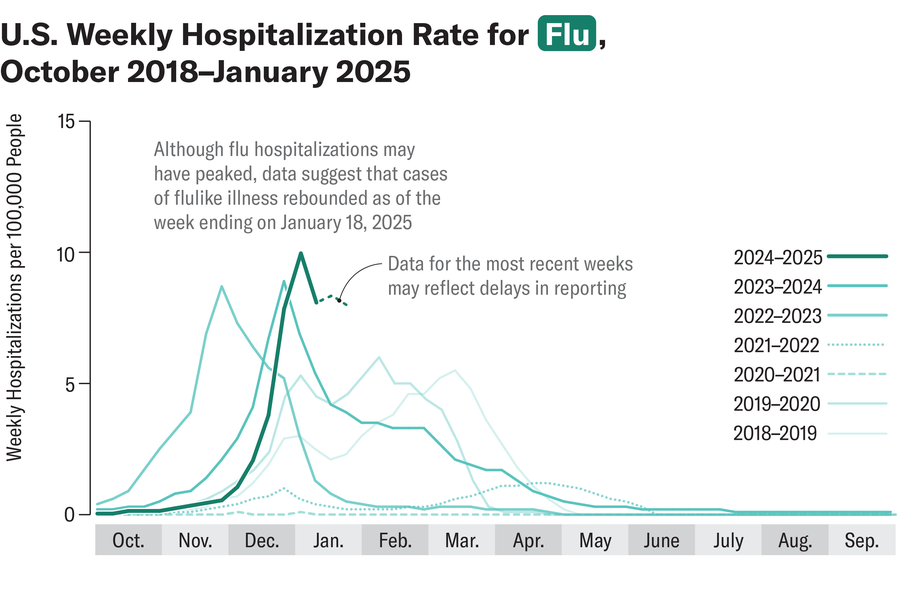
Flu spikes
Influenza-like illness hits a second peak
This
special edition of Outbreak Outlook examines an unexpected turn in this
year's flu season. Influenza activity is rebounding aggressively, with
outpatient influenza-like illness (ILI) now surpassing its January peak
to hit 7.0%.
In the past 22 years (i.e., dating back to the
2002-2003) season, only four other seasons have seen a peak that high.
And although there are a few years with a double peak, but only the
2019-2020 season was comparable in intensity.
(Note: these
plots are interactive when viewed in a browser. That functionality does
not work in email, so I recommend opening the webpage.)
Complicating matters, federal health data is still suffering from interference.
Last week, outpatient influenza data was missing, so I visited the websites
of all 50 state health departments to round it up. That data was later
brought back online, but then CDC’s main data repository (data.cdc.gov)
was taken down. For the second week in a row, I was back to rounding up
data by hand.
While
data.cdc.gov is back online, key datasets—including HIV statistics—are
still missing from the repository. These disruptions are very troubling,
not just because they undermine data reliability but because they're
happening just as we're weathering unusual flu patterns.
With that in mind, let’s look at the data.
Most
of the country is still experiencing high or very high levels of
influenza activity, and many states have hit outpatient ILI numbers that
exceed those seen around the turn of the New Year.
The
Southeast is experiencing particularly intense activity, with several
states reporting very high levels of both outpatient visits and
emergency department utilization. The coastal Mid-Atlantic region is
also seeing elevated activity, with some areas reporting outpatient ILI
percentages above 10%, which again are some of the highest numbers we
have seen all season.
In the Northeast, activity is also high but
it does vary by location, with urban states generally showing higher
rates than rural states. Emergency department are particularly busy
along the I-95 corridor, where multiple locations are reporting ED visit
percentages above 7%.
The Midwest is also seeing an uptick in
activity, particularly in the Upper Midwest where some areas (e.g.,
Minnesota) are reporting emergency department visit rates reaching 10%.
The southern portions of the Midwest show moderate but increasing
activity levels.
The Western region is more mixed, with the
Pacific Northwest showing the highest activity in the region. Mountain
states generally report lower levels of both outpatient ILI and
emergency department visits, though activity is increasing in some
areas. The Southwest shows moderate activity with signs of recent
increases.
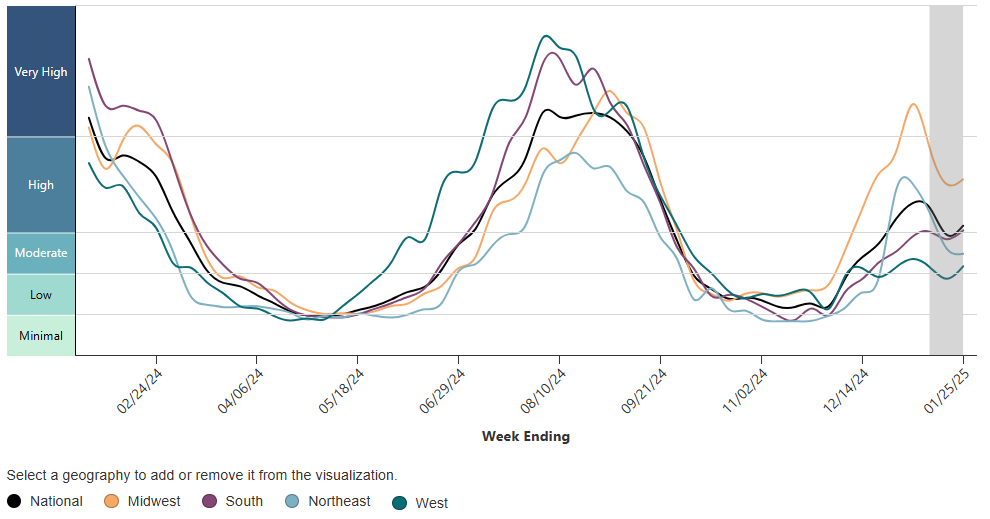
Wastewater
concentration, often a leading indicator, does not show signs of
slowing. The South, Midwest and Northeast are all seeing marked
increases. Only the Western region is stable.
As
usual, children under 4 years old are experiencing the highest rates of
illness at 16.2% ILI, a marked increase from 14.4% the previous week.
School-age children and young adults (5-24 years) also show high
activity at 11.0%, up from 9.0% last week.
Working-age
adults (25-49 years) are experiencing moderate activity at 5.9%, while
older adults show progressively lower rates, with those 50-64 years at
4.3% and those 65 and older at 2.7%. Unfortunately, all age groups are
seeing increases compared to the previous week.
Unfortunately,
these increases in children are translating into severe illness.
School-age kids have seen a significant spike in emergency department
visits for influenza, overtaking the 0-4 age group.
If
you are wondering whether the new spike in activity is due to H5N1, you
are not alone. But I checked, and there is no evidence of this.
Public health laboratories ran additional testing on 2,150 influenza A specimens last week, and none of them were H5N1. Circulating subtypes are evenly split between H1N1 and H3N2.
There is also no sign of extensive H5 in wastewater.
The
spike in human influenza activity is not due to H5N1, but the price of
eggs sure is! The Federal government tracks retail egg prices, and the
latest data (through December 2024) shows that the price of eggs is
climbing toward last year’s high water mark of $4.82.
These
impacts are due to outbreaks in commercial flocks, and they will likely
continue. Late winter into early spring is peak season for H5N1 in
birds. We will likely continue to see high prices for another month or
two, at least.
Share
COVID-19
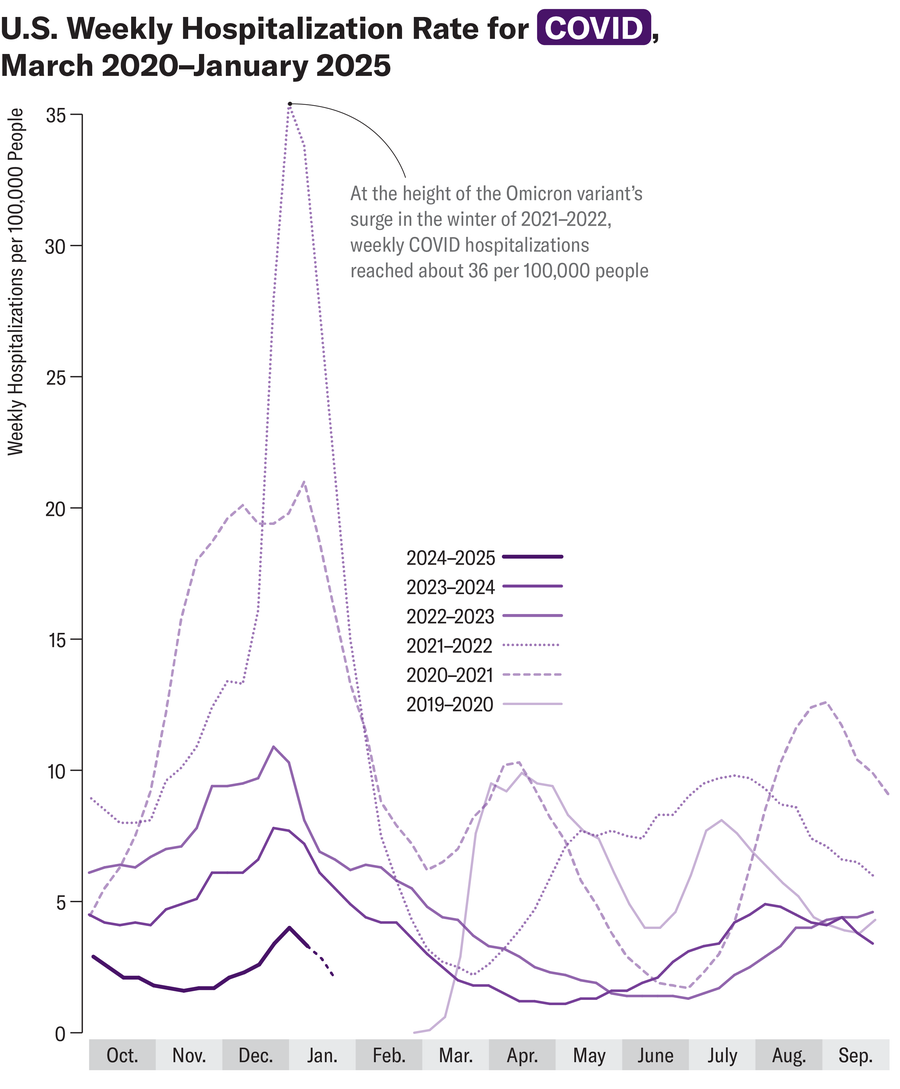
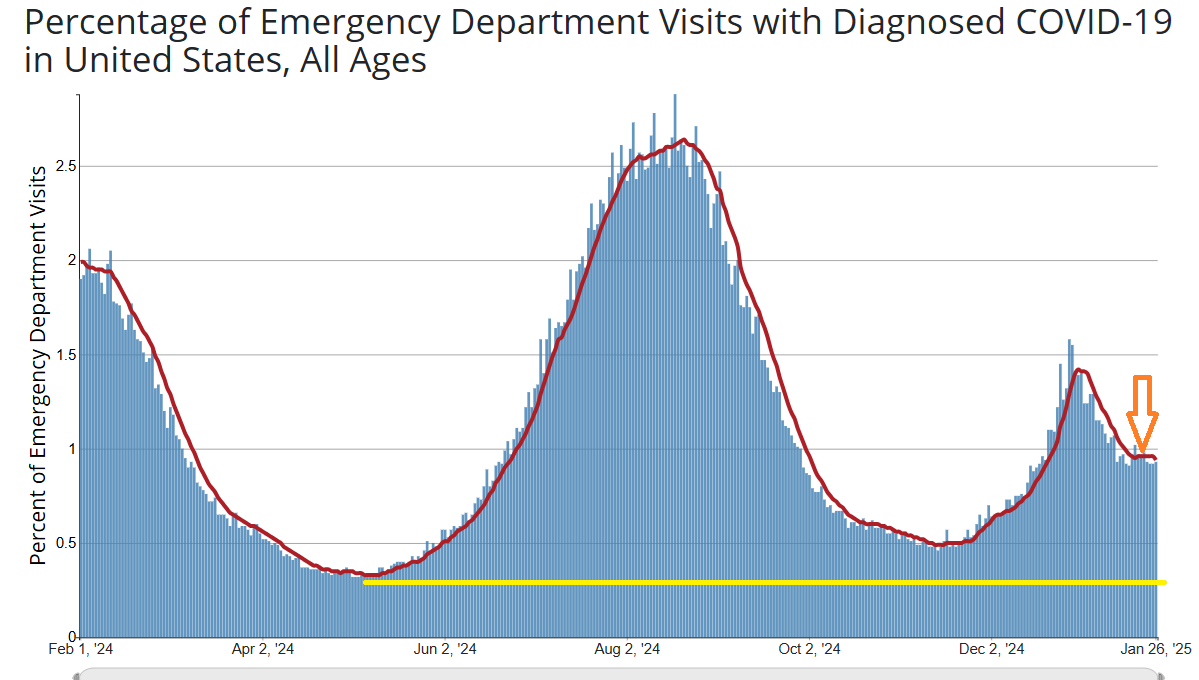
Covid-19 also continues to circulate. Wastewater inched back up again this past week after a couple weeks of declines.
The highest rates continue to be in the Midwest, followed by the South.
Most regions are seeing stable or slightly increased wastewater
concentrations, which suggests we will continue to see elevated activity
in the weeks ahead.
Severe
illness is not increasing nationally, however. Emergency department
visits for Covid-19 held steady this past week at 0.9% of all ED visits.
The rate of people hospitalized for Covid-19 decreased slightly, to 3.6
hospitalizations per 100,000 people.
RSV & Other Bugs
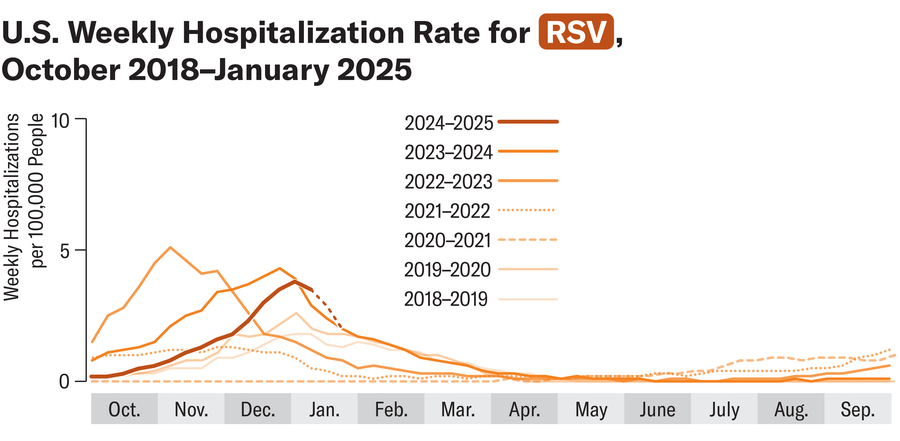
RSV activity continues its steady decline nationwide, though still above off-season levels.
Two
causes of cold- and flu-like symptoms (human coronaviruses and human
metapneumovirus) are both high but on the declining side of the curve.
Other bugs are fairly low right now.
Norovirus
Data
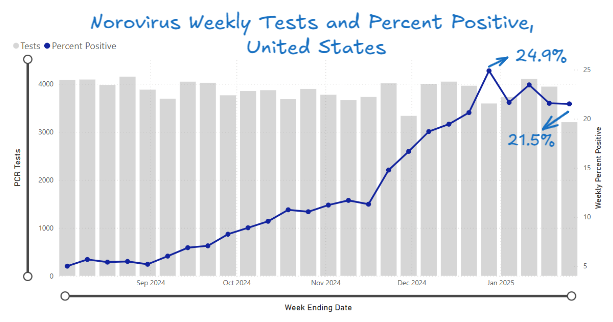
are back after the pause last week and, as expected, things have not
dramatically improved. Test positivity is 21.5%, which is marginally
better than it was a few weeks ago but still extremely high. The Midwest and Northeast are being hit particularly hard, but rates are very high across the country.
Food recalls
The
following foods are being recalled because they are contaminated.
Please check your cupboards and throw out any of these items:
New:
Blue Ridge Beef Natural Mix [for dogs] (more info).
While not for human consumption, humans may be infected with Salmonella
if they do not adequately wash their hands or contaminated surfaces
after handling the product.
Wegman’s fully cooked breaded chicken nuggets (more info)
Previously reported:
Casa Mamita frozen chicken and cheese taquitos (more info)
Wicklow Gold Cheddar Cheeses (more info)
Blue Ridge Beef Kitten mix [for Cats] (more info)
If you have food allergies, you may wish to review these FDA safety alerts and USDA alerts for foods with undeclared allergens.
In other news
Health programs funded by the United States have been halted
by President Trump’s 90-day pause on foreign aid and stop work orders.
Critical lifesaving medications and medical supplies, for everything
from HIV/AIDS to treatment for diarrhea, are no longer reaching people.
Thousands of healthcare and aid workers who carry out these programs
have already lost their jobs, including two-thirds of the staff of the
President’s Malaria Initiative, which benefits more than 700 million
people every year.
Several government websites providing information and data on public health have been removed
following President Trump’s recent executive orders, including datasets
on HIV/AIDS transmission and the health behaviors of teenagers. It is
not clear which pages will be made available to the public again. These
datasets are used by public health professionals and academics across
the country to research trends and properly tailor and target public
health programming and interventions.







.jpg)
