-------------------------------------------------
Top 8 questions about the “plague” situation
Katelyn Jetelina, Marisa Donnelly, PhD, and Elisabeth Marnik, PhD
Oct 07, 2026
Well, “the plague” is trending on almost all social media channels now.
With a topic like this, I really struggle with how deeply to cover it. When the hazard is low (i.e., the risk of the plague reaching the U.S. from Russia is essentially nil) but the outrage is high (lots of chatter and concern), what is the right call? Almost no official information is coming out of Russia, creating enormous information voids and rumors/falsehoods.
So we decided to answer the top questions we are seeing circulate online (and, let’s be honest, the ones family and friends keep texting us). This may help as you wade through the online storm.
Dr. Marisa Donnelly, epidemiologist, and Dr. Liz Marnik, immunologist, will take it away with the top eight questions.
A quick note: If you have no idea what I’m talking about, go to yesterday’s post about the situation in Russia. And then pick up from here.
Also, keep in mind the plague hasn’t been confirmed. What we know is that a scientist who worked in an anti-plague lab died of pneumonia of unknown cause.
1. How worried should I be? Epidemiologists and biosecurity experts are worried mainly because of the lack of transparency. It is their job to worry. This worry shouldn’t transfer to the general public right now, mainly because there is nothing for you to do and your risk is so low.
On a scale from 0 (not worried) to 10 (super worried), our worry that this will turn into something big is a 1. This will change if there are more cases or we find out if the pathogen was altered in the lab.
2. If this is the plague, what is it? The word plague probably brings up memories of your high school history class where you learned that ⅓ of Europe (about 25 million people) died. You may picture the eerie beaked masks of plague doctors, though those actually came along centuries later, in the 1600s. Scientists are still piecing together parts of the story, but back then plague spread in two ways: 1) through flea bites (fleas that fed on infected rats) and lice and 2) person to person through the air.
The world is very different now. We don’t have lice, fleas, and rodents everywhere in our living quarters anymore. And our medical systems are better. But plague is still around. It’s endemic in some places, like Madagascar, and sporadic in others, including the U.S. An estimated 1,000 to 2,000 people are infected worldwide each year.
There are three forms of plague, but all are caused by the same bacterium: Yersinia pestis. The type of plague someone gets depends on how they become exposed (see figure below). Symptoms also vary depending on the type.
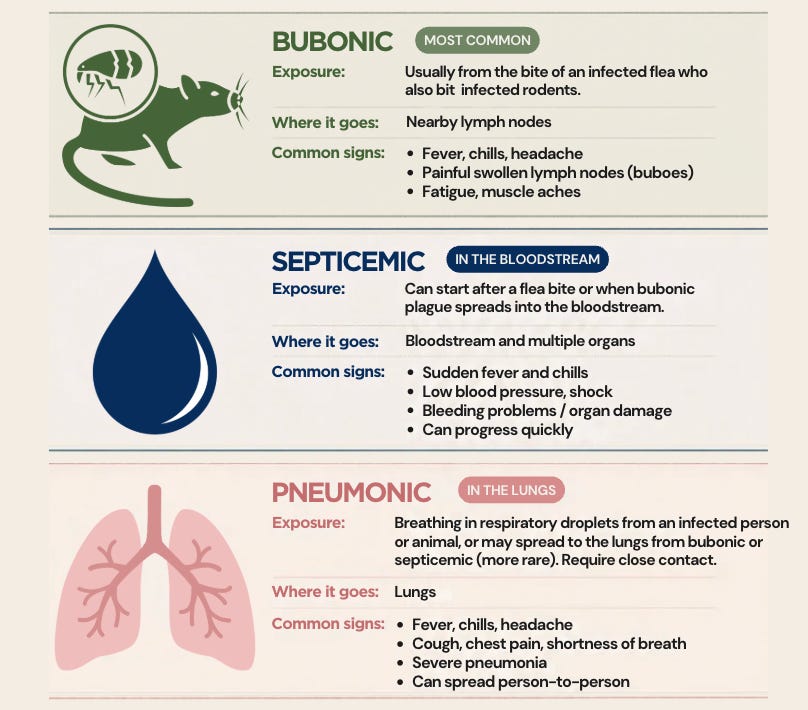
If this lab worker died from the plague, it’s suspected she had pneumonic plague.
3. Is pneumonic plague contagious? Could it spread widely? Yes, pneumonic plague is contagious, but not the most contagious thing on earth. It requires close or direct contact, like caring for someone who is sick. It doesn’t spread through casual contact, like from just being in the same room as someone. On average, one person with pneumonic plague may infect one to three additional people.
The public health response after a pneumonic plague case is detected is pretty straightforward:
Treat and isolate the patient
Identify all contacts that were potentially exposed
Begin monitoring
Depending on the extent of exposure and the suspected type of plague, public health may choose to give all exposed contacts post-exposure prophylaxis antibiotics, just in case.
This approach works really well in stopping plague outbreaks in its tracks.
4. Can we treat plague?
Yes! All three forms of plague are treatable with antibiotics, and recovery rates are high, but treatment must start quickly after exposure because the infection progresses rapidly. Untreated plague can be very dangerous, and pneumonic plague in particular can progress very quickly. As soon as a clinician suspects a possible plague infection, they will usually prescribe antibiotics rather than wait for laboratory tests to come back.
5. Is there a plague vaccine?
Not in the U.S. There used to be a vaccine available for military personnel and people at high risk (like those who work with animals or in labs with plague), but production was discontinued in 1999 because of serious side effects and because it was not effective at preventing infection.
6. Could plague be used as a bioweapon? Didn’t a book just come out about this?
Yes. In the book, a Russian lab released a genetically modified form of plague that progresses to a pandemic.
The book is marketed as “nonfiction” because it’s based on scientifically relevant work and the history of biosecurity, but the outbreak is fictional. It’s never happened before.
CDC and defense agencies have considered the bacterium that causes plague, Yersinia pestis, a potential bioweapon. The CDC has written guides for how to respond to a potential plague bioterror event.
Scientists have also considered the possibility that a bad actor may engineer plague to be antibiotic-resistant and use that as a weapon. But CDC’s guidance accounts for this potential and recommends two different classes of antibiotics to treat plague if there is reason to suspect engineered resistance.
Importantly, there is no evidence so far that the death in Russia is due to a bioweapon or genetically modified form of plague.
7. Are there enough antibiotics in the U.S. for a biological weapon?
For many reasons, plague outbreaks these days stay very small (see the previous YLE post on this). We do have antibiotics in the national stockpile, although it is considered underfunded (like many public health systems) and could always use more support. Also, keep in mind there are multiple antibiotic options for treatment, not just one.
Both of these would help avoid a supply chain bottleneck.
8. What should I do?
Demanding transparency (and accountability) from Russia is important right now.
Also, when you see friends and family talking about the plague right now, you can remind them why investing in science and public health matters. It helps keep us safe every day; we just often don’t see it. This includes investing in infection-monitoring systems and in research on new prevention and treatments.
Bottom line
If this woman died from the plague, the risk of a pandemic is very, very small. We will be back with more if that should change. But let this be a reminder, once again, that we need strong public health systems in the U.S. and across the world.
Love, YLE
Your Local Epidemiologist (YLE) is a team of experts, from physicians to immunologists to epidemiologists to nutritionists, working together with one goal: to “translate” ever-evolving public health science so people are well-equipped to make evidence-based decisions. The YLE suite of newsletters reaches over 475,000 people across more than 132 countries. This newsletter is free to everyone, thanks to the generous support of fellow YLE community members.





.jpg)
No comments:
Post a Comment