------------------------------
4 hantavirus updates and other things that can impact your health right now
The Dose (May 12)
This week, the hantavirus outbreak continues in a climate of distrust toward each other and authorities. We also answer a reader question: Are cruise ships really floating petri dishes?
There’s also all the normal stuff going around: Peak tick and allergy season, norovirus surges on another cruise ship, and scientific wins worth celebrating.
Here’s The Dose: what’s going on in the world of health and what it means for you.
Spotlight: 4 updates on the hantavirus outbreak
The risk to the general public remains exceptionally low, but the situation continues to march forward for the high-risk cruise passengers.
Note: If you missed it, this post builds on last Friday’s. You can catch up here. And big thanks to the entire YLE team, from virologists to physicians to epidemiologists, helping keep track of this rapidly moving situation.
1. Touchdown in Nebraska
Yesterday, 18 Americans landed safely in Nebraska by private transport after disembarking from the cruise ship in Spain.
Why Nebraska? In 2019, your federal tax dollars paid to build the only national quarantine facility in the U.S. specifically designed to safely monitor individuals exposed to high-consequence disease. This facility has a college-dorm feel, complete with TVs and exercise machines (see picture below), but people are completely separated. They don’t share air and don’t mingle. This facility was built for situations just like this.
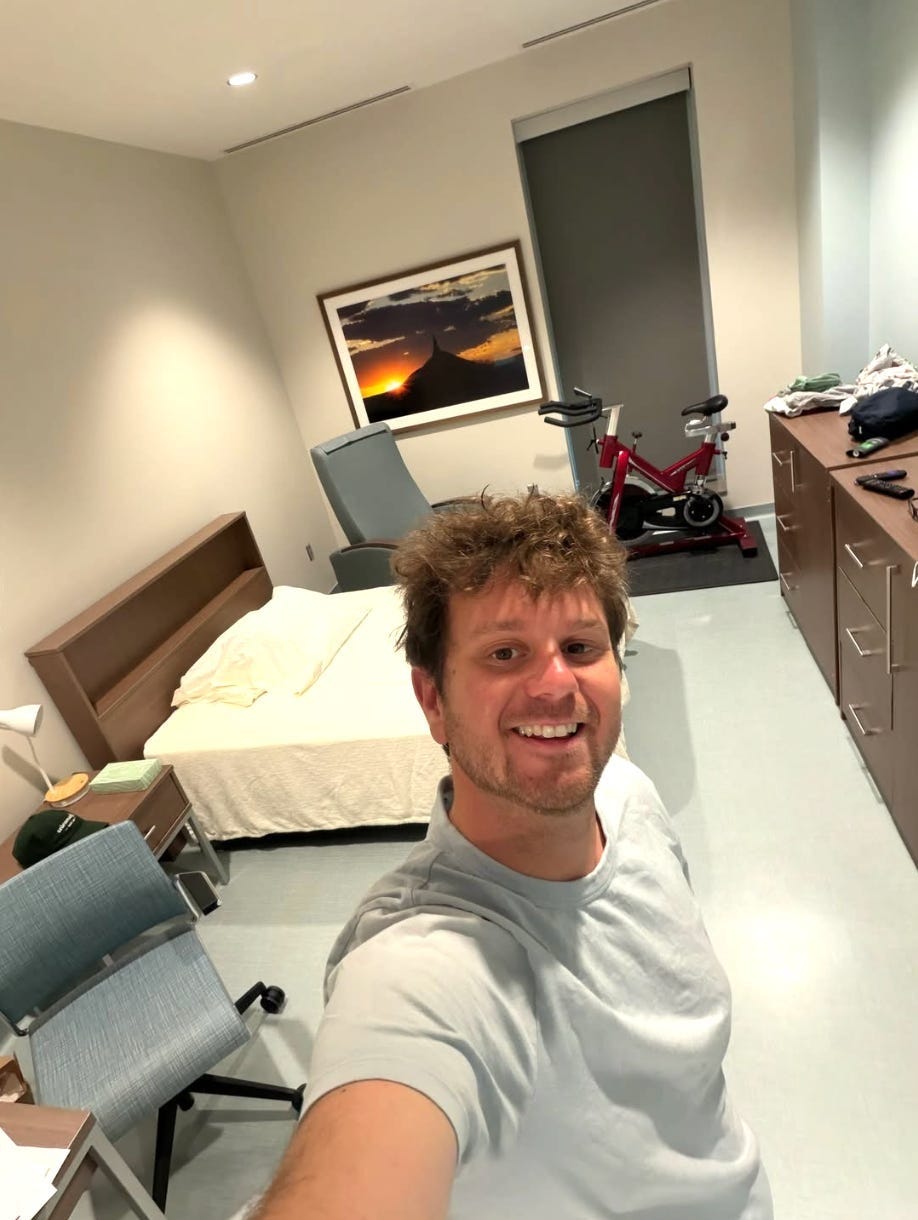
Down the street, there is also a biocontainment unit, similar to a hospital room but with many more precautions to safely treat someone who becomes ill. Importantly, Nebraska isn’t the only biocontainment unit. The U.S. has a network to help distribute people in situations like this. All of these systems are activated.
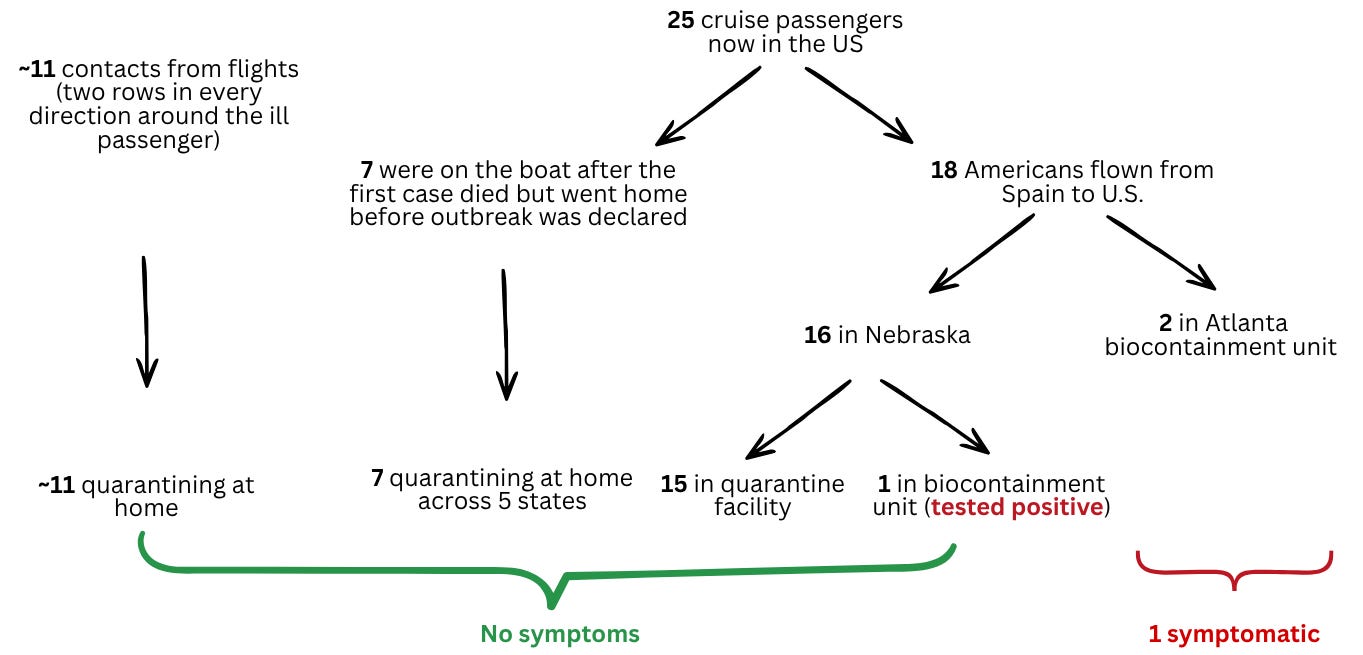
So, out of the 18 people:
Fifteen are in the Nebraska quarantine center: They are resting, being screened, and participating in detailed interviews to establish underlying health, exposure timelines (quarantine clocks start at the last exposure, so the interview matters), and their home situations to determine whether they can safely quarantine at home (distance from a hospital, home situations, etc.). None have symptoms.
One person is in the Nebraska biocontainment unit. They tested positive for hantavirus without symptoms. Hantavirus can turn positive on PCR testing before symptoms arise and before it becomes contagious.
Two passengers went to the Atlanta biocontainment unit. This is a couple: one person has mild symptoms, and the other has no symptoms. Importantly, symptoms of a cold or stomach bug at this stage may warrant a visit to this unit. (Remember, there was a flight attendant who was presumed to have hanta, based on her symptoms, and she ended up testing negative and recovered.)
In addition, there are seven Americans in quarantine at home across five states who were on the ship after the initial case died, but before public health authorities knew this was an outbreak. There are also ~11 people exposed to these cruise passengers while flying. None have symptoms, and all are in close contact with local public health departments.
2. The debate on whether to send passengers home intensified
After the home assessment, if they remain symptom-free, CDC will give those in the Nebraska quarantine facility a choice: stay or return home on a charter flight (not commercial) and stay in close, daily contact with local health departments. Either way, a full 42-day quarantine is expected.
A lot of people disagree with this move. After all, requiring people to stay in Nebraska reduces the risk to everyone else to zero. And, we are living in a very low-trust environment. Offering this option is asking communities to trust that those people will remain in quarantine and cooperate.
But, as with any public health decision, there are real trade-offs to consider. This is both a public health and humanitarian response:
Public health goal: Reduce risk to the passenger and the community. To do this, the most important thing is not necessarily where they are, but that they are monitored daily, remain quarantined (meaning they do not mix with other people), and have access to an appropriate hospital if they get sick.
Humanitarian goal: Allow passengers to quarantine where they prefer, such as at home. They were in international waters and living in a nightmare for more than a month. There’s a real psychological toll to that.
It doesn’t seem any individual has made a decision yet. And there is a possibility that pressure is enough to prompt the administration to change course. But I think the best option is the least restrictive approach that still keeps communities safe.
3. Transmission: How close is a close contact?
I know people are worried about this one, so let’s talk about what we do and don’t know.
We do know that there are two primary ways Andes hantavirus spreads: through contact with infected rodents and through “close contact” with people who are both infected and symptomatic.
We also know that the first passengers to be infected with the Andes virus were exposed in the most typical way: through contact with infected rodents off the boat. The next two cases also contracted the virus in a typical way: through close contact with infected people. (Close contact is defined by CDC as 6 feet for more than 15 minutes.) Cruise ships are notorious for putting people into close contact.
But, during a 2018 Argentina outbreak, a symptomatic patient infected 5 people while sitting close at a birthday party. One case may have involved only a brief, passing interaction. That said, 94 other partygoers didn’t contract the virus, and 82 healthcare workers who cared for the resulting patients remained healthy, many without PPE. (See a deeper dive from Ed Nirenberg here.)
Getting the transmission pathways matters a lot for contact tracing to ensure everyone who needs to be monitored is monitored (like on a flight). It also matters that scientists collect the right specimens on the ship so we can learn more.
In general, though, the overall risk of a pandemic remains very, very small, especially when added to a few other things we know:
We’ve successfully stopped Andes outbreaks in the past through standard contact and droplet precautions.
This does not appear to be a highly contagious virus between people.
Variants don't appear to be a concern here. Scientists confirmed this week that passenger samples were almost identical to one another and to samples from 1997 and 2018. This virus is behaving as scientists expect.
I will start worrying if we start seeing new infections among people who were not on this ship and had no contact with a positive case. (We haven’t seen this yet.)
4. HHS communications finally woke up
Over the weekend, physicians received a HAN (a routine alert about what to watch for), and the CDC website was finally updated, followed by a press briefing yesterday morning. Better late than never, but the drip of information has made all of this genuinely difficult to track. WHO remains stellar in communications.
What this means for you
The risk to you remains extremely low, and, thankfully, we have systems in place to address this rare disease. There is no need to cancel trips and this is not another Covid-19. The most important thing you can do is help spread accurate information. Triple-check sources, don’t spread unverified rumors, but DO share reputable and verified information. This includes information from the WHO, local health departments, and reputable public health leaders.
Disease weather report
While this small but deadly hantavirus outbreak plays out, there are four other pathogens that are more likely to affect your health right now.
Ticks: Are they slowing down?
Tick bites are certainly earlier this year than in previous years, but it’s not clear whether this will translate to a more severe season. After some exponential growth, the rate has come to a slow crawl. Regardless, we are in peak tick season.
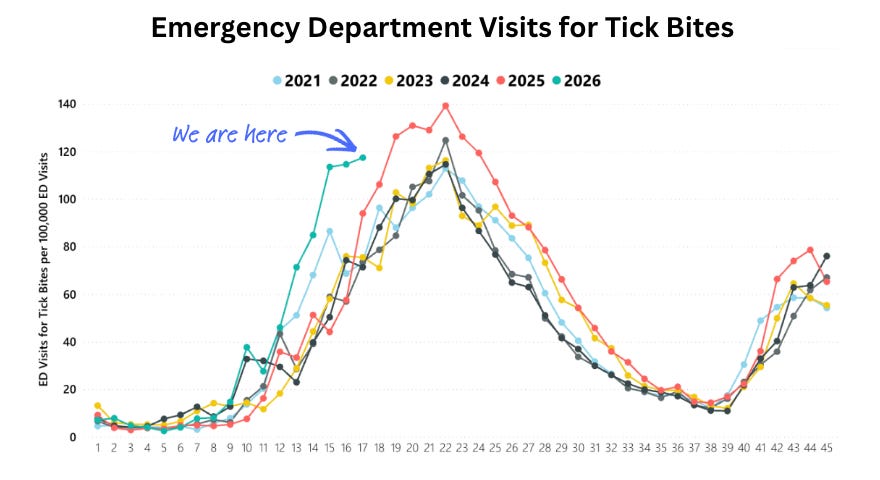
What this means for you: Prevention goes a long way. Most pathogens can only be transmitted after a tick feeds for some time, so call your physician if one has been attached for 36 hours. Use tweezers for removal (the only recommended method). And remember: nymphs are the size of a poppy seed.
Feeling crummy? It’s likely the common cold and/or allergies
Common colds are approaching their spring peak while other respiratory viruses become dormant. If you’re feeling crummy right now, it’s probably a cold.
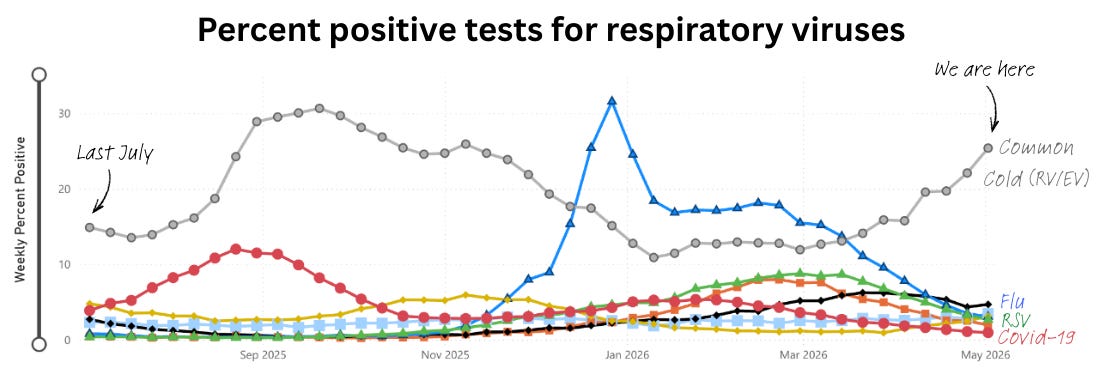
Or it may not be a virus at all. This week is going to be another bad one for people with allergies, particularly in the North and Midwest.
Allergy season is getting longer and more intense. Plants are releasing pollen about 40 days earlier than they used to and stopping about two weeks later, thanks to rising temperatures. Higher CO2 levels mean more pollen per plant.
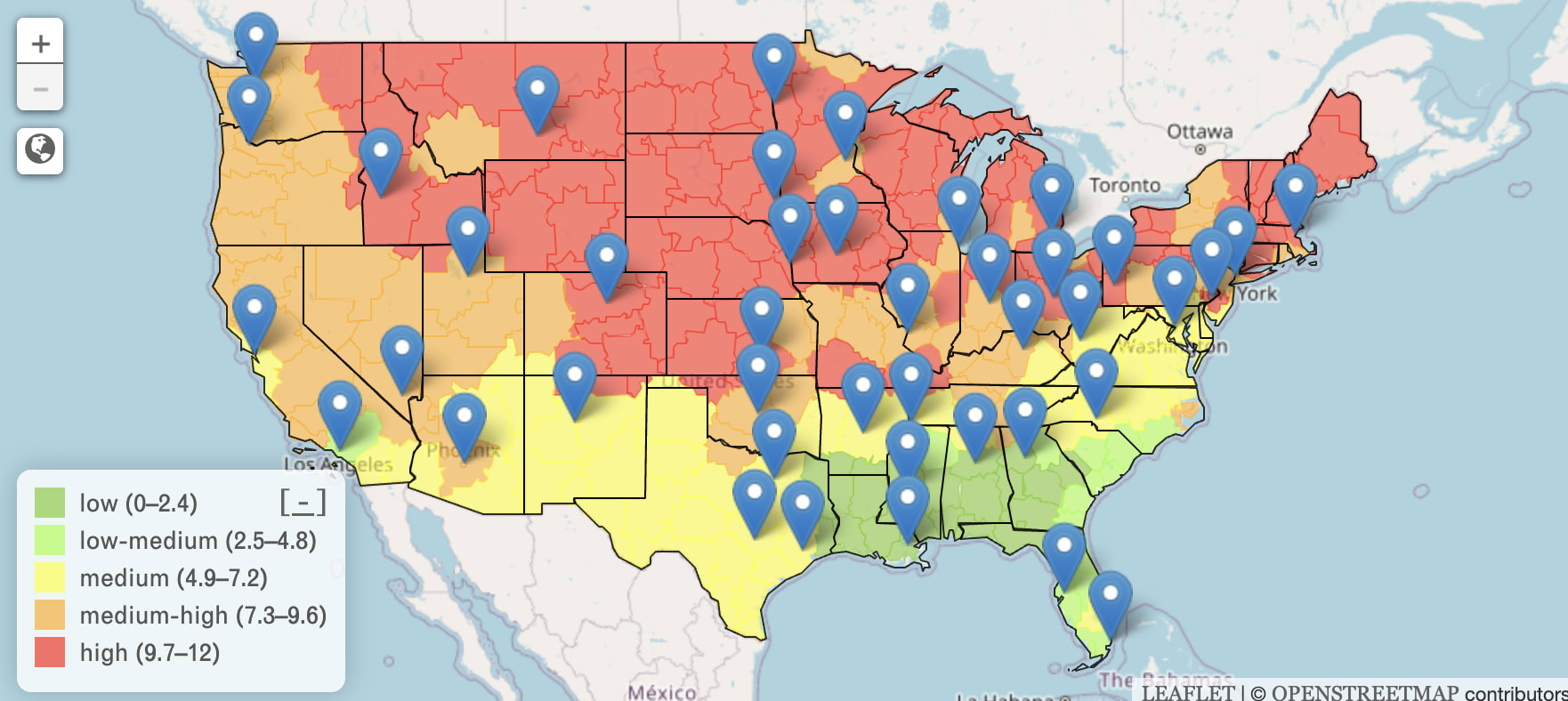
What this means for you: Check the pollen forecast, rinse your nose with saline (use distilled water), and shower before bed to wash pollen off. For medication, go with second-generation antihistamines like Zyrtec over Benadryl. (Benadryl has been around since the 1940s but carries more side effects.) Always check with your doctor. Also, here is a great room-by-room guide you may find useful.
Another cruise, another outbreak: Norovirus
Another cruise ship made headlines last week due to a major norovirus outbreak with more than 115 cases. Norovirus—think nausea, vomiting, and diarrhea—is also midseason but on its way down.
Norovirus is very infectious. On average, one infected person will infect two to seven other people, and the virus can live on surfaces for weeks.
And while cruise ship outbreaks usually make the news (like this one), they only account for 1% of outbreaks. Three out of four norovirus outbreaks occur in nursing homes. Restaurants and schools are the next most common settings.
What this means for you: Norovirus is extremely contagious. If you have the stomach bug (assuming you’re not reading from the cruise ship), use a separate bathroom in your house. Hand sanitizer doesn’t kill this bugger, either. Soap and water are your best bet after touching hotel door knobs or elevator buttons, for example. If you’re second guessing your cruise plans, read on for our take.
Good news
Wastewater is here to help with measles. A new study found that wastewater monitoring enabled officials to detect a measles outbreak in New Mexico five days earlier than clinical testing. Given this is such a contagious virus, this could really help get on top of outbreaks before they get out of control.
Suppressing HIV could become more successful and more manageable. HIV requires lifelong treatment, which currently means daily medication for most patients. Scientists found that one infusion of immune cells that recognize HIV reduced the virus to undetectable levels. Only a couple of patients have received this treatment so far, but its success—for one patient, HIV remained undetectable for two years after that one infusion —is a milestone for treatment options.
Question grab bag
These outbreaks have me reconsidering my cruise plans. Are cruise ships really floating petri dishes compared to other settings?
Cruise ships have a reputation as floating petri dishes.
Some of this is a monitoring artifact. The CDC's Vessel Sanitation Program requires cruise ships to report outbreaks and maintains a public database of all reported cases, which doesn’t exist for hotels, resorts, college dormitories, or restaurants, where the same viruses spread just as readily but without mandatory public reporting. So public health is looking for outbreaks, like norovirus.
That said, the environment does matter. Dr. Adam Kucharski shared his interesting research on social mixing, which found that cruise passengers have nearly twice as many close contacts per day as people on land (20 versus 10). This means more opportunity to catch something.
In 2020, the Diamond Princess became one of the most studied natural experiments in infectious disease history. One study found that Covid-19 airborne transmission likely accounted for more than half of disease spread on the ship, a finding that reshaped thinking about ventilation in enclosed spaces well beyond cruising.
If you do cruise, the single best thing you can do is wash your hands before and after every meal, every time. And stay behind if you’re sick.
Bottom line
Public health is never dull, but beneath the alarming headlines, there are systems, scientists, and dedicated people quietly doing their jobs to keep you safe and largely succeeding.
Love, YLE
Your Local Epidemiologist (YLE) is founded by Dr. Katelyn Jetelina, MPH PhD—an epidemiologist, wife, and mom of two little girls. YLE comprises a team of experts, ranging from physicians to immunologists to epidemiologists to nutritionists, working together with one goal: to “Translate” ever-evolving public health science so that people are well-equipped to make evidence-based decisions. YLE reaches over 425,000 people across more than 132 countries.





.jpg)
No comments:
Post a Comment