---------------------------------------------
Yes, I know it’s a summer Friday afternoon, but I wanted to pop in with two important health updates that might be useful as you head into the weekend. If you’re in the Midwest or Northeast, you’ve probably already noticed it just by looking out the window: air pollution is at extremely high levels right now. We also just got an update on the source of the cyclosporiasis outbreak.
Here’s what it all means for your health. I’ll keep it quick.
Air pollution is at extremely high, dangerous levels
Air pollution levels in Chicago, Detroit, New York, and DC are the worst in the world right now. We are starting to see it on the West Coast too. All from wildfire smoke. I called my friend, Dr. Joseph Allen—a professor of exposure assessment science—to help break this down for you.
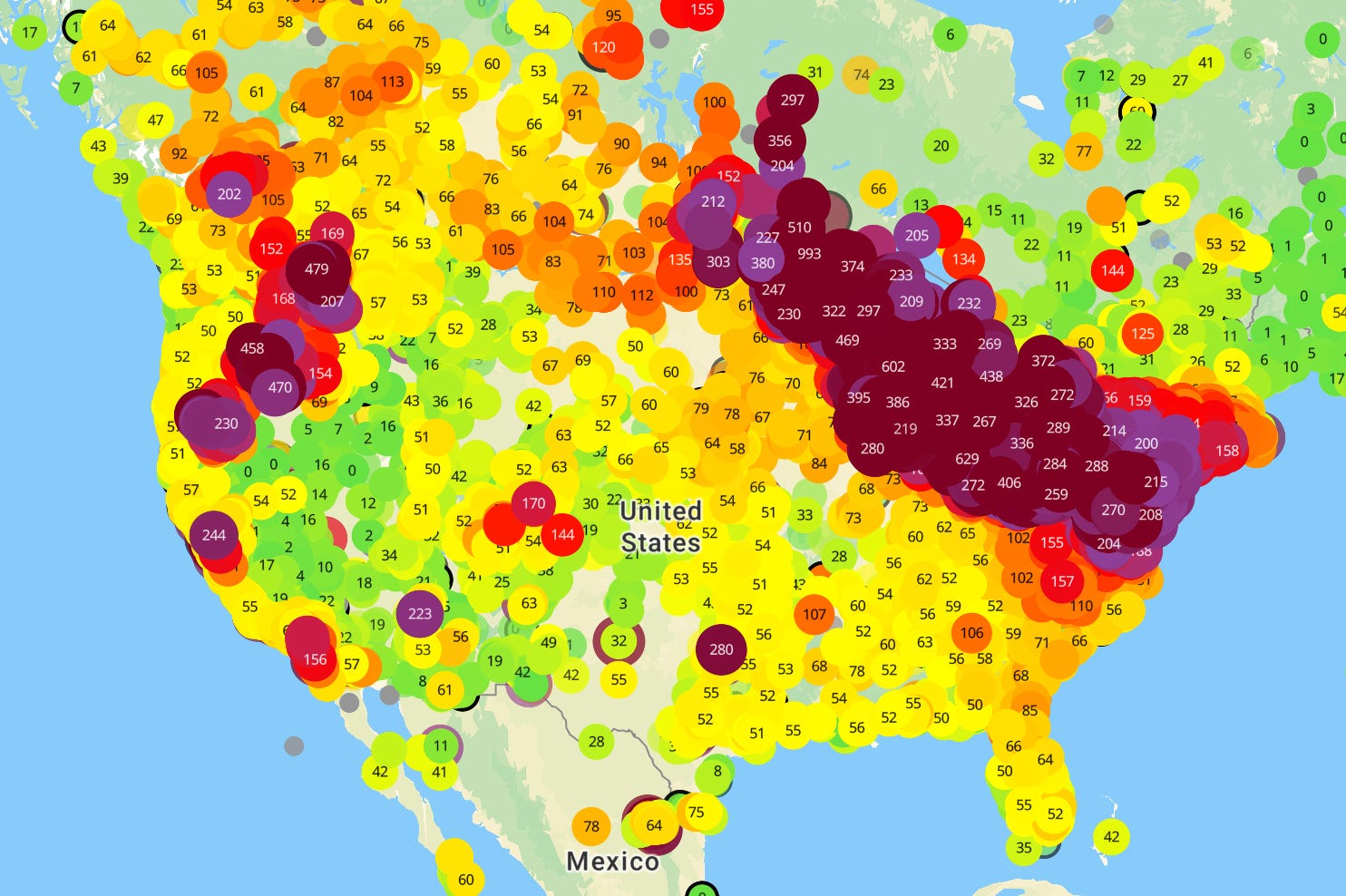
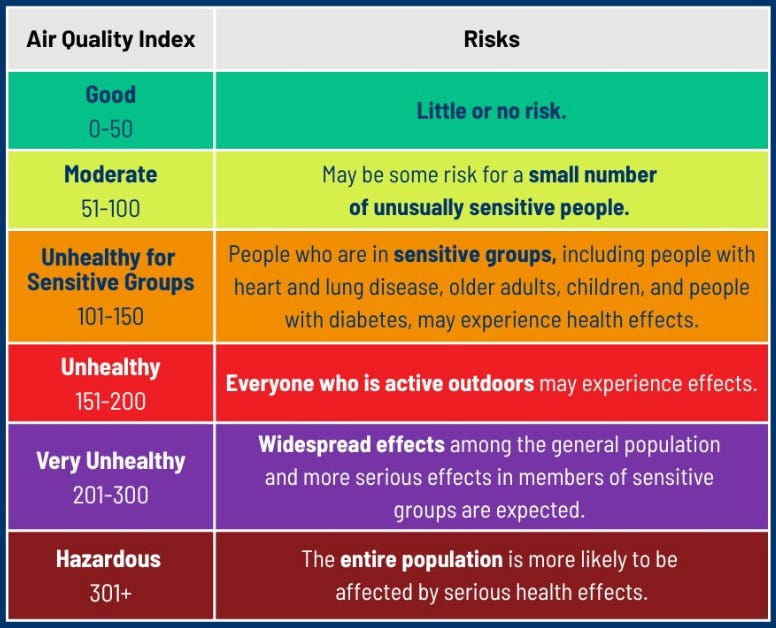
This is very dangerous for everyone’s health — not just people with high-risk conditions. Wildfire smoke contains tiny particles less than 2.5 microns in diameter (PM2.5) that can enter the lungs and irritate our respiratory linings, as well as toxic gases. Once wildfire particles hit your lungs, your body reacts like it’s under attack: it triggers inflammation and puts stress on blood vessels that spreads beyond the lungs into the bloodstream. That inflammation makes blood clot more easily and can destabilize plaque in your arteries, which is why breathing bad air can trigger a heart attack, not just breathing problems.
The more smoke inhaled, the higher the risk to your health. For every 10 micrograms per meter (μg/m3) increase, the heart attack risk increases by 2.5%. So if baseline air pollution in DC is 10 and it’s currently 160, the increased risk of heart attacks is close to 40%. In some places, air quality ranges from 300 to 900. You can do the math, but this is not good.
Here's another way to think about risk, though the comparison isn’t perfect: spending an hour in "purple" air quality is roughly equivalent to smoking half a pack of cigarettes.
Some people are at higher risk than others (like pregnant women, older adults, children, and people with pre-existing respiratory or heart conditions), but once it reaches “unhealthy” levels (over 151 on the air quality index), everyone should take action:
Keep checking air quality; it will ebb and flow over the next few days. My go-to is Purple Air, but you can also download the EPA’s AirNow mobile app. Dr. Matt Willis had a great look at air quality apps in our California newsletter last week—check it out here.
Yes, an N95 mask works if you need to go outside during unhealthy levels. The “95” means at least 95% removal efficiency of particles like those in wildfire smoke. Research found that N95s reduced hospitalizations from wildfire smoke by 30%. In other words, it offers some protection, at least in the short term, while running to the grocery store. Cloth, paper, and tissue masks will not filter out the smoke.
Air pollution can get inside our buildings; in fact, we breathe more outdoor air pollution indoors because we spend so much time indoors. There are several things we can do:
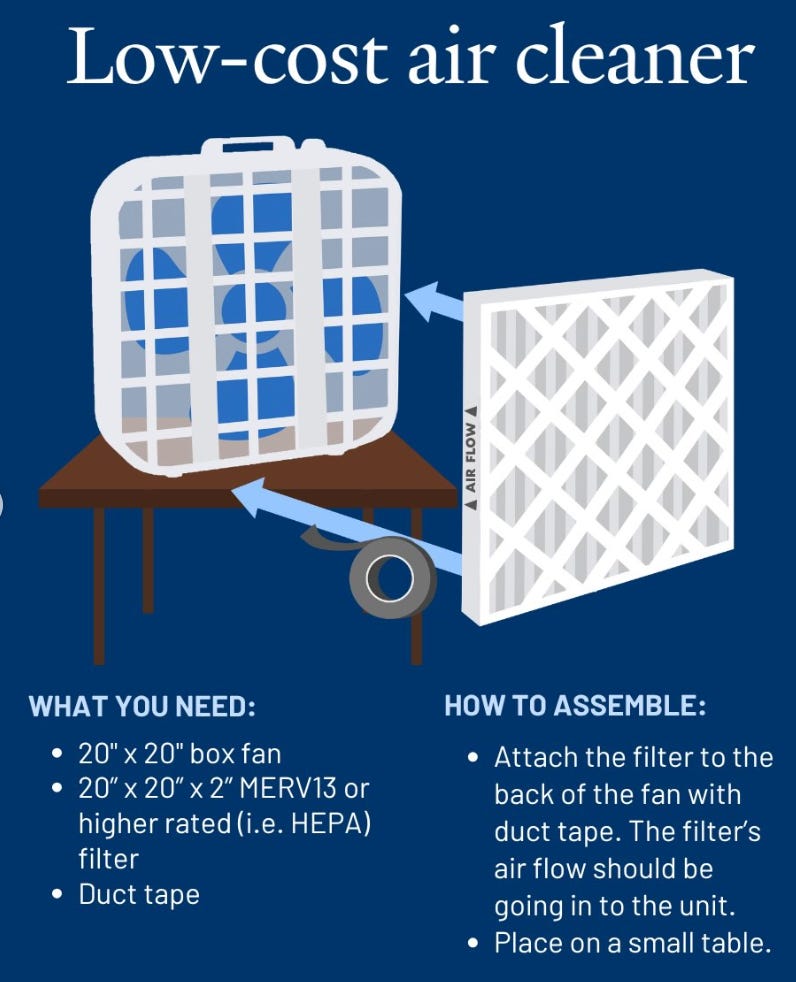
Have good filtration for the particles and gases. HEPA filter units are good for cleaning the air in individual rooms, while MERV 13 or higher filters are good for entire HVAC systems. You can also create a low-cost air cleaner for inside your house (see picture below). There are portable air cleaners that can capture both particles and gases (but these get expensive).
b. Run your system 24/7, even if it’s on “fan only” mode, if you have a central system. If not, the air isn’t passing through filters.
c. Get an indoor air quality monitor that measures PM2.5. Then you can compare your indoor levels to what’s outside to be sure your filtration is working properly.
d. When this mess is all done, make sure you change your AC filter. Many filters rely on electrostatic charge, and because wildfire smoke is charged, it can reduce the filter’s effectiveness significantly because it ‘depletes’ the charge.
Finally, some clues for an explosive diarrhea outbreak
The number of people getting sick continues to rise in the Midwest, and we are finally starting to get clarity on the likely culprit: shredded iceberg lettuce. The federal government named Taco Bell. The FDA reports that in epidemiological investigations (i.e., patient interviews), Michigan found that roughly 90% of people who got sick reported eating at Taco Bell in the prior 10 days.
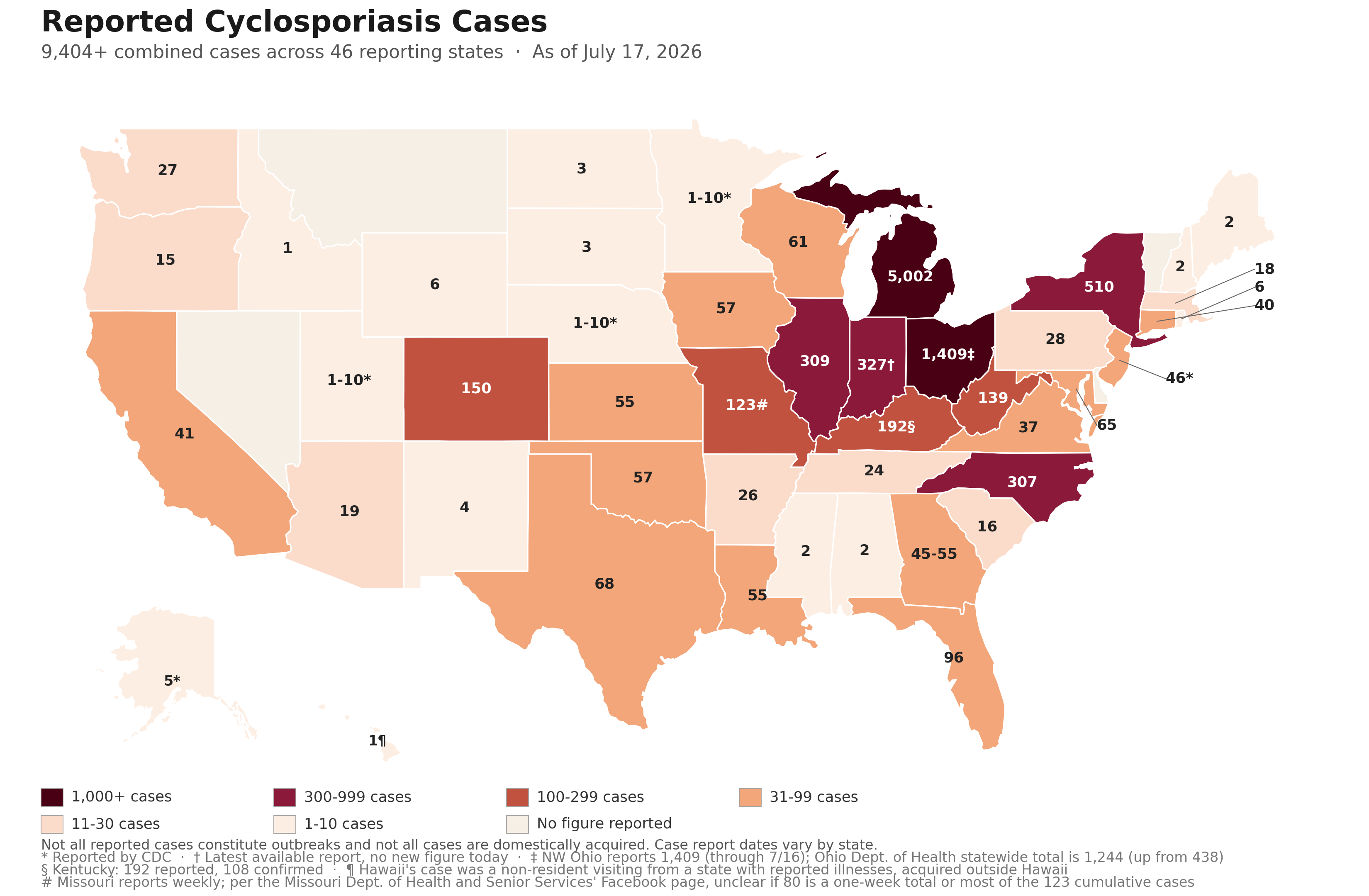
However, I find it very hard to believe it’s just Taco Bell, and I am hearing from the public and investigations that this isn’t the case. Produce distributors don’t just supply one fast-food chain; they typically supply many retail grocery and food service bulk. It’s incredibly unusual that the federal government didn’t name the supplier. However, the Washington Post reported yesterday that the culprit is Taylor Farms. Taylor Farms feeds up to 160 million servings of produce to stores and restaurants each week.
What does this mean to you? Avoid shredded iceberg lettuce in these hotspot states, and I am personally avoiding it beyond Taco Bell.
I’m hopeful the circulation of these products is close to (or possibly even out) of circulation, given lettuce’s shelf life, but we don’t have data showing that yet. We also don’t know whether there’s cross-contamination, so if I were at high risk (like a pregnant woman) in this area, I would remain cautious about certain other produce. Hopefully, we see this outbreak finally calm down soon.
Bottom line
The world of public health never gets boring. Stay healthy out there.
Love, YLE
Your Local Epidemiologist (YLE) comprises a team of experts, ranging from physicians to immunologists to epidemiologists to nutritionists, working together with one goal: to “translate” ever-evolving public health science so that people are well-equipped to make evidence-based decisions. The YLE suite of newsletters reaches over 475,000 people across more than 132 countries. This newsletter is free to everyone, thanks to the generous support of fellow YLE community members.





.jpg)
No comments:
Post a Comment