--------------------------------------------------
Measles and Hep B vaccine changes: What it means for you. Today's ACIP meeting
"Today was the first of two meetings of ACIP—the CDC’s vaccine policy advisory group. On the docket were two votes: one on a measles vaccine and another on hepatitis B. Tomorrow, they will be back with Covid-19 vaccine recommendation changes.
"Usually, I’d give you the key takeaways of the science and rationale behind a change in recommendations. But this meeting was different. RFK Jr. has handpicked every member, and many are not experts in this space and have built careers—and fortunes—by sowing doubt about vaccines. So it wasn’t surprising that today’s discussion felt less like a scientific review and more like a Jerry Springer show: performative, at times absurd, and littered with red flags. There were multiple falsehoods, repeated mistakes, and comments that revealed more ideology and incompetence than evidence. To make matters worse, at the end, one of the members’ hot mics caught him saying he didn’t know what he just voted for.
"In sharp contrast, the CDC scientists and staff who presented at the meeting were clear, careful, and grounded in evidence. Their presentations laid out the data, the risks, and the benefits with precision. Frankly, they all deserve a medal of honor.
"Unfortunately, this isn’t just inside baseball. ACIP and HHS decisions directly affect you and your family: Will you be able to get a vaccine, and where, at what cost? Here’s a breakdown of what’s changed and what it means for you, including my own level of concern.
Bottom line up front
"Today, ACIP:
Removed MMRV (measles, mumps, rubella, and varicella combination vaccine) as an option for your child’s first dose: Level of concern “yellow”
Discussed moving the first dose of the hepatitis B vaccine from birth to 30 days, but postponed the vote until tomorrow (they ran out of time). If this goes through, which is highly likely given this committee’s make-up, my level of concern is “yellow/orange”.
"Today’s meeting was chaotic, and your vaccine choices just got narrower. RFK Jr. hasn’t set the house on fire yet, but they’ve definitely doused it in gasoline and started small forest fires on the property. Grassroots pushback, political pressure, and strong internal voices likely curbed the most extreme proposals. But “not the worst outcome” isn’t the standard families deserve. The changes adopted today weren’t based on new safety or effectiveness data. They were driven by ideology. And it’s our kids who will be harmed.
Hepatitis B vaccine from birth to 30 days: Yellow/orange alert
"Today, ACIP discussed delaying the hepatitis B birth dose vaccine until 30 days of age for infants not considered “high risk.” While it’s far better than what was initially reported (delaying until 4 years), it’s still a step backward and wasn’t based on new scientific evidence.
Why do we vaccinate?
"Hepatitis
B is a virus that attacks the liver and often causes lifelong
infection. Once inside a cell, the virus hides its DNA in the nucleus,
making it nearly impossible to clear. We do not have a cure. That’s why
prevention is so critical.
"Babies are especially vulnerable—9 in 10 infants who catch it become chronically infected, compared to about 1 in 10 adults. It’s not entirely clear why this risk decreases dramatically over time, but it’s likely because a baby’s immune system is weaker—it’s harder for them to clear the virus, allowing it to become a chronic disease.
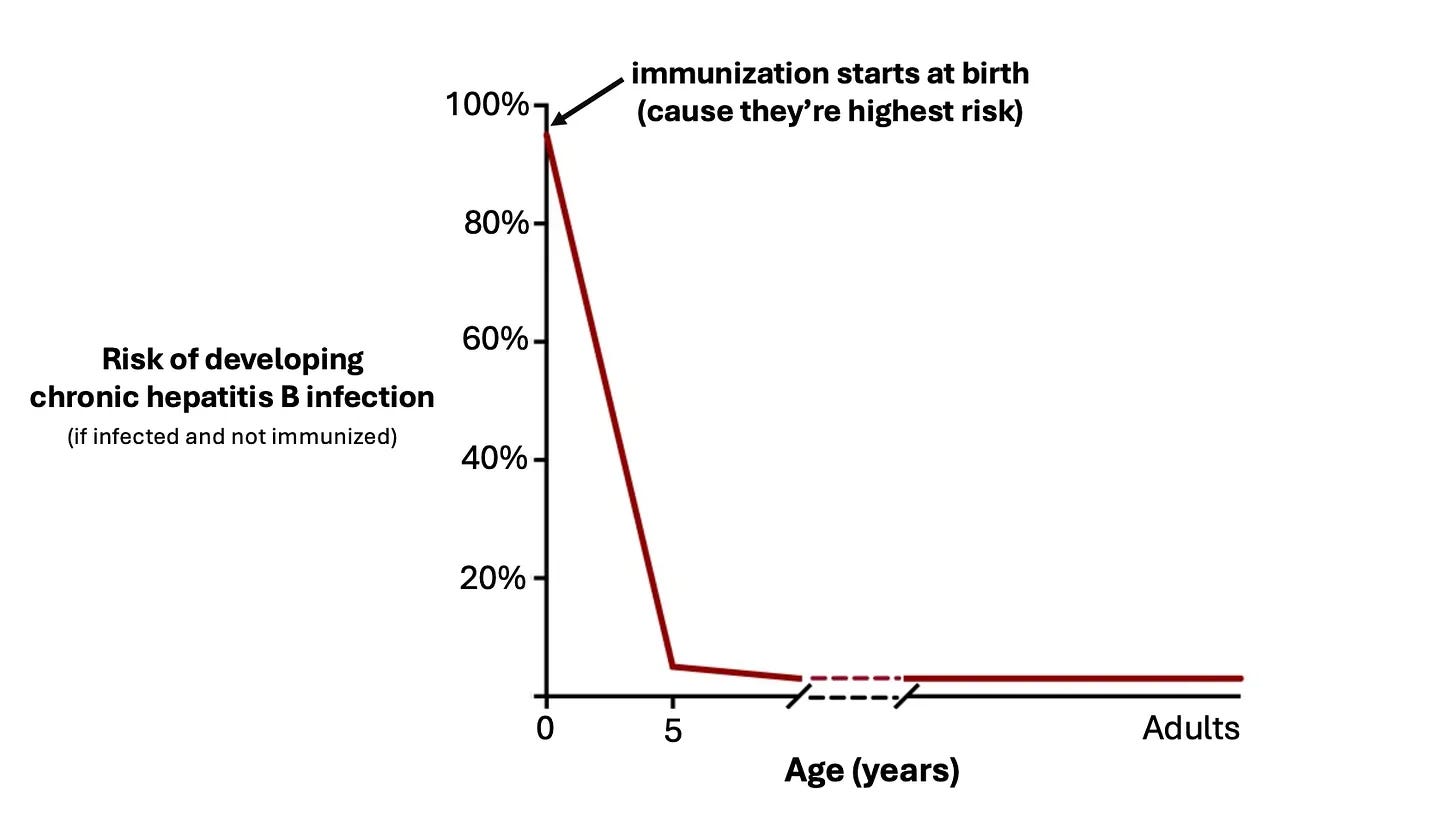
"Chronic hepatitis B often goes unnoticed at first but silently causes cirrhosis, liver cancer, and liver failure, with about 25% of chronically infected children eventually dying from liver disease.
"The highest risk factor for hepatitis B (or HBV) is mothers with a history of sexually transmitted infections or multiple sex partners. Infants mainly get infected from their mothers during birth through blood transmission or other bodily fluids. But this virus is a booger. Babies can also get it from other household members who may unknowingly carry the virus. Because hepatitis B spreads easily through tiny amounts of blood—even from things like scrapes or nail clippers—newborns can be exposed in ways that parents can’t always predict or prevent. Half of babies infected in infancy did not have mothers infected with HBV, meaning that the risk came from other household members.
Why do we have a universal recommendation, then?
"In the 1980s, before the universal birth dose was recommended in 1991, about 18,000 children under age 10 were infected with hepatitis B each year—half of them at birth. Today, thanks to universal vaccination, CDC reports fewer than 20 cases per year (though modeling suggests the true number is still several hundred). Let me say that again: universal hepatitis B vaccination cut the number of children infected by 1000 times!
"Universal vaccination acted as a safety net, given a few critical factors:
Not everyone gets screened. Roughly 15% of mothers are never screened for hepatitis B, despite recommendations.
Prenatal care is uneven. Similarly, 12-16% of mothers get no prenatal care at all. About half of mothers who test hep B positive don’t get the right treatment in time. There are gaps in interpreting lab results, connecting with moms, and getting them into the clinic before they deliver.
Hepatitis is often silent. More than half (50-70%) of all cases are asymptomatic, and up to 60% of people are unaware they are infected with hepatitis B.
"And, importantly, the benefits of vaccination have long outweighed the risks: The HBV vaccine induces protective immune responses in nearly everyone (80-100%). The vaccine risks are extremely low—the only safety signal found is rare allergic reactions (one severe allergic reaction for every 2-3 million doses).
What changed this week?
"Historically, recommendations were that everyone get the hepatitis B vaccination at birth, 1–2 months and 6–18 months.
"ACIP has proposed to delay the first hepatitis B vaccine dose to 30 days for non-high-risk people. They advised that people who want it at birth should consult their doctor. This wasn’t based on any nuance or any new (or old) safety or effectiveness data.
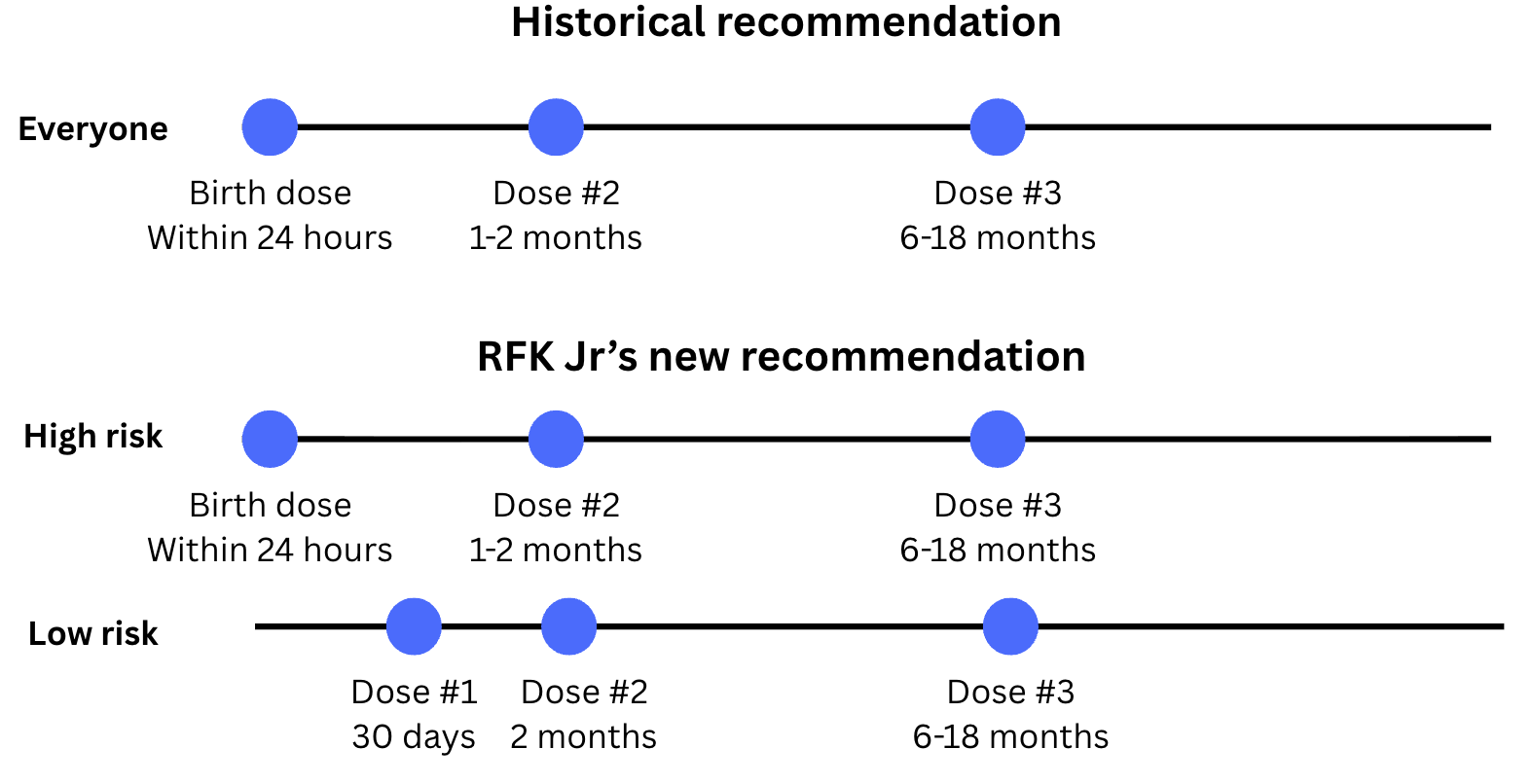
"A vote has been postponed until tomorrow to make this an official change. It is very likely to pass with the current ACIP membership.
What will be the impact?
"Infections will rise, especially among newborns, and chronic disease will lead to more preventable deaths. How much they will increase is a big unanswered question and depends on two things:
Missed opportunities. Hospitals provide a prime opportunity for vaccination: nearly every newborn is there, and vaccines are part of the default bundle of care. But about one third of infants miss their one-month checkup. Leaving them unprotected and making it harder to catch up later.
System-level changes. Some health systems may interpret the new recommendation as a green light to drop the birth dose from their standard care bundle, pushing it to primary care instead. That shift—driven by finances or administrative burden—could widen the gap even further.
What does this mean for you?
"If you and your family are vaccinated against hepatitis B, you’re very well protected. More than 95% of people who complete the series are protected for many decades, potentially for life.
"If you’re pregnant, you now may have to navigate a patchwork of rules, with some states, hospitals, or pediatricians still recommending and providing the birth dose, while others follow the delayed schedule. Parents who want early protection may need to advocate for it, pay out of pocket, or face limited access. But some states are already pushing back. (Follow YLE CA and YLE NY for the latest on vaccine access protections in those states.)
MMRV first dose removed: Yellow alert
"Today, ACIP voted to remove the option for families to get the MMRV (measles, mumps, rubella, and varicella [chickenpox]) combination vaccine for the first dose. This is better than what was initially floated—removing the option for MMRV as the second dose as well, which is what the vast majority of kids receive.
Why do we have this vaccine?
"Measles, mumps, rubella, and chickenpox can all cause serious illness, death, and significant disruption for families. The MMRV vaccine combines MMR (measles, mumps, rubella) with varicella, reducing the number of shots, doctor visits, and tears.
Is there a true safety signal for MMRV?
"Not exactly.
"About 1 in 3,000 (0.03%) children may experience a febrile seizure after their first dose of the MMR vaccine, which is typically given at 12-15 months old. For MMRV, the risk is slightly higher: about one extra febrile seizure for every 2,300–2,600 children vaccinated (0.04%). Importantly, this increased risk disappears by the second dose (age 4–6).
"This is far lower than the baseline risk of febrile seizures (2–5%) from viral infections. Vaccination helps prevent those infections.
What changed this week?
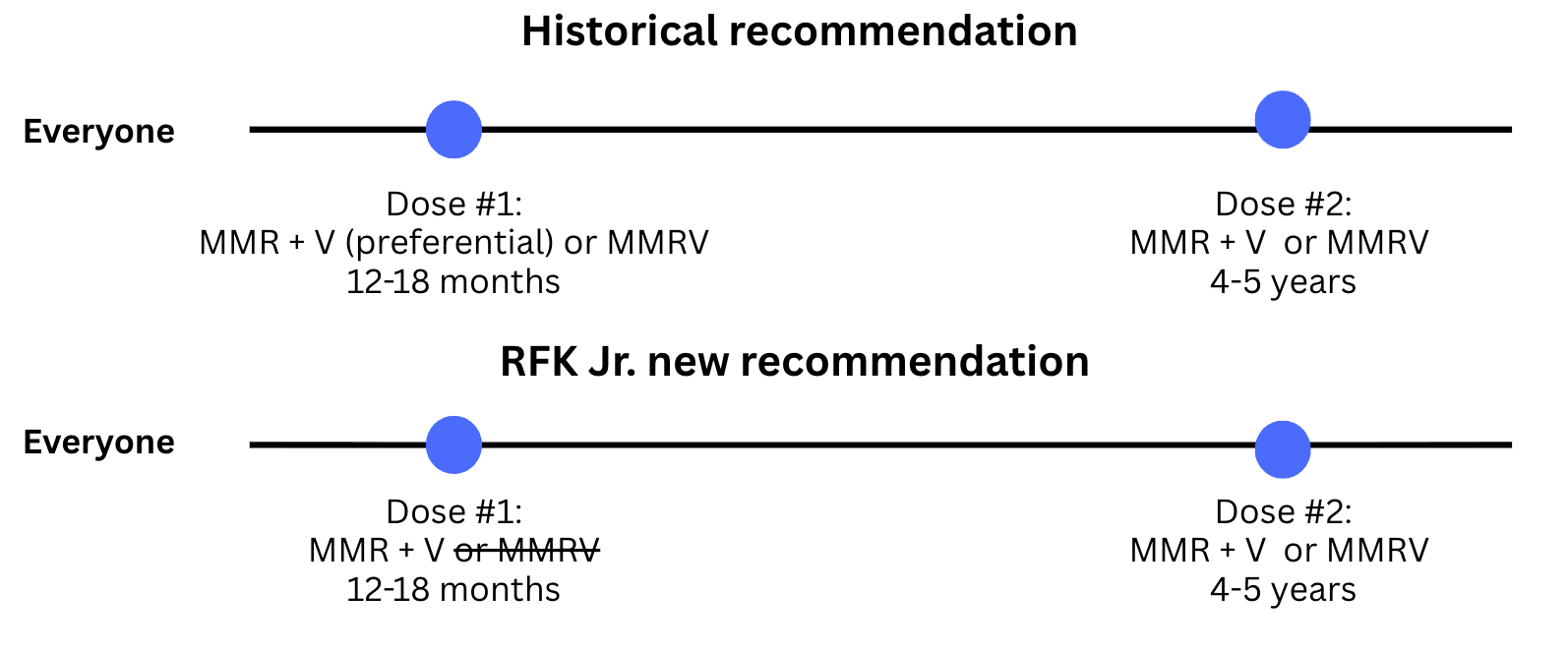
"Until now, pediatricians and families had two options at 12 months:
Give MMR and varicella separately, or
Use the combination MMRV vaccine
"Due to the small increased febrile seizure risk, most pediatricians (70–85%) already opt for separate shots for the first dose. In fact, there was already a preferential recommendation in the childhood immunization schedule. However, because the risk is already so low, parents could reasonably want to use MMRV because it would mean fewer pokes and less stress.
"But after today’s vote, MMRV is no longer recommended for 12–18-month-olds. It will only be used for the second dose at 4–6 years.
What will be the impact?
"Short term: This will be disruptive. Roughly 15–30% of pediatricians stock the combination vaccine for first doses, and switching supply chains and clinic workflows takes time—even as long as 6 months. That lag could mean gaps in vaccination and missed opportunities.
"Long term: The overall population impact is likely small. Most providers already avoid MMRV for first doses, and the second dose remains unaffected.
Bottom line
"Today’s meeting was chaotic, and your vaccine choices just got narrower. RFK Jr. hasn’t set the house on fire yet, but they’ve definitely doused it in gasoline and started small forest fires on the property. Grassroots pushback, political pressure, and strong internal voices likely curbed the most extreme proposals. But “not the worst outcome” isn’t the standard families deserve. The changes adopted today weren’t based on new safety or effectiveness data. They were driven by ideology.
"And it’s our kids who will be harmed.
"Love, YLE
"P.S. I will be back tomorrow with the Hep B vote and changes in Covid-19 vaccinations. I’m anticipating much more dramatic changes than today, but we’ll see."





.jpg)
No comments:
Post a Comment