---------------------------------
Covid-19 state vaccine access, flu on the horizon, grandparents to the rescue, Florida’s school requirement rollback, food safety cuts, and more
The Dose (September 8)
"Welcome to this week’s update (a day late because I spent the weekend fully unplugging with friends—highly recommend).
"Here’s what’s on the radar: Covid-19 summer wave, with flu peeking around the corner. Also, a patchwork of state vaccine access for Covid-19 vaccines, Florida’s decision to scrap school immunization requirements, and grandparents organizing for their grandkids’ health. Sprinkle in a scaled-down food safety system and a dose of fall foliage science, and you’ve got the picture.
"Let’s dive in!
Disease “weather” report
"Covid-19: The summer wave continues nationally, still at a moderate level. Growth is slowing overall, but the South and West (especially Florida and Hawaii) remain hotspots. Wastewater levels are still climbing in these states, suggesting we’re not quite at the peak, though we may be getting close.
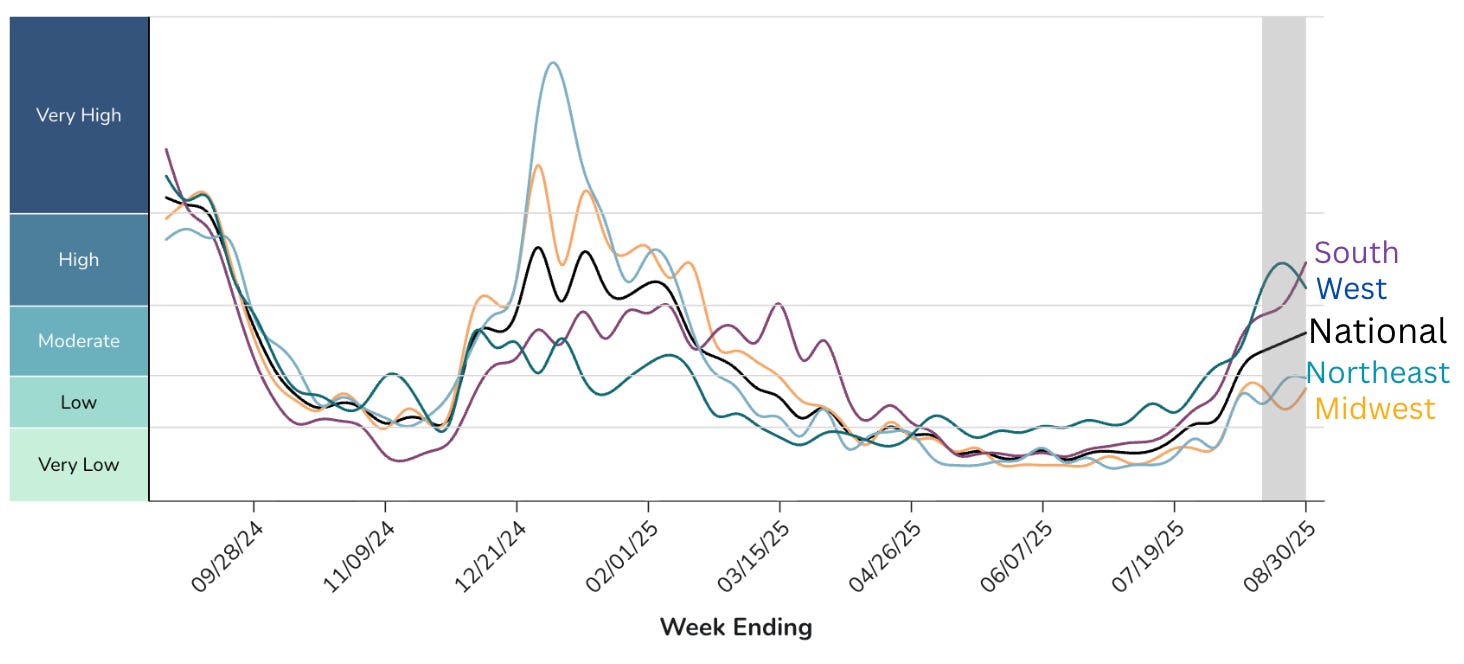
"RSV: Still quiet nationwide. Historically, activity kicks off in the Southeast first—nothing is moving there yet.
"Flu: Starting to stir, especially in the South. Outpatient visits haven’t hit the 3% epidemic threshold that marks the official start of flu season, but activity is creeping upward, particularly among kids.
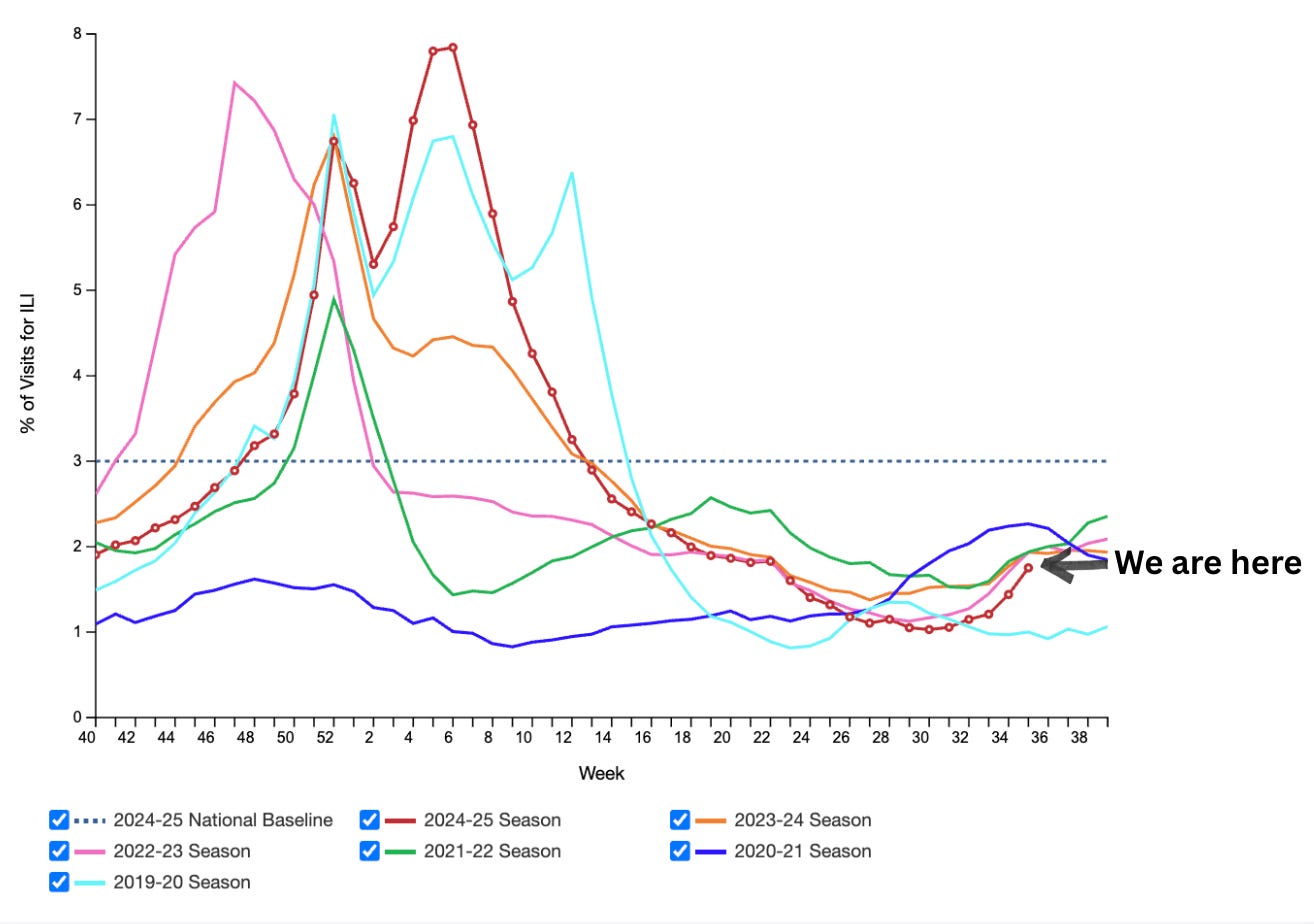
"What does this mean for you? Wearing a mask in indoor crowded areas will help avoid viruses, especially Covid-19 right now. If you start to feel the sniffles, test before seeing grandparents at the nursing home. Also, this is the time to start planning for fall vaccines. For your options and ideal timing, go here for your 2025 guide for Fall vaccines.
Covid-19 vaccine access: A patchwork quilt
"Right now, access to Covid-19 vaccines depends on your address. Even on-label people (ages 65+ or under 65 with high-risk conditions) face different rules across state lines. Off-label access (younger, lower-risk adults) is essentially blocked everywhere at pharmacies, except in a few states that acted quickly, like Massachusetts.
"Why the patchwork? Many state laws link vaccine access directly to guidance from FDA or ACIP (the CDC’s Advisory Committee on Immunization Practices). But in June, ACIP was replaced with members handpicked by HHS Secretary Robert F. Kennedy Jr., and they declined to vote on Covid-19 vaccine recommendations. Their next meeting is set for next week.
"Until that happens, guidance is stalled, leaving state statutes tied to ACIP in limbo and creating uneven access across the country.
Business as usual (green in map below): Pharmacies and physician offices can vaccinate people ages 65+ and high risk without extra hurdles.
Prescription required (purple below): Patients need a doctor’s order before getting vaccinated at a pharmacy, even if they are 65+ or high risk.
"The good news is that many states have been taking action (diagonal lines below) to move from “purple” to “green.” They’ve used several levers, including changing legislation expanding pharmacist authority (e.g., Colorado), to executive orders overriding restrictions (Massachusetts, New York, New Mexico), to pharmacy board directives filling gaps (Pennsylvania, Nevada, Kentucky).
"Off-label access (i.e., if you’re under 65 and not high risk; not shown on the map) is still going to be highly restricted in almost all states, for now. Massachusetts is one exception.
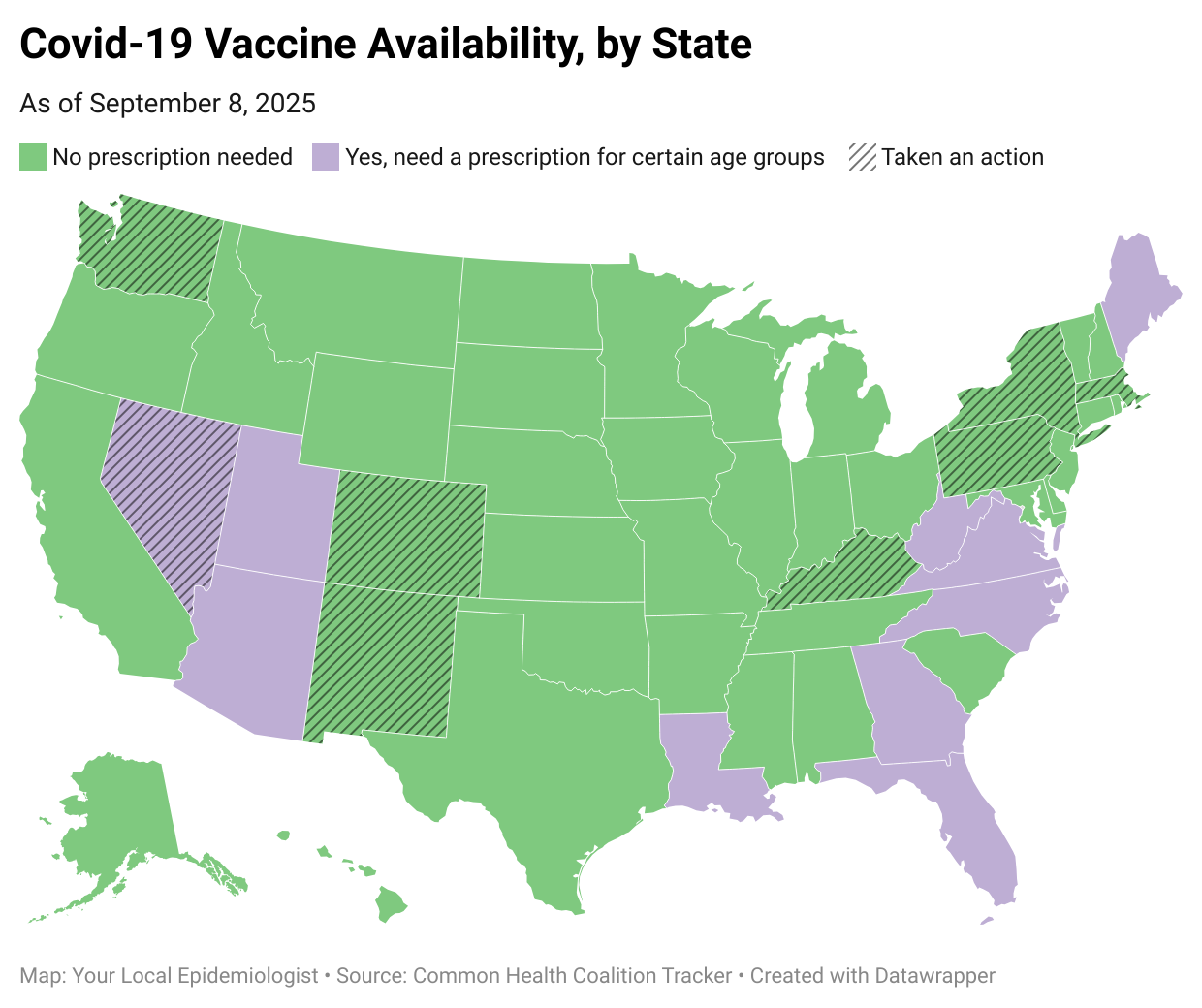
"What’s next? If ACIP votes to recommend broad Covid-19 vaccine use next week, many access barriers could lift for on-label patients (purple states above), though off-label access (not shown) would still depend on state action. If ACIP restricts use—or recommends against it—confusion and inequities will deepen.
"Even “business as usual” states like California are preparing for downstream challenges, especially with insurance coverage. If you’re in CA or NY, follow our state-level newsletters for updates. Matt (CA) and Marisa (NY) are really staying on top of the local context.
Florida’s school vaccine requirements: More than shots at stake
"Florida is set to become the first state to end school immunization requirements. The timing and process remain unclear, but the implications are not.
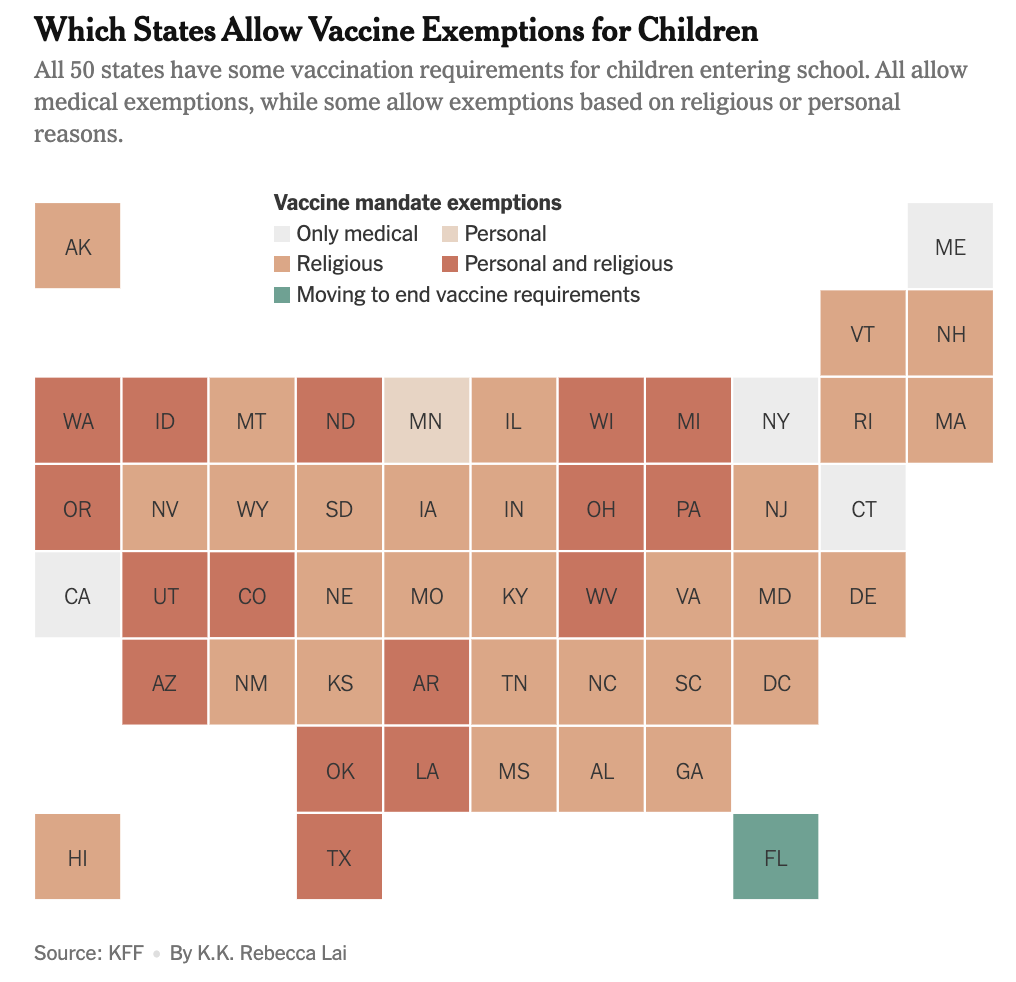
"For decades, every state required vaccines for school entry because requirements increase vaccination rates, prevent outbreaks, and keep classrooms open. Even today, support is high, including in Florida. Data from last month shows:
81% of Americans support school immunization requirements for diseases like measles, mumps, and rubella (MMR) and polio, with some medical and religious exemptions.
In Florida, 82% say public schools should require these vaccines.
"This means that Florida’s move doesn’t reflect parents’ opinions; it reflects politics.
"When Florida drops school entry requirements, vaccination rates will fall—and the ripple effects go far beyond vaccines. These requirements get kids into pediatricians’ offices. Many families delay care until it becomes necessary, and kindergarten is a well-documented trigger: epidemiologists consistently see a sharp spike in vaccine uptake at age five. Without this nudge, many children—whether due to parental hesitancy, barriers, or busy lives—would remain undervaccinated.
"The broader health impacts are just as serious. Pediatric visits tied to vaccines are often when doctors:
Screen for developmental delays
Catch undiagnosed asthma, anemia, or vision/hearing problems
Connect families to services like nutrition counseling or lead testing
Detect child abuse or neglect, often for the first time
"Without school requirements, fewer children will receive needed medical care.
"What this means for you: Vaccination rates in Florida will likely decline. If your child is up to date, they are very well protected. Long-term protection depends on the vaccine and disease: measles shots last a lifetime, while whooping cough protection fades more quickly, for example.
Grandparents take the mic.
"Think Moms Against Drunk Driving, but for polio and measles. A new grassroots group of grandparents just launched to protect kids’ vaccine access. They’re driven by lived experience—remembering when these diseases ran rampant—and are elevating their stories.
"Fueled by personal experiences, they are asking for support and stories. Learn more and join them here!
Food Safety: Fewer eyes on the plate
"On July 1—unbeknownst to the public—the CDC scaled down its Foodborne Disease Active Surveillance Network (FoodNet), which actively monitors foodborne illness in 10 states.
FoodNet reduced the pathogens it tracks from eight to just two: Salmonella and Shiga-toxin producing E. coli (STEC).
Infections from other common pathogens, like Campylobacter and Listeria, are no longer tracked.
"The CDC maintains that individual states and other programs like the National Notifiable Diseases Surveillance System and the Listeria Initiative can still monitor these pathogens, and that the cut lets them “prioritize core activities.” Food safety experts, on the other hand, warn that unlike FoodNet’s active surveillance, those other surveillance programs are passive—they rely on states to report cases.
"Bottom line: The cuts may slow outbreak detection and response, and make it harder for the CDC to see the full picture of food safety trends at the national level. Check state-level resources to learn of outbreaks and foods to steer clear of.
Question grab bag
“My almost 5 year old really wants to go to Disney World and we promised her a trip this January. Then FL decided to do away with vaccine mandates. Thoughts on keeping the trip? Maybe it won’t have much effect come January [or] maybe Disney will require vaccine cards? She’s fully vaccinated btw.”
"You should definitely still keep your trip. It’s not clear when this will go into effect, and it will take a while for vaccine coverage to decline. The calculus may change if outbreaks emerge, but right now your fully vaccinated child is well protected. Have fun!
“What should be the time period between Covid vaccinations? We had the last one in mid- May. Both of us are over 65.”
"About six months. In your case, that works out perfectly—your next dose will be due in November, likely right before the winter wave picks up. That’s ideal timing.
In case fall leaves make you as happy as me…
"The 2025 Fall Foliage Prediction Map is here! September kicks off leaf-chasing season. I hope you’re able to sneak away to take a look this fall. I’ll be living leaf season vicariously from San Diego.

Bottom line
"That’s your update for the week: Covid-19 vaccines tied in legal knots, Florida testing “freedom” against measles, CDC slimming down food safety, and grandparents stepping up. And one thing that is right on track: fall leaves.
"Love, YLE"





.jpg)
No comments:
Post a Comment