"Five years ago, on March 11, 2020, the World Health Organization
declared COVID-19 a pandemic. Whether it still is depends on who you
ask. There are no clear criteria to mark the end of a pandemic, and the
virus that causes the disease — SARS-CoV-2 — continues evolving and
infecting people worldwide.
“Whether the pandemic ended or not is an intellectual debate,” says
clinical epidemiologist and long COVID researcher Ziyad Al-Aly of
Washington University in St. Louis. “For the family that lost a loved
one a week ago in the ICU, that threat is real. That pain is real. That
loss is real.”
"Dropping death and hospitalization rates, largely due to vaccinations and high levels of immunity, led to WHO and the United States
ending their COVID-19 public health emergencies in 2023. The U.S.
government has since reduced reporting of infections and access to free
vaccines, tests and treatments. In the last two years, health
professionals, scientists and policymakers have shifted to managing
COVID-19 as an endemic disease, one that’s always present and may surge at certain times of the year.
"Over the last five years, researchers have learned heaps about the
virus and how to thwart it. But the pandemic also provided insights into
health inequities, flaws in health care systems and the power of collaboration. But it’s hard to predict how the United States and other countries will manage COVID-19 going forward, let alone future pandemics.
"To get a sense of scientists’ current understanding of COVID-19 and what’s at stake, Science News
spoke with Al-Aly, infectious disease physician Peter Chin-Hong of the
University of California, San Francisco Health, and epidemiologist Bill
Hanage of the Harvard T.H. Chan School of Public Health in Boston. The
conversations have been edited for length and clarity.
What have scientists learned about COVID-19 since the pandemic began?
"Al-Aly: We learned it’s an airborne virus. We
learned that, unfortunately, it was [and still can be] fatal. More than 1
million Americans lost their lives. We also learned that it resulted in
a wave of chronic disease and disability. There are now more than 20
million Americans living with long COVID.
"Chin-Hong: We’ve learned the genetic sequence of COVID. We’ve developed vaccines, including mRNA vaccines that hadn’t been used on a wide scale
before. We’ve developed tests, particularly tests at home, which hadn’t
been the favorite strategy of the U.S. Food and Drug Administration
before this pandemic.
"Hanage: We’ve learned that a virus can transform itself, such that you get waves of infections like the omicron wave.
We also had a lesson that the folk evolutionary biology saying,
“viruses don’t want to kill you, they will evolve to become nicer over
time,” is false. The alpha variant was somewhat more dangerous than the
original strain, and the delta variant was somewhat more dangerous than
the alpha variant.
"We suspected quite early on that, given many people could be shedding
virus without very severe symptoms, this was likely to be [something
that spreads] like wildfire before anybody knew they were sick. The
things that are most societally damaging are … the ones that people
don’t notice until tens of thousands are infected.
How is COVID-19 being monitored now in the United States?
"Hanage: There’s still reasonably active genomic
surveillance, trying to figure out whether the virus is going to make
another of those leaps and which leap is going to herald an unusually
large surge of infections.
"Chin-Hong: What’s actively monitoring [COVID-19
infections] is wastewater. We can’t tell what number of individuals [in a
community are infected, but] we know what variants are circulating.
"Deaths and hospitalizations are still being monitored, although hospitals aren’t obligated to report data centrally anymore.
What do we know about long COVID-19 at this point?
"Al-Aly: It affects at least 400 million lives across the globe. We recently estimated the economic losses to be about $1 trillion per year. That’s about 1 percent of global productivity.
"Long COVID can affect nearly every organ system. People think about
it [as causing] brain frog and fatigue. Those can be symptoms of long
COVID, but it’s much more than that. We have people with heart problems,
kidney problems and metabolic problems. In some individuals, long COVID
can be mild and not disabling. But in others, it can be severely
disabling, to the point of people being in bed and losing their jobs.
"Unfortunately, we haven’t really cracked the code for treating long
COVID. There are still no established treatments approved by the FDA.
How has COVID-19 management changed now that the virus is considered endemic?
"Chin-Hong: I think the biggest shift is thinking
about respiratory viruses together, because they do travel as a pack.
Many of them appear in similar ways and at similar times of the year.
But they are also prevented in similar ways, for example, by wearing a
mask or getting a vaccine.
"There is some danger in forgetting about COVID, specifically. It’s
still causing a significant number of deaths, although much lower than
early in the pandemic.
"Hanage: [Ending the public health emergency] has led
to shifts in funding. The funds that people were expecting to have, in
some cases, have been withdrawn or become more uncertain. That happened
during the Biden administration, and it’s going to become even more
[uncertain] under the current one.
"Researchers are looking at longer-term questions. We still have quite
a lot to learn about the ways in which SARS-CoV-2 interacts with the
immune system, different cells and so on. They matter for devising
things like potential treatments for long COVID or antivirals.
The United States is withdrawing from the World Health Organization. How might that affect COVID-19 management?
"Chin-Hong: Number one is resources. The WHO is
funded by many countries, but the United States provides the lion’s
share, so the withdrawal will limit the management of world health in
general. Number two is siloing — you can’t see the whole picture [of
global health]. The third is the appearance that the United States is
not part of a global network.
Are we any better prepared for potential future pandemics?
"Chin-Hong: I think we’re prepared in some ways and
not prepared in others. The ways that we’re prepared are really in
bringing technology from the bench to the bedside.
"Some of the biggest threats are people being fatigued with COVID [news] and the amount of misinformation and disinformation.
"Al-Aly: No, I think it’s the reverse. We’re even
more ill-prepared and in a worse situation because we politicized COVID:
vaccines, treatments, masks. We politicized every single pandemic
response.
"If a pandemic breaks out in March 2025, I predict that vaccine uptake
would be way less than it was for COVID-19, and there would be less
enthusiasm for masking and a lot of the public health measures that
protected millions of people in the U.S.
Does anything that’s happened during this pandemic give you hope for the future?
"Al-Aly: Operation Warp Speed was a human feat. We as
a community of scientists, under the leadership of President Trump,
marshalled resources and realized vaccine development in record speed.
"Scientists across the globe dropped everything they were doing and
said, “Okay, we’re going to focus on long COVID.” There’s no other
condition that, within the span of five years, we have this many
academic publications — about 40,000 and counting.
"Then, really the patient community that led the way.
Patients with long COVID helped us understand that long COVID is
happening, alerted the medical community and guided us in every step of
the way in understanding long COVID.
"Hanage: We saved lives not only by vaccination, but
by the people who voluntarily limited their contacts, were caring enough
to stay home if they felt sick, [and did] not prioritize themselves
over the risks to the people they lived alongside."
Good
morning! Hope you had an easier time adjusting to the time change than I
did—toddlers don’t exactly respect daylight saving time.
Here is your week’s public health news you can use.
Measles marches on, facing two major challenges
The measles outbreak in West Texas is growing.
This
is the most contagious virus, making any public health response
resource-heavy. But two obstacles are making this outbreak particularly
challenging:
1. The true number of cases is unclear
The official count is 228 cases across 10 counties.
(Note: New Mexico’s measles outbreak—30 cases, 1 death—is now
genetically linked to Texas, meaning these two outbreaks are one, so I
will combine them from here on out.)
It’s
very hard to say whether we are at the beginning or middle of the
outbreak, mostly because I don’t trust the numbers. Several signs
suggest substantial underreporting:
Death ratio. We’ve
seen two deaths so far, yet only 228 cases have been reported. Measles
typically kills 1 in 1,000 unvaccinated individuals. They were either
extremely unlucky, or there are more cases than reported.
Very sick hospitalized patients.
By the time these hospitalized children get to the hospital, they are
very sick, meaning parents may be delaying care. The second measles
fatality (which was an unvaccinated adult) never even went to the
hospital.
Epidemiologists are encountering resistance to case investigations.
We don’t just have a murky numerator (case count)—we also have a murky denominator (population size). The community at the center of this outbreak is likely far larger than official U.S. Census figures suggest.
I
wager the “true” count is much higher than reported. A CDC response
team is now on the ground, working directly with local and state
epidemiologists to help get this under control.
Local picture sent to YLE on March 9, 2025.
2. First taste of RFK Jr. and falsehoods
When
an unfamiliar epidemiologist with a clipboard parachutes into a
community, their impact is often limited because trust takes time to
build. Effective outbreak response depends on local
partnership—especially with trusted messengers. But in West Texas, some
of the most trusted voices are actively working against public health:
Some local physicians are pushing unproven treatments—like budesonide, vitamin A, and cod liver oil—as substitutes for vaccination. Bulk shipments of these false remedies are being flown in.
Some pastors are celebrating low vaccination rates, including T-shirts bragging about being the “least vaccinated county.”
Messages are making their way into Secretary Kennedy’s talking points, including a Fox News segment, a recent op-ed, and his anti-vaccine nonprofit, Children’s Health Defense.
Falsehoods
aren’t just a nuisance—they have real consequences. People may
experience short-term symptom relief that masks a severe infection,
delaying life-saving care. This has already happened at least once in
this outbreak. There’s also growing concern about them poisoning
themselves due to overdosing on vitamin A.
What does this measles outbreak mean to you?
There are a few things to do if you’re in the hot zone, like children
as young as 6 months old getting vaccinated and paying attention to
exposures. If you’re traveling here for spring break, I would reassess,
especially if you have an unvaccinated or immunocompromised family
member.
Your national disease report: Illnesses are nosediving
Good
news: we’re getting a break from “influenza-like illnesses” (fever,
cough, sore throat), which continue to nosedive—typical as the weather
warms up and we head into the spring months.
Influenza-like illness levels; Source: CDC; Annotated by YLE
What does this mean to you? Flu is still around, but the worst of the season is behind us. If you haven’t gotten your flu shot yet, it’s probably not worth getting at this point. Chat with your doctor.
Other virus activity in the past week
There
are more measles cases from international travel, and H5N1 keeps
showing its teeth, as more backyard flocks and housecats are infected.
Due to an infected cat, we also have a rabies alert in Volusia County,
Florida.
Figure by YLE
What does this mean to you?
For rabies prevention, avoid physical contact with wild animals. Here are the high risk locations for Floridians.
For H5N1, the advice for backyard folks and cat owners stays the same. For cat owners, ensure your cat drinks no raw milk and limits exposure to wild animals and birds.
Opioid deaths drop 24% and data challenges loom
New
CDC data shows opioid overdose deaths have dropped to 87,000
annually—the lowest since 2020. The drop is due to a return to normal
for substance use prevention and treatment services that were stalled
during the pandemic. There’s also been marked improvement in access to
substance use treatment and naloxone. Naloxone (name brand Narcan) is a
life-saving medication that can reverse an overdose.
Data continuity is key to tracking progress. The new administration recently called
for more data for another goal: to keep Canada and Mexico tariffs at
bay. In February, the administration agreed to delay tariffs on those
countries when they confirmed they’d help prevent fentanyl from entering
the U.S. However, tracking this in real time is a big data challenge
for a few reasons:
Overdose deaths are already declining, making it hard to measure policy impact. Fewer deaths doesn’t necessarily mean less fentanyl; it could just mean better treatment and response.
No real-time fentanyl death data exists—current numbers lag by months.
Fentanyl can enter the drug supply through many channels. (Canada plays virtually no role in the U.S. fentanyl influx, for example).
What does this mean to you?
Although decreasing, opioids are still the leading cause of death for
Americans aged 18-44. Narcan is available over the counter, carried by
EMS providers, and even stashed in vending machines in some places, like New York City.
Cervical precancer drops 80%
Data
on the effectiveness of the HPV vaccine against cancer is continuing to
pour in. The latest is from the Human Papillomavirus Vaccine Impact
Monitoring Project (HPV-IMPACT), which surveys people across the U.S.
From 2008-2022, cervical precancer rates dropped by a whopping 80%
among women aged 20-24. As a comparison point, precancers decreased by
37% in the 25-29 age group, who were more likely to contract HPV
pre-vaccination.
HPV vaccines are recommended as part of routine vaccination for all genders at age 11 or 12, with catch-up vaccination up through age 26 (but you can still receive the vaccine until age 45).
What does this mean to you? If you or your child haven’t gotten the HPV vaccine yet, ask your healthcare provider. It does not affect fertility, despite false rumors. Read more in the PDF below (see #11).
A new KFF poll
last week found that 80% of Americans oppose cuts to Medicaid. About
one-third of Republican voters supported cuts, and over half of all
respondents—especially in rural areas—said they or someone they know has
used Medicaid.
Medicaid programs go by different names in each state, making it tricky to
track how federal changes might affect your health care. For example,
“cutting Medicaid” is the same as “cutting PeachCare” in Georgia or
“cutting Healthy Connections” in South Carolina. Hover over the graph
below to see what Medicaid is called in your state.
Question grab bag
“Not another virus.What the heck is hantavirus?”
Betsy
Arakawa and Gene Hackman’s bizarre deaths have been all over the news.
Her cause of death is in: hantavirus infection. While this event is
tragic, it is not a major public health concern.
Hantavirus
infection in humans is extremely rare, and cases are concentrated in the
Western U.S. In 2024, there were only 15 reported cases in the U.S. The
virus is mainly carried by desert-dwelling mice or rats, and humans can
be infected by breathing in dust contaminated with their urine or
droppings.
Hantavirus is not spread between humans, so the key is
to avoid rodent contact, including cleaning areas with rodent activity.
Before sweeping or vacuuming, spray the urine or droppings with a
disinfectant solution, let them dry, and wear your trusty N95 mask.
How do people get hantavirus pulmonary syndrome (HPS)? Source: CDC
These are not "migrants". These are illegal alien criminals and murderers with extensive records who should not have been on our streets in the first place. Our Justice Department should try to reverse the 'sanctuary city' policies that prioritize criminals over law-abiding residents.
"Two murder suspects who allegedly killed a good Samaritan in Los
Angeles County while he was attempting to stop them from stealing his
neighbor’s catalytic converter were in the country illegally and have lengthy criminal records, Fox News has learned.
"Wilber Alberto Rabanales and Jose Christian Saravia Sanchez were
arrested by police in the Los Angeles suburb of Inglewood Thursday for
the Feb. 25 murder of Juan Miguel Sanchez.
"The incident was caught on surveillance video.
"Rabanales, a Guatemalan national, has been arrested at least 15 times
in the last few years in the county, predominantly on gun charges,
grand theft, burglary and drug charges, police sources told Fox News.
"He has multiple grand theft arrests, mostly for stealing catalytic converters,
and past charges for multiple DUIs, conspiracy, felon in possession of a
gun, possession of burglary tools, possession of meth, possession of
stolen property and felony hit-and-run during a police pursuit.
"Sanchez has been arrested at least a dozen times, mostly for grand
theft, gun charges, drugs, burglary, kidnapping, possession of meth and
possession of burglary tools, the sources said.
"Fox News Digital has reached out to U.S. Immigration and Customs Enforcement.
"The victim was shot in the chest after he confronted the suspects
while they were allegedly attempting to steal the catalytic converter,
FOX 11 reported."
These are neither "protesters" nor "activists". These are terrorists. Will any of them suffer any jail time, pay for the damages, or just get away with it?
"Trump Turnberry Resort in Scotland was the victim of
widespread vandalism on Friday by pro-Palestine activists, according to
reports from the Associated Press and the BBC.
"The
damage to the resort and the golf course was extensive, as seen in
photographs released by the Palestine Activist group that claimed
responsibility for the act of vandalism.
"The clubhouse was
spray-painted with red paint, at least one green was dug up and the
message “Gaza is not 4 sale” was spray-painted near another green.
"In a statement reported by the AP, the PA group said that it
“rejects Donald Trump’s treatment of Gaza as though it were his
property to dispose of as he likes… To make that clear, we have shown
him that his own property is not safe from acts of resistance.”
"Donald Trump’s company purchased the resort in 2014, and the resort has undergone significant renovations since then.
"The
course has not been awarded an Open Championship since Trump took over
the resort. And there are no plans to host future Opens, based on
comments from the R&A, which operates the Open.
"Late last year in an interview with Golf Channel,
former R&A CEO Martin Slumbers argued that the host course would be
a distraction from the competition. “Major championships should focus
purely on the golf course and the competitors battling upon it. We
cannot allow external media noise to overshadow what remains the
original and most historic championship in golf. The tournament’s
integrity demands that golf alone commands the spotlight.”
"The R&A’s new CEO, Mark Darbon, added a second reason Trump Turnberry is unlikely to host another Open in an interview with The Telegraph: logistics and money.
“That’s
crucial for us, because through the Open, we generate most of our
revenue and we use that to invest in the rest of the game all around the
world. So the reality is that modern-day Open requires a venue that can
support us logistically and commercially,” Darbon said."
The anti-vaxxers are so desperate to prove that vaccines are more harmful than their diseases that they will gladly twist every bit of news they see. Here's a case in point, from Salon:
"The COVID-19 pandemic is in the rearview mirror for many people, despite the fact that the virus still kills hundreds every week and could surge again if another mutated strain comes along,
as witnessed multiple times in the last five years. Still, infections
are at relative lows lately thanks in part to acquired immunity from
infections and vaccines. Indeed, record-breaking vaccine development
played a big role in keeping the SARS-CoV-2 virus at bay.
"Vaccine
skeptics have long-since leveraged the rapid roll out of mRNA vaccines
to add fuel to heated arguments surrounding vaccine safety. As a result,
a growing share of the public is wary of getting vaccinated with both
mRNA and other kinds of vaccines. Yet, despite the fact that their
developmental process has been unfolding over decades and these vaccines
were subject to the same safety standards
as others, political figures continue to push forward unvalidated
research to take aim at mRNA vaccines, with serious health consequences.
"Last month, researchers from Yale University published a study,
which has yet to be peer-reviewed, on the preprint server medRx, which
rapidly circulated online among vaccine skeptics. The study said a small
group of patients reported lingering symptoms similar to long COVID
— including brain fog, fatigue, tinnitus and sleep issues — after
receiving the Pfizer or Moderna mRNA COVID vaccine. (Four patients also
received the Johnson & Johnson
COVID vaccine which does not use mRNA.) It was quickly circulated
online and used to support anti-vaccine conspiracies and misinformation.
"But
experts urged caution when interpreting these results before the study
can be verified and peer-reviewed. For one, the study used a small
sample size, with only 42 people (and 22 healthy control subjects)
self-identifying their symptoms, explained Dr. E. John Wherry,
the director of the Institute for Immunology and Immune Health at the
University of Pennsylvania, who was not involved in the research.
“When
you do studies where you are comparing one cohort to another, there
needs to be some rigorous criteria for who is included in a cohort,”
Wherry told Salon in a phone interview. “From what I can tell, this is
self-identified and it is unclear what exactly that means.”
"Because it is a preprint study that has not been peer-reviewed, the authors acknowledged in a press release that their findings needed to be validated. One author told STAT News
that the data is not “ready to be used in clinical decision-making.”
The corresponding authors of the paper did not respond to Salon's
requests for comment.
“This study is
early-stage and requires replication and validation,” they wrote in the
paper. “We emphasize the critical task of discerning between meaningful
results and random fluctuations in the data.”
"Sometimes,
reported side effects from medical interventions do turn out to be
statistical noise. During the 2009 H1N1 pandemic, for example, early
research showed
the risk of miscarriage seemed to be elevated among pregnant women who
got the vaccine two consecutive years in a row. This was captured in
safety surveillance data and further examined by other research from the
Centers for Disease Control and Prevention (CDC), which found the
signal in the earlier studies to be a false alarm.
"On
the other hand, other safety signals that appear have led to the
removal of certain vaccines from markets. For example, the first
rotavirus vaccine was withdrawn
in 1999 when researchers detected an increased risk of intussusception,
a rare type of bowel obstruction, for children who received the
vaccine.
"Any
medical intervention carries the risk of side effects and vaccines,
just like common medications like acetaminophen or aspirin, can
sometimes harm people, said Dr. John Moore, a microbiology and
immunology professor at Cornell University, who was not involved in the
study. Some side effects from the COVID vaccine, like menstrual cycle changes and cardiac issues like myocarditis,
have been reported in a small proportion of the population receiving
shots. But it is important to weigh these risks with the protective
benefits the vaccine provides as well — after all, viruses cause harm
too.
“There is a generally acknowledged myocarditis side effect to the mRNA
vaccines, predominantly in young men, and it's invariably in the States
been non-fatal,” Moore told Salon in a phone interview. “No one disputes
that, but COVID-19 infections cause far more significant and far more
prevalent cases of myocarditis and pericarditis.”
"Sources emphasized how
important it is for doctors and researchers to be guided by patient
experience and to explore any potential symptoms that patients report
after a COVID-19 vaccine. After all, many patients with long COVID, Lyme
disease, and myalgic encephalomyelitis/chronic fatigue syndrome (ME/CFS), among other chronic disease conditions, have fought for recognition within a medical system notorious for dismissing or ignoring their experience.
"Yet
as it stands, “post-vaccination syndrome” — which the authors use to
describe the symptoms reported by patients in this preprint study — is
not an official diagnosis that has been recognized by medical
authorities. Overall, COVID vaccines, including those that employ mRNA,
are considered extremely safe.
“When
you start analyzing tens of millions of vaccinations for COVID-19, you
start to see side effects that pop up at the level of one in a million,”
Moore said. “You have to balance that against, per some estimates,
between hundreds of thousands and millions of people whose lives were
saved in the United States alone by COVID-19 vaccination.”
"Still, studies like
this fall into precarious circumstances, where researchers often find
themselves stuck between a rock and a hard place of trying to follow the
data and not fuel a growing mistrust in the medical system. It is a
task increasingly difficult to accomplish with political leaders like
the secretary of the Department of Health & Human Services Robert F.
Kennedy Jr., a known vaccine critic, encouraging vaccine skepticism.
"This preprint study recently exploded on social media, where it was shared by Joe Rogan,Alex Berenson and Elon Musk.
Two of the authors, described as independent researchers in this paper,
are involved with a vaccine injury advocacy nonprofit called React19. One co-author is also suing AstraZeneca over symptoms she experienced after being vaccinated.
"As
Dr. Adam Gaffney, an assistant professor at Harvard Medical School and a
pulmonary and critical care physician at the Cambridge Health Alliance
wrote in a STAT News
editorial, some of the co-authors seem to be motivated by a genuine
desire to “give a voice to a community of patients who are experiencing
real suffering.” Yet there are still too many unanswered questions to
draw any conclusions about the study.
“[A]
closer look at the basic approach and assumptions undergirding this
research, the inclusion of vaccine critics among the co-authors, and the
‘patient-led’ paradigm from which it emerged all shed serious doubt on
the study’s conclusions,” Gaffney wrote. “In this age of surging
anti-vaccine and anti-science sentiment, harm will likely follow.”
"The Center for Disease Control (CDC) is
questioning decades of research determining that vaccines do not play a
role in autism and is instead launching a large-scale study on the
alleged connection, Reuters reported.
"The U.S. Health Secretary Robert F. Kennedy Jr. has long claimed that autism causes vaccines, a theory popularized by a discredited doctor and later retracted from The Lancet.
"Although it is unclear if Kennedy is leading the study, Trump addressed
Congress this week and said the administration is looking into the rise
of autism in children and “there’s nobody better than Bobby.”
"Kennedy has some authority over the CDC and has
frequently maintained his stance on the supposed connection. Although he
has denied being anti-vaccine, he has often repeated debunked theories
on vaccines and claimed that the U.S. lacked vaccine safety monitoring.
"He’s
also expressed hesitation on the effectiveness of the measles, mumps,
and rubella (MMR) vaccine. His doubts have spread at a time where the
United States population faces its largest measles outbreak in the past
decade.
"Measles vaccines can effectively
prevent the disease, which can cause fever, pneumonia, and even death.
More and more cases are popping up in Texas and New Mexico because
families are refusing to vaccinate their children.
"Kennedy dismissed the news that a child died in
Texas of measles and called the outbreak typical. He has continuously
told parents that vaccines are a personal choice.
"While
Kennedy has denied on several occasions that he is anti-vaccination,
his beliefs have been called into question by other U.S. government
representatives and doctors across the country. Even Republican Sen.
Bill Cassidy urged him to admit there was no connection between vaccines
and autism—but he didn’t.
"He’s also ignored the scientific consensus that COVID vaccines saved American lives.
"It is true that autism diagnoses have increased
since the early 2000s. Most researchers agree this is due to more
accessible, widespread screening and doctors broadening the diagnosis
criteria after learning about new common behaviors. Peer-reviewed and
expert-led studies over the past several decades have reached the same
conclusion: vaccines do not cause autism. However, the official cause is
still unclear.
"Still, Trump told congress
that “not long ago, and you can’t even believe these numbers, one in
10,000 children have autism. One in 10,000. And now it’s one in 36.
There’s something wrong.”
"It is correct that
one in 36 children are diagnosed with autism. But it stood at one in 150
over two and half decades ago—not one in 10,000.
"Several
negative stereotypes about autism have left parents afraid of the
disorder. But autistic people have long sought to contradict stigmas and
remind the world that autism does not make them lesser.
"The Daily Beast has reached out to the CDC and Kennedy."
Excellent news. It's a relief to see an administration that finally stands up for Jews and for Israel! Hate-filled propagandists like the ones below need to get off our college campuses and be blacklisted from good jobs.
In 1938 Nazi Germany, Jews were expelled from all universities. In 2025 America, anti-Jewish "students" like these should be expelled.
"FIRST ON FOX: The Trump
administration announced on Friday that it will rescind more than $400
million in federal grants to Columbia University, citing concerns over
rising antisemitism on campus and the school's failure to address it.
"Earlier
this week, the Departments of Health and Human Services (HHS),
Education (DoED) and the U.S. General Services Administration (GSA)
announced the initiation of a "comprehensive review"
of more than $5 billion in federal grant money that goes to Columbia,
"in light of ongoing investigations for potential violations of Title VI
of the Civil Rights Act" related to antisemitism on campus.
"It
has only been four days since the Trump administration's announcement of
this review, but the agencies have already begun slashing funds.
Sources familiar with the matter, who asked to remain anonymous, say
that more than $400 million in federal grant funds from HHS and DoED
will be rescinded from Columbia as a result of the antisemitism that is allegedly continuing on campus."
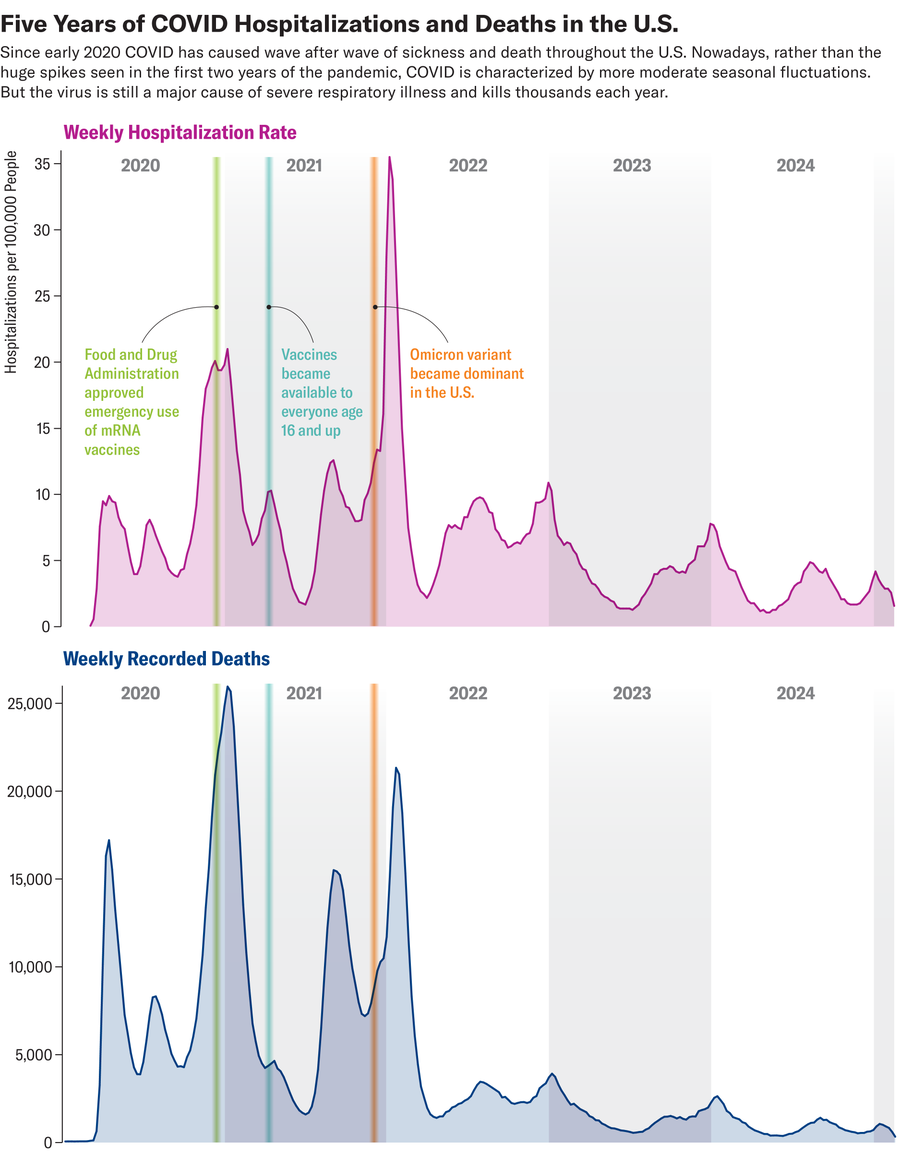
Here's an excellent COVID retrospective from Scientific American 3/5/25 that should be required reading. Of course, hindsight is 20/20, and it's easy to say now what we should have done then. But in 2020, we were fighting a fatal new disease completely from scratch, and everyone did the best they could under impossible circumstances.
-------------
On COVID’s Fifth Anniversary, Scientists Reflect on Mistakes and Successes
Public health experts discuss lessons learned from the U.S. response to the COVID pandemic, on topics ranging from school closures to trust in science
By Tanya Lewis edited by Dean Visser
Five years ago next Tuesday, the World Health Organization declared a global pandemic
involving a dangerous new virus—and across the planet, life as we knew
it ground to a shuddering halt. But the COVID emergency started well
before that. Rewind to late December 2019: hospitals in Wuhan, China,
were filling up with cases of a mysterious pneumonia.
By January 2020, as the body count started to mount and Wuhan was
locked down, other countries began reporting cases. The virus spread
like an invisible airborne poison through a cruise ship quarantined off the coast of Japan. Italy became a hotspot of infection. One by one, countries and U.S. states issued stay-at-home orders, and major cities went eerily quiet. Within weeks, New York City hospitals filled up with desperately ill people. The dead piled up so quickly that refrigerated trucks were used as temporary morgues.
Today these events may feel like a distant nightmare for many people.
This is not the case for those who lost loved ones or for health care
workers who treated people when hospitals were overwhelmed. They will
never forget. Still, by most measures, COVID feels nowhere near the dire
threat it was in those first few years. People in the U.S. are not
being hospitalized and dying of the illness at
anywhere close to the rates that occurred in previous years. Experts
have varying definitions of what it means for a virus to become endemic, but they agree that the COVID-causing virus SARS-CoV-2 is closer to that state now than it was in the past several years.
“It
is not at the level of an emergency that it once was,” says Jennifer
Nuzzo, a professor of epidemiology and director of the Pandemic Center
at the Brown University School of Public Health. But she cautions
against making assurances. “We’re still not very good at predicting what
COVID-19 is going to do,” Nuzzo says.
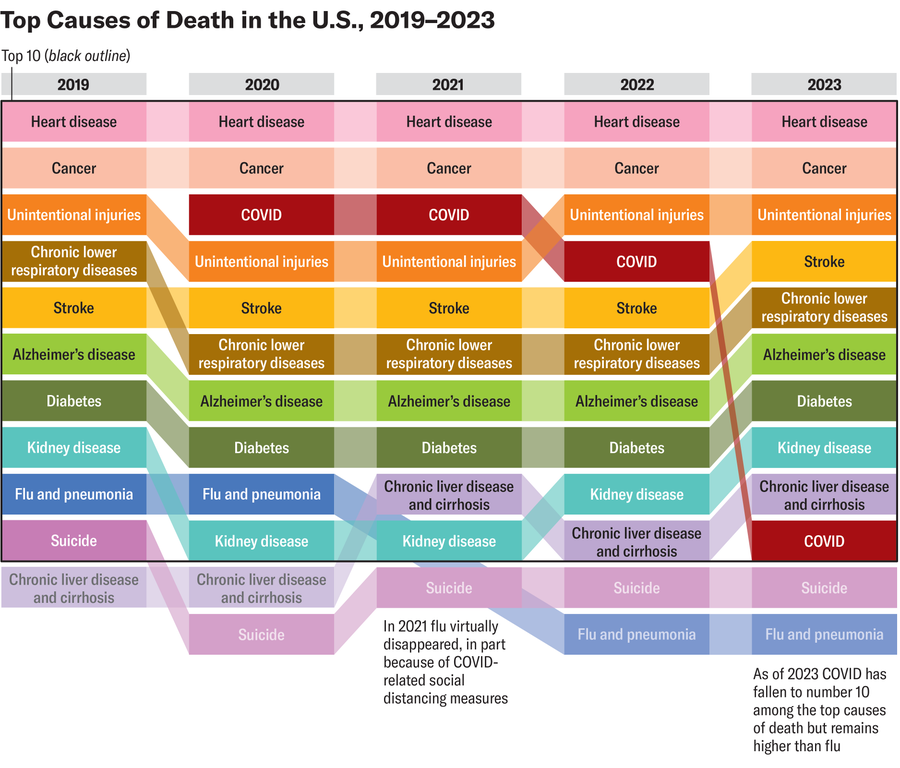
Amanda Montañez; Source: Centers for Disease Control and Prevention
A Disease That Is Milder but Not Gone
Experts
agree that the biggest reason COVID is now causing less death and
severe disease is a high level of immunity to SARS-CoV-2. Most of the
world’s people have had the disease or been vaccinated against it, or
both. Studies estimate the COVID vaccines have saved millions of lives. And in contrast with early 2020, effective treatments—antivirals, including Paxlovid, and common steroid drugs—are now available.
"This winter there's been a lot
of respiratory disease, but relatively little of it has been COVID. And
there’s been a continuing trend downward in terms of the total amounts
of severe illness and death,” says William Hanage, an associate
professor of epidemiology at the Harvard T. H. Chan School of Public
Health. Scientists don’t know whether that downward trend will continue,
though. “COVID is with us for the long run, as it always was going to
be,” Hanage says. “It’s been getting better, but it’s still worth trying
to make sure that you don’t transmit it to people who are vulnerable.”
“It’s been a pretty difficult five years for everyone, for the whole
world,” says Maria Van Kerkhove, technical lead for COVID response at
the World Health Organization. “I think the whole world wants to forget
that it happened and move on, which is completely understandable,
because we’ve gone through something that has been tremendously
difficult,” she says. But “I think we need to make it very clear that
COVID is not gone.”
Millions of people had or suffer from long COVID—a catchall phrase describing postviral symptoms that range from mild to debilitating. Scientists have begun studying the causes of long COVID. Evidence suggests vaccines reduce the risk of developing the condition, but treatments remain elusive.
With
the worst of COVID seemingly in the rear-view mirror, however, we can
finally take stock of what happened and try to make sense of the U.S.’s
response.
Successes, Failures and Hard-Earned Lessons
In the early days of the pandemic, scientists and public health experts had to react in real time to a brand-new pathogen—and mistakes were certainly made.
U.S. officials botched the initial COVID testing strategy, for example.
At first, all tests had to be run through the Centers for Disease
Control and Prevention, which created a serious bottleneck. Exacerbating
this, the CDC’s test itself turned out to be flawed, making results
inconclusive. In future pandemics, testing should be made available much
more quickly and widely via the private sector, experts say.
Additionally, public health
officials both at the WHO and in the U.S. government were slow to
acknowledge that SARS-CoV-2 could spread through tiny airborne
particles, or aerosols. Some experts actively warned the public not
to wear face masks, arguing either that they were ineffective or that
health care providers needed them and should be prioritized amid the
initially short supply.
“I
think the challenge was the use, specifically, of that word ‘airborne,’
which did have a technical meaning. It took three years to change the
terminology related to airborne transmission, and we now say ‘through
the air,’” Van Kerkhove says. But she pushes back on the narrative that
the WHO didn’t acknowledge the virus’s potential to spread this way. “We
had always recommended airborne precautions. In the beginning, it was
particular settings, and it was related to health care workers. But then
that expanded to other settings” such as gyms and churches, she says.
Still, she acknowledges that the messaging could have been clearer.
In those first few days and
weeks of uncertainty, as terrifying news about the virus emerged from
around the world, by and large, Americans—with some exceptions—initially
banded together against a common threat. Gatherings were limited or
canceled. Those who could do so stayed home from work or school to help
“flatten the curve” of transmission. The goal was to slow the numbers of
people getting infected with COVID and becoming severely ill to avoid
burdening already overwhelmed hospitals. And in fact, research showed
that flattening the curve actually worked. The problem, experts say, is that there was no exit strategy.
“The
whole idea of flattening the curve was like a pause button: measures
you could employ to buy time to prevent hospitals from becoming
overwhelmed, such that you could protect them for six months” or until
we had a vaccine, Nuzzo says. But there was no clear end point. “We
didn’t have the next phase lined up.”
Hanage agrees that the U.S. could have been smarter with stay-at-home
orders. “I also think that we really missed an opportunity in, roughly,
the summer of 2020, because by that point in the United States, the
initial surges had sort of been brought under control,” he says.
Perhaps no aspect of the U.S.
pandemic response has been as fiercely debated as school closures. “The
issue of schools and disease is such a political third rail right now
that nobody wants to even talk about what, if anything, we should do to
protect kids in schools,” says Nuzzo, who wrote a March 2020 op-ed arguing against closing schools.
These
closures made some sense in the pandemic’s earliest days and weeks,
when the virus’s impacts were still unknown and we lacked even basic
treatments, let alone vaccines. Yet many people expressed outrage at how
long they went on—or questioned whether they were necessary at all.
Some argued that the virus caused milder infections in children; this
was generally true, though not in all cases. But protecting kids was not
the only point of closing schools; it was also meant to stop chains of
transmission to vulnerable adults such as teachers, staff and adult
family members.
As time wore on, however, the mental health and social costs of keeping
kids home and doing online schooling began to mount. Lengthy, blanket
closures could have been replaced by more sustainable interventions such
as masking and improving air quality through better ventilation systems.
As
time wore on, however, the mental health and social costs of keeping
kids home and doing online schooling began to mount. Lengthy, blanket
closures could have been replaced by more sustainable interventions such
as masking and improving air quality through better ventilation systems.
“I
think what really was unfortunate is that the messaging from public
health often wasn’t clear, or it was much more definitive than it should
have been,” says Michael Osterholm, chair of public health and director
of the Center for Infectious Disease Research and Policy at the
University of Minnesota. “Then something happened that negated what we
previously said, and it made people challenge how honest we were
being—when, in fact, it was never about dishonesty. It was about trying
to communicate uncertainty, and that was a real problem.”
Despite
these challenges, there were some undeniable triumphs in the scientific
response to the pandemic. Within 11 months of the virus being
genetically sequenced, the U.S. had developed two mRNA vaccines that
prevented severe disease and death extremely effectively. These were the
fastest vaccines ever made, says Paul Offit, an attending physician in
the Division of Infectious Diseases at Children’s Hospital of
Philadelphia. “To me, the hero of this pandemic is the National
Institutes of Health,” whose scientists laid much of the groundwork for
the remarkably effective mRNA vaccines, he says. “And then what the
Trump administration did was Operation Warp Speed, an $11-billion
commitment to basically bet on six horses to win one race, and that was
an amazing production of funding.”
But “vaccines do absolutely nothing when they’re sitting there in a
vial,” Hanage notes. “They actually need to be in arms.” Unfortunately,
vaccines—like many aspects of the pandemic—became politicized amid a
steady barrage of blatant lies and misinformation from President Donald
Trump and many of his supporters, and a small but vocal part of the
population refused to get them. In many areas, people who wore a mask
were mocked or berated, and some were physically assaulted. As a result, people in Republican-dominated states and counties died at higher rates than people in Democratic-dominated ones.
The divide highlights just how
polarizing the COVID response was. A recent Pew survey found that nearly
three in four U.S. adults say the pandemic did more to drive the country apart
than to bring it together. Americans have always been individualistic,
and many people did not take kindly to being told to wear a mask or get
vaccinated—even when such recommendations were aimed at protecting
others. The concept of this kind of collective altruism is hard to
communicate, and public health messaging often fell short.
“I
think the worst possible situation that you can have, when you’re in
the middle or the beginning of an evolving pandemic, is the profound
degree of divisiveness that we have had and still have in our country,”
said Anthony Fauci, the famous doctor and former head of the National Institute of Allergy and Infectious Diseases, in an interview with Scientific American
last year. “It’s like being at war. The common enemy is the virus. And
we were acting in many situations and in many respects as if the enemy
were each other.”
Indeed, Fauci—widely celebrated as a hero and “America’s doctor” early in the pandemic—was ultimately vilified
by Trump and many of his followers as the face of stay-at-home orders
and other social restrictions. Masking and proof-of-vaccination
requirements drew a strong backlash, and a few U.S. counties have since banned maskingin public (with some exceptions). Some states have banned COVID vaccine mandates.
Such bans may unfairly target disabled and immunocompromised people and
could leave the entire population more vulnerable to future disease
outbreaks.
One
thing is certain: the world will experience other pandemics, likely
within our lifetime. The most likely culprit would be some type of
influenza, as was the case in the 1918 pandemic.
In fact, the U.S. is already battling a steadily growing outbreak of H5N1 avian influenza, or bird flu,
which has been infecting wild birds, poultry and, as of March 2024,
dairy cattle. The virus is highly deadly to poultry, triggering massive
culls that have driven up the price of eggs.
Historically, H5N1 hasn’t been readily transmitted to humans. But in
the few outbreaks that have occurred among people, it has had a
staggering mortality rate of almost 50 percent. In the current outbreak affecting dairy cattle and poultry in the U.S., 70 human cases—most of them mild—and one death have been reported.
Experts have criticized the H5N1 response
among federal and state health agencies, warning that testing has been
insufficient and that infections are likely being missed. Dairy farms
have been reluctant to test for the virus over worries about losing
income, and farm workers—many of whom are undocumented—often fear losing
their jobs or being deported if they seek medical care. The election of
an intensely anti-immigrant president has only exacerbated these fears.
It's
far from certain that H5N1 will become a pandemic. The virus would need
to mutate to a form that spreads easily between humans, which
apparently hasn’t happened yet. But if and when we in the U.S. do face a
pandemic, regardless of what causes it, in some ways we may now
actually be worse equipped than we were when we faced COVID.
Right now I think we’re less
prepared for the next pandemic than we were in 2020,” Osterholm says.
“One of the most important weapons we have in a fight against [a
pandemic virus is trust in] public health recommendations. And I think
that, at this point, that’s a huge issue for the public, in terms of not
trusting vaccines.”
Current
threats to the institution of science itself are exacerbating the
problem. Trump has nominated some overtly antiscience and antivaccine
people—most notably Secretary of Health and Human Services Robert F. Kennedy, Jr.—to lead federal health agencies. He has made sweeping cuts to the CDC, the NIH and other science agencies. And in one of Trump’s first executive orders, he announced plans to withdraw the U.S. from the WHO.
“You have a public health infrastructure that is falling apart,” Offit
says. You have people that are heads of various agencies—like NIH or CDC
or [Food and Drug Administration] and now [the Department of Health and
Human Services]—that have disdain for those agencies, that don't trust
those agencies.”
Yet in other ways, we may be
slightly better prepared, Nuzzo adds. “People have lived through a
pandemic recently, and they remember it to some extent,” she says.
Unlike what happened with COVID, if an influenza pandemic were to hit
us, we would be able to use tests for the virus and some vaccines that
we have already stockpiled. “People generally understand influenza
disease. We’ve been studying H5 infections for 25 years, so we know a
bit about the virus and how it affects the body,” Nuzzo says. “That
said, there are going to be challenges.” [Editor’s Note: H5 is a subtype of bird flu that includes H5N1 and other viruses.]
The
WHO’s Van Kerkhove agrees we are more ready in some ways and less so in
others. “We are [better prepared] because we’ve all gone through this,
and what we learned at the beginning of COVID was: countries that had
the trauma and experience of these types of outbreaks—with SARS, with
MERS, with avian influenza—were better prepared. They acted fast. They
knew how bad it would be. And so now every country has that experience.”
But
maintaining that level of preparedness is a challenge. “How do we keep
up the momentum and the pressure on governments and organizations and
institutions to make sure that we continue to invest in public health,
we continue to invest in prevention? Prevention is a very hard sell,”
Van Kerkhove says.
She hopes
the U.S. will change its mind about working with the WHO and other
countries. “I think it is in all member states’ best interest to work
collectively together on pandemic preparedness, on surveillance,
detection, risk assessment,” Van Kerkhove says, “because these pathogens
don’t respect borders.”
Real Democrats like Hubert H. Humphrey and John F. Kennedy must be rolling in their graves after the disgraceful and childish display the current Dems put on at Trump's address to a Joint Session of Congress.
These Democrats are radicals who hate anything to do with Donald Trump, even if it's a 13 year-old cancer survivor
Today, the obnoxious Rep. Al Green, who was ejected from the chamber Tuesday night after disrupting the address by shouting and waving his cane, was censured in the well of the Housetoday. I watched it live on TV as he and a group of his Dem supporters sang "We Shall Overcome". Being censured has nothing whatsoever to do with racism, but I'm sure that was the impression these fools hoped for. Instead, they just looked like a bunch of sour old hippies, and it was another indication of a party in great decline.
Let's just hope the Republicans don't end up self-destructing as they have so many times before, giving the Democrats the opportunity to regroup and reclaim their former glory.
I've seen most of Trump's campaign speeches and Presidential speeches, but the one he delivered last night was the best I've ever seen. As long as the Republicans don't botch it, these next 3 years should be great.
He's really amazing. After all he's been through, he looked strong and sounded optimistic, and the Dems just couldn't stand it.
The guests he spotlighted provided some of the most touching moments, including 13 year old DJ Daniel, awarded an honorary Secret Service membership; and Jason Hartley, informed by Trump that he has been accepted to West Point.
As for the Democrats:
The Congresswoman with the sign that read "This is not normal" didn't realize how right she was. They aren't normal. The Dems' sour expressions; their childish refusal to look at or shake hands with Trump as he entered the chamber;their decision not to applaud even at very moving moments; Al Green's tantrum, all demonstrated that the so-called party of compassion is nothing more than a group of old hippies that wants Americans to be as miserable as they are...