---------------------------------------------
Fall vaccination rates are down, flu takes off, the U.S. is not Denmark, ICE’s negative impact on health, and more!
The Dose (December 8)
Welcome to Monday!
The administration has a new crush on Denmark’s routine vaccination schedule, flu is taking off, fall vaccination rates are doing a concerning slow crawl, and a gut-punch report covers how deportation fears are hurting kids’ health. Also: make sure to download the pre-RFK routine childhood vaccination schedule below.
Here’s your quick health briefing to start the week informed, prepared, and maybe a little more fired up than you expected.
And yes, YLE is building an AI model (because who isn’t these days) and would love your input. See more at the bottom!
Two things for your ACIP hangover
Three days later, I’m still reeling from that ACIP meeting. (Read our debrief here.) And from the reactions that followed, like the “mission accomplished” tweet from Robert Malone (yes, the anti-vaxxer now sitting on ACIP), and Trump’s call to “fast track” changes to the childhood vaccination schedules to align with other countries. Denmark, in particular, was repeatedly brought up during the meeting.
Two things are now at the top of my mind:
Download the pre–RFK Jr. routine childhood vaccination schedule. My sister asked me for this, so I figured you and your family may want it too. Stick to this as best you can; more changes are likely coming. Here is the schedule before RFK started messing with it:

Remember: the U.S. is not Denmark. Our health system, population, and infrastructure differ in ways that matter when people suggest simply “copying” another country’s routine vaccination schedule. Roughly 80% of health outcomes are shaped by socioeconomic, environmental, and behavioral factors—not just medical interventions. And many of these factors are subpar in the U.S. I wrote about this in the context of Covid-19 vaccines a few years ago, and the same logic applies to routine childhood vaccinations.
Be careful comparing the U.S. to other countries
·
In recent weeks, some have been quick to criticize health policy decisions in the U.S. by pointing to decisions made in other countries.
Infectious disease “weather” report
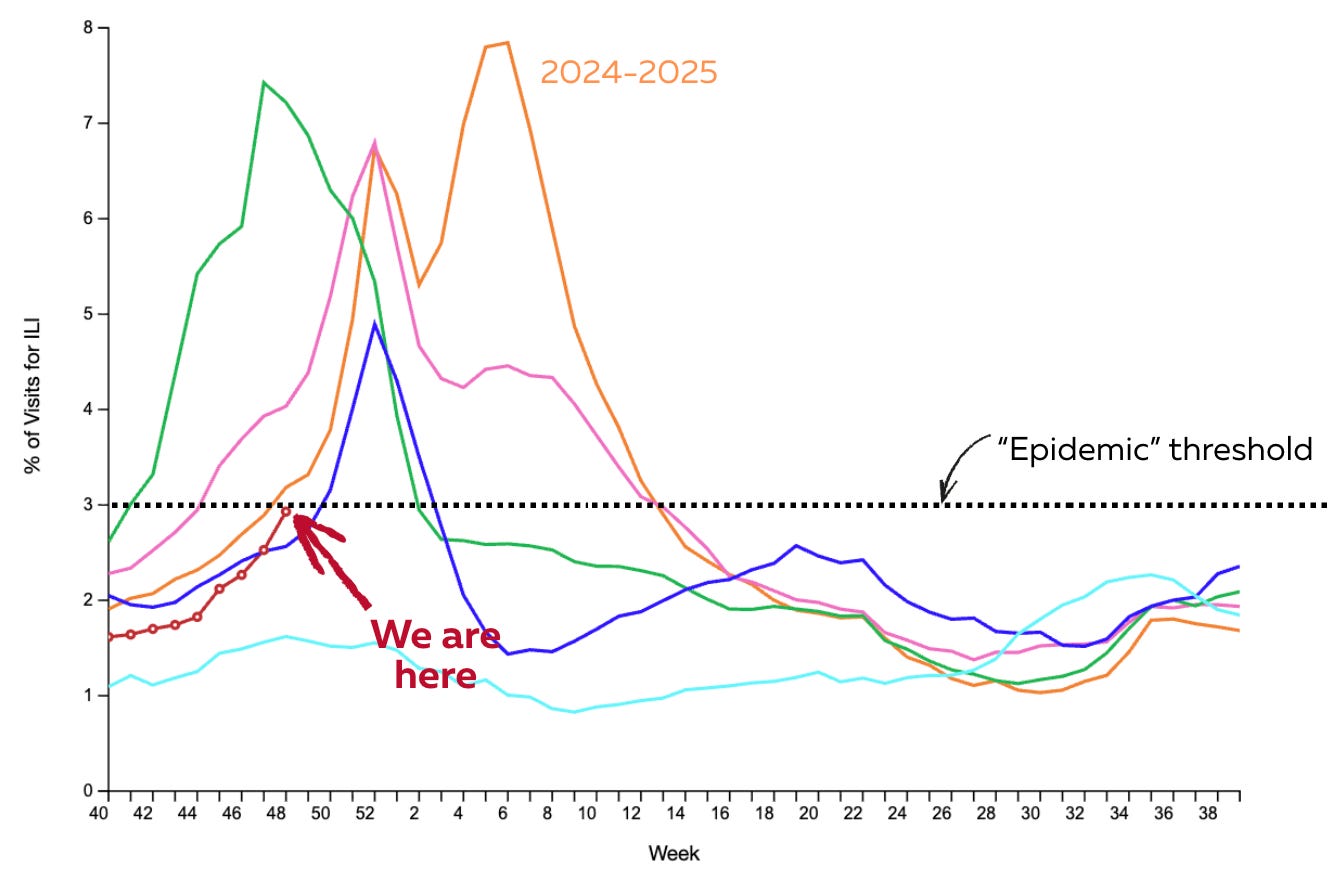
The percentage of people with coughs, fevers, and sore throats—what epidemiologists call influenza-like illness—is rising sharply. Rates just crossed the epidemic threshold for the season, though a bit later than usual.
This is when I start masking in crowded indoor spaces like airports. Yes, well-fitted masks work. This is a physics question with a clear answer. And I’ll take all the protection I can get—I’d love to not miss upcoming school performances, work travel, and some fun family events.
Right now, the common cold is still driving most of the stuffy noses, though it’s starting to decline. Flu is taking off, although not more than usual. (We still have our eyes on this new flu strain. It’s really impacting the UK right now.) Covid-19 levels are stalled at low levels for now.
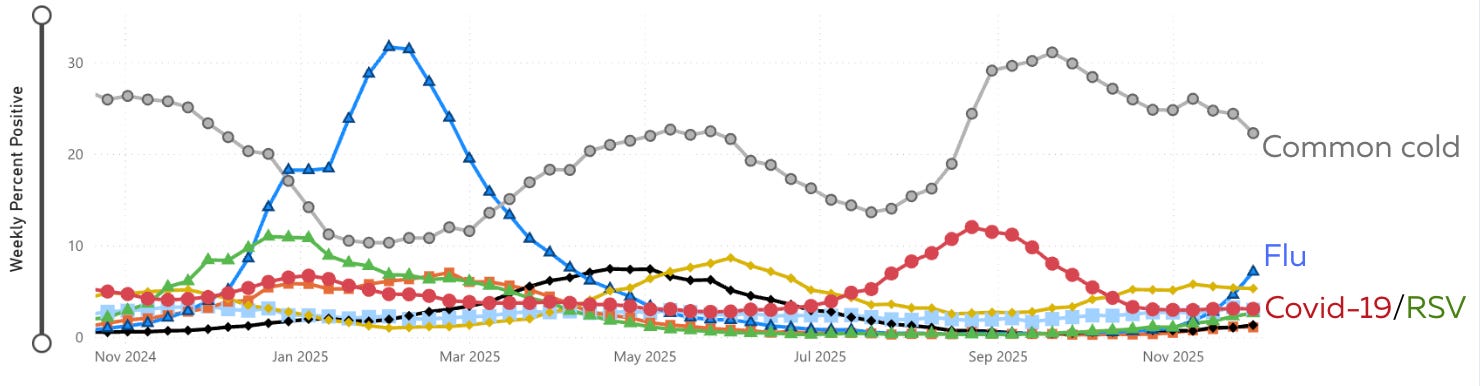
RSV is still struggling to take off this year, which is good news for babies and pediatric hospitals. We don’t yet know whether it’s simply delayed, inherently weaker, being crowded out by flu, or reflecting increased protection from pregnancy vaccination and infant monoclonal antibodies. Nonetheless, we’ll celebrate this quiet season.
Covid-19 and flu vaccination rates: It’s not looking good, folks
CDC has finally begun publishing vaccination data for this season. I trust this information because the states manage it, and I know many of the CDC scientists who collate and review it—they would flag any changes made for ideological reasons. Although the data is about two months late, it should now be updated every Wednesday. Here’s what we’re seeing.
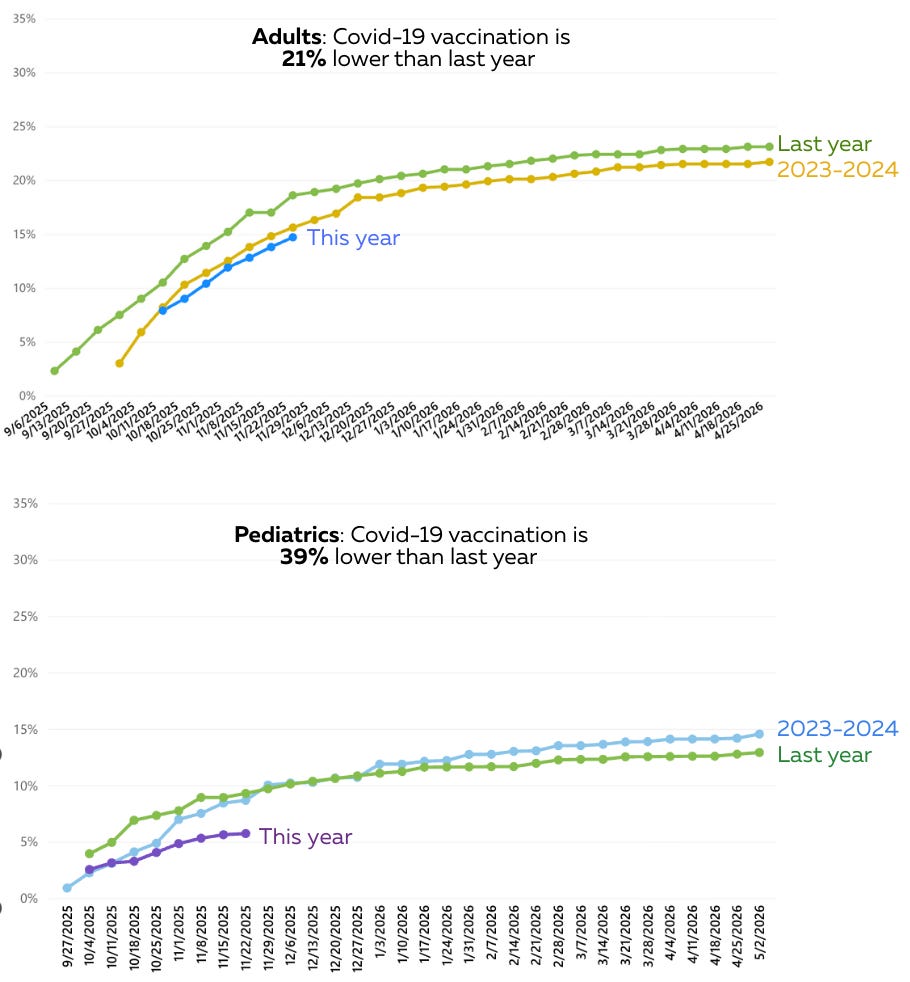
Covid-19 vaccination rates are down 21–39% compared to last year. Specifically:
5.7% of children are vaccinated compared to 9.3% this time last year
14.7% of adults are vaccinated this year compared to 18.6% this time last year
I’m especially worried about older adults. Only 32% of people 65+ have received the new Covid-19 vaccine—a 20% drop from last year. For comparison, the U.K. is at 61% for this age group.
This is our most vulnerable population. As people age, their immune systems don’t “remember” viruses as efficiently. This is due to a combination of factors, including a higher prevalence of chronic conditions and waning immune memory—both antibody levels and T cell responses.
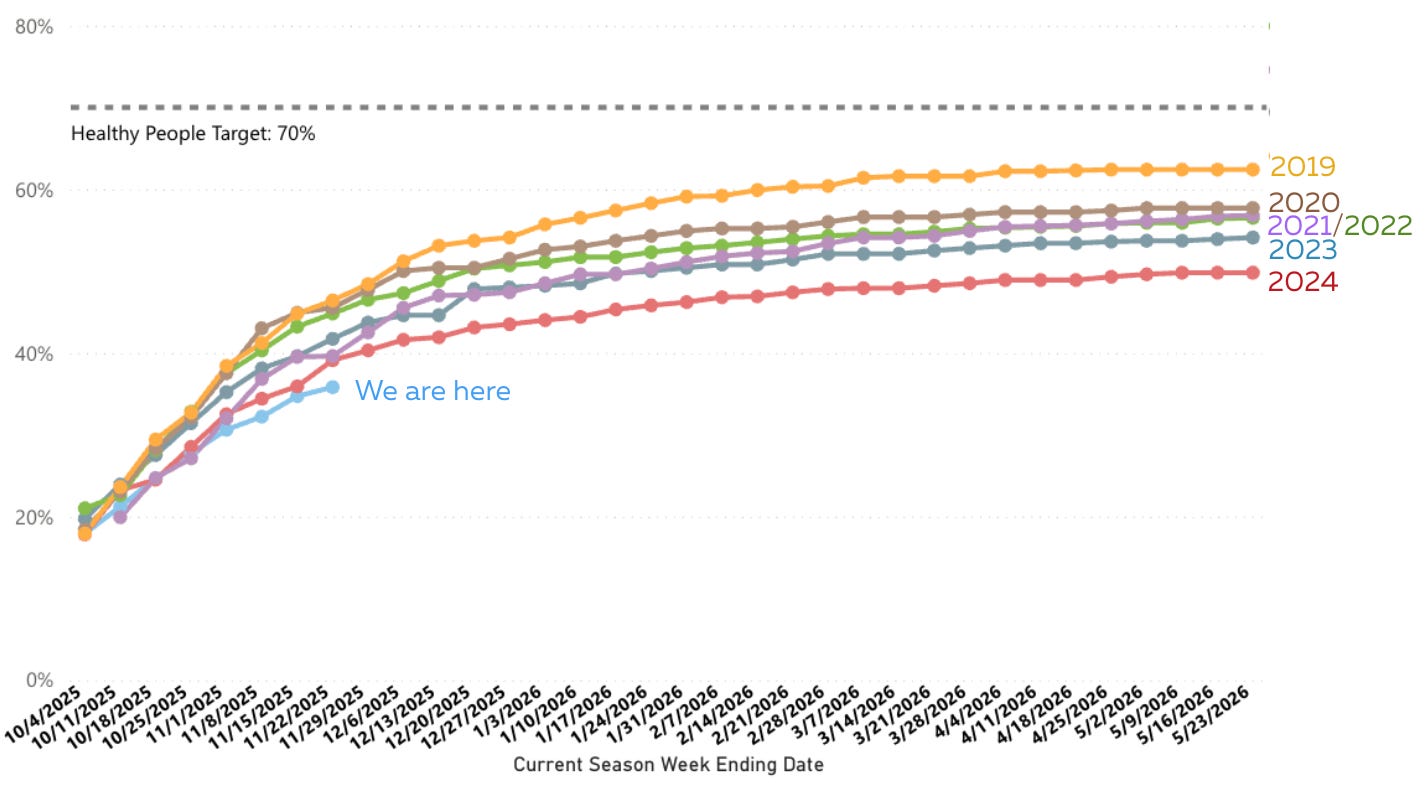
Flu vaccination rates for children continue to slide. Since 2019, pediatric vaccination has fallen in a steady, stepwise pattern, and this year looks particularly concerning, with only 35.8% of children vaccinated—a 23% drop compared to 2019 at the same time.
Adult vaccination rates are largely unchanged from previous years—still below the Healthy People 2030 target of 70%, but not showing additional decline.
These disappointing numbers aren’t surprising. It’s been a rocky year for vaccines given federal disarray, confusing and changing eligibility communications from RFK Jr.’s CDC, a lack of federal vaccination campaigns, waning concern about Covid-19, and lower circulating virus levels, all of which add up to reduced urgency and low uptake.
What this means for you: With low vaccination coverage now, we could be facing a more severe hospitalization season as winter transmission ramps up. Get vaccinated. It’s not too late.
A devastating new report on immigrant family health
A new report from Migrant Clinicians Network and Physicians for Human Rights shows how deportation fears are shaping health behaviors. The findings are heartbreaking and entirely preventable.
This chilling effect is well documented: fear of deportation or legal consequences keeps families from seeking care. But now we are seeing it in real time at a massive scale: 84% of surveyed health care workers report significant or moderate decreases in patient visits since January 2025 executive orders on immigration.
Specifically:
Families are declining surgeries, ER visits, and specialty care. A California physician reported: “I have had multiple parents decline visits with specialists, including delaying surgery, because of the fear of immigration enforcement in the destination city or on the way there.”
Kids are afraid to play outside. One physician in Massachusetts described this: “I have pediatric patients that are flagging in the obese range for weight and when we talk about playing in parks and getting other forms of exercise the parents note that they are not leaving their apartments for fear of encountering ICE. Their children suffer the double trauma of fear of family separation and immigration enforcement as well as lacking a safe place to play and exercise and other healthy outlets for children.”
Children, some as young as six, are showing up to clinics alone, carrying anxiety and trauma. A physician from Illinois noted “children coming to ED by themselves as parents await outside.”
Families are avoiding insurance or SNAP renewal, viewing it as a “trap.” One community health worker in North Carolina stated: “We are increasingly alarmed that the children of immigrants may soon lose access to vital programs like SNAP and Medicaid, not because they are ineligible, but because their parents are being targeted and surveilled when attempting to complete these applications on their behalf.”
What this means for you: There’s a lot that we can all do, including educators and clinicians, to support the needs of these children. See a helpful list here.
In case you missed it
There have been changes to the Hep B vaccine recommendations, and not for the better. Read more here:
Marisa over at YLE New York covered a lot, but the most exciting news: New York City just beat its own life expectancy goal, 5 years early! Read about it here.
Matt over at YLE California covered how San Francisco is taking on the nation’s first lawsuit against major food manufacturers over ultra-processed foods (UPFs). Read about it here.
Develop a better health chatbot with YLE
YLE has partnered with Dewey, an organization that creates search and Q&A tools from searchable libraries of information. Together, we’re training a chatbot on all YLE content so your questions can be answered faster and more reliably.
We need your help! We want the YLE community to test, shape, and refine the chatbot. Curious? Please fill out this short survey to get involved and help make the chatbot as useful and accurate as possible.
Bottom line
A lot is shifting fast—from vaccines to virus trends to families avoiding care—but staying informed, getting vaccinated, and showing up for one another is how we keep our communities safer this winter.
Love, YLE





.jpg)
No comments:
Post a Comment