--------------------------------------------------------------------
We dodged a vaccine disaster (for now). And a quick virus weather report before the break.
The Dose (December 22)
Katelyn Jetelina and Hannah Totte, MPH, Dec 22, 2025
Happy holidays! I have never needed a break more than I do after this year, so YLE will be off for the next two weeks.
Since it’s a holiday week, this Dose was supposed to be a light one, with a quick infectious disease “weather report” to help you navigate holiday gatherings. But alas, 2025 had one last surprise in store with a last-minute vaccine policy scare from RFK Jr. Thankfully, we dodged the bullet for now, but it’s worth understanding what happened.
So, here’s my attempt to bring you along for the ride. Let’s dig in!
A last-minute vaccine policy scare—and why it matters
Last Thursday, I was in a vaccine policy meeting talking about something that has become increasingly fragile: how to protect access to vaccines for Americans who want them, given increasing uncertainty and destruction from the federal government.
In the middle of the conversation, my phone started buzzing. Text after text said the same thing: tomorrow, RFK Jr. would move the U.S. childhood vaccination schedule to the Danish schedule. A press conference was scheduled for Friday at 4 p.m.
Over the next four hours, I was the most worried I have ever been about access to childhood vaccines in the United States. Introducing a completely different vaccine schedule into our system overnight would not have been a minor tweak; it would have been disastrous.
Then the press conference was canceled.
A few days later, Politico reported why: legal and political concerns. HHS was not confident that changing the childhood vaccine schedule to match Denmark’s would hold up in court, and it would be politically risky. (Duh. More than 80% of Americans support routine childhood vaccinations.)
So, for now, Americans dodged a bullet. But I have no doubt this idea will resurface in a different form, so it’s worth understanding what it was all about.
What is actually different about the U.S. and Danish schedules?
Denmark’s childhood vaccine schedule includes fewer vaccines than ours. They don’t routinely vaccinate children against chickenpox, RSV, rotavirus, hepatitis A or B, meningococcal, flu, or Covid-19.
This can look appealing to some. But what makes this work in Denmark is everything beneath the surface: universal healthcare, 46 weeks of paid parental leave, near-universal prenatal screening, centralized medical records, and reliable follow-up.
Because of this system, disease burden is low. Take the Hepatitis B infant dose. Denmark screens nearly 100% of pregnant women and follows up reliably to help prevent transmission. In the U.S., 12–18% of pregnant women aren’t tested, and only 35% of those who test positive complete follow-up care. Before the U.S. universal birth-dose recommendations, thousands of U.S. babies were infected annually by family members who didn't know they carried the virus.
Our broader recommendations exist precisely because our system has gaps. What is safe and effective in Denmark does not translate to the U.S. context. I’ve written about this before here.
Can RFK Jr. actually do this?
Possibly, but it sits in a legal gray area. An independent CDC advisory committee, the ACIP, has historically set vaccine policy. However, the HHS Secretary can issue a directive that changes the schedule without an ACIP vote. That happened earlier this year with Covid-19 vaccine guidance for kids and pregnancy.
That decision is now being challenged in court by the American Academy of Pediatrics. No injunction was issued, so the changes remained in place while the case progresses. In other words, this path exists, but it’s legally shaky.
Why would this be such a big deal?
The childhood vaccine schedule is not just a list of shots. It determines which vaccines kids need for school, what insurance must cover, and which vaccines families can get for free through Vaccines for Children—a program that pays for vaccines for more than half of U.S. children.
It also affects which vaccines are covered by the Vaccine Injury Compensation Program (VICP). This program was designed to compensate people who experience rare but real vaccine-related injuries, while sparing families from lengthy lawsuits against manufacturers or health care providers and safeguarding vaccine supply and access. If a vaccine is removed from the routine schedule, that safety net can disappear, liability risks increase, and manufacturers may discontinue production because it becomes too costly.
Taken together, changes like these could cause supply chain problems, leave states with massive unexpected bills (~$600 million to $2 billion), increase liability for doctors and hospitals, and create widespread confusion. And confusion alone is enough to lower vaccination rates.
What this means for you
For now, nothing. Thank goodness. All vaccines are still available to you. But it’s clear HHS intends to move dramatically on childhood vaccinations. There is significant mobilization behind the scenes to ensure this doesn’t move forward quietly. I will be sure to bring you up to date if anything changes
For those of you looking for more, together with the Evidence Collective, we pulled together a short briefing you can find HERE, which includes:
Background, including comparison of schedules, key context, and comparison of the country’s processes
What could realistically happen
Common misconceptions to be ready for
Infectious disease “weather report”
Influenza-like illnesses—coughs, fevers, and sore throats—are on the rise across the country, with particularly high levels in New York, New Jersey, Colorado, and Louisiana. Soon, much of the map will be lit up in red/purple with very high rates.
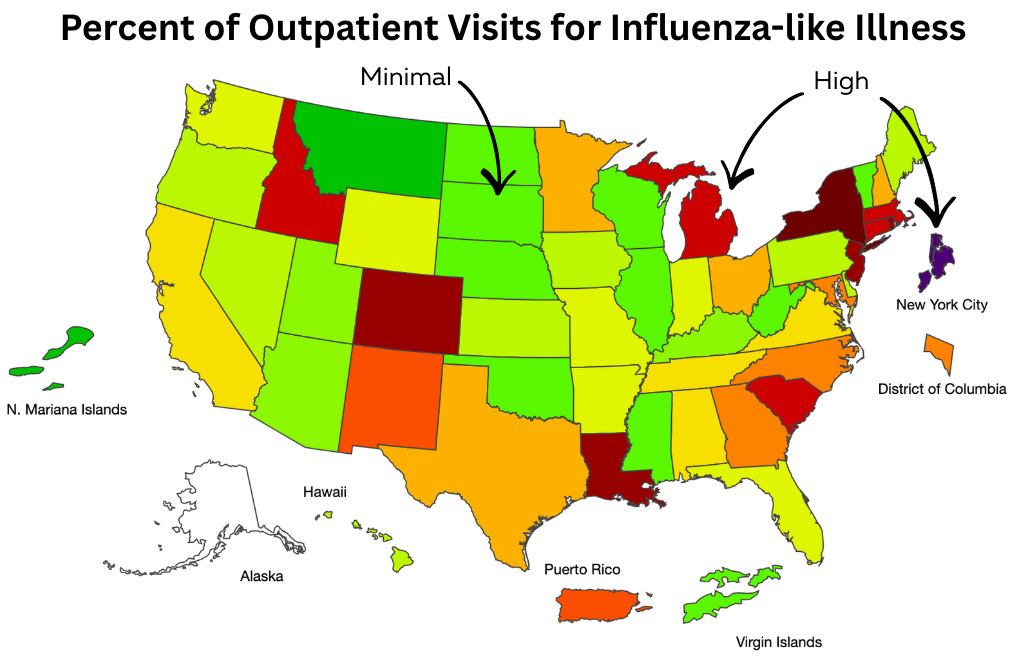
This increase is mostly driven by the flu, which is already making the rounds. Unfortunately, two more pediatric flu deaths were reported this week.
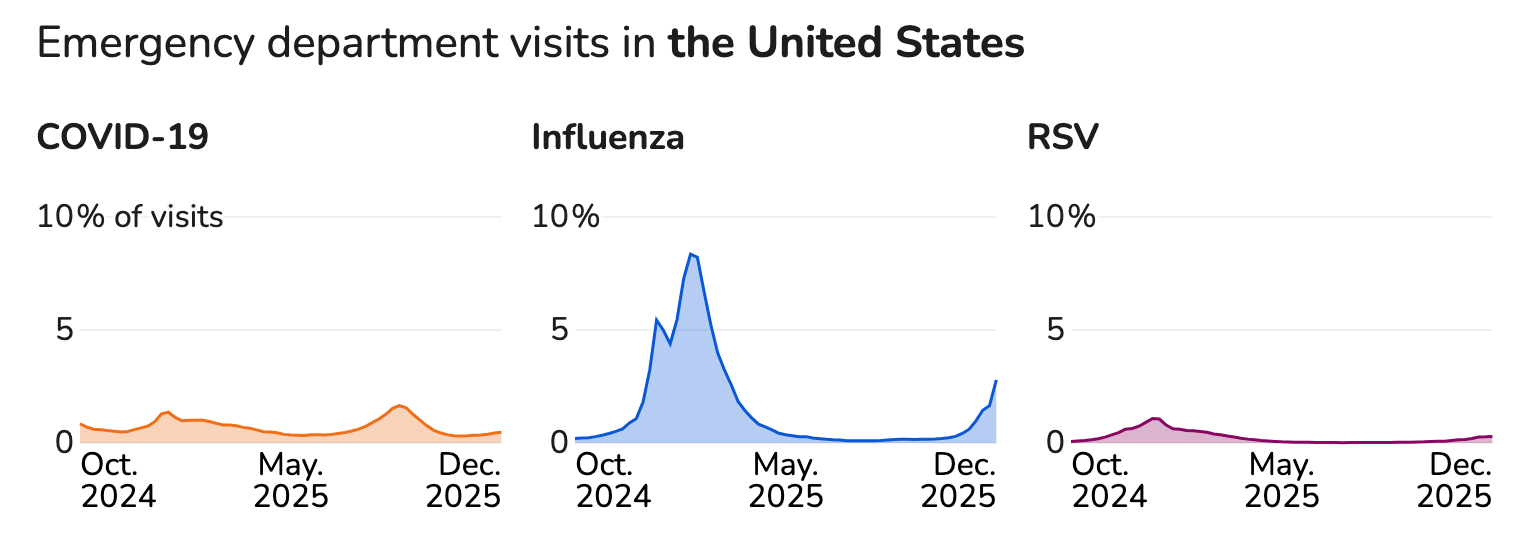
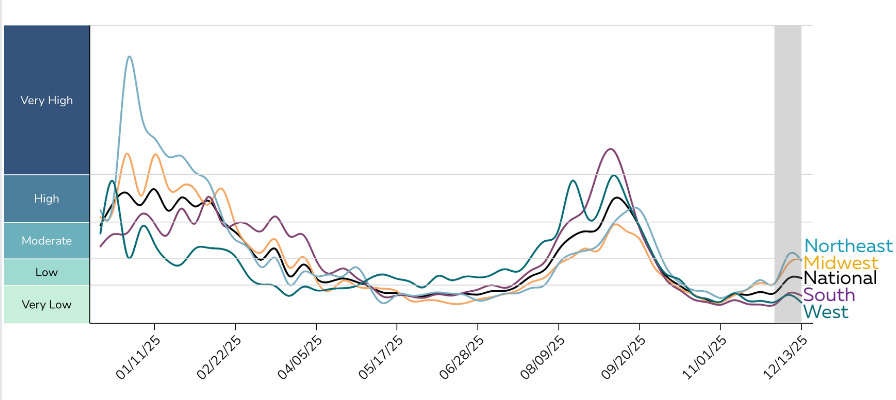
Covid-19 levels are still relatively low nationwide but are slowly creeping up, especially in the Northeast and Midwest. Based on patterns from the past five years, Covid usually peaks in the first week of January. This year, the wave may arrive a bit later than usual.
RSV is also rising, but the season appears to be milder than in previous years. According to the Center for Forecasting Analytics (CFA), hospitalizations from flu, Covid-19, and RSV combined are expected to be roughly the same as last year. The new flu variant may make this season feel heavier, but the mild RSV season and low Covid levels are good news.
What this means for you: There are a lot of sick people peppered throughout the nation. Travel and indoor gatherings will accelerate the spread of all viruses. So…
If you’re sick, stay home.
Consider wearing a mask in crowded indoor spaces, like airports.
It’s not too late to get your flu or Covid vaccines—protecting yourself now can prevent severe illness later.
Bottom line
We’re heading into a much-needed break (unless RFK Jr. pulls another fast one). For now, vaccine access remains intact, viruses are rising across the U.S., and the basics still matter: protect yourself, stay home if you’re sick, and get vaccinated if you haven’t yet.
Most of all, I hope you’re able to rest, unplug, and find some joy over the holidays.
Love, YLE
P.S. Some of you have been asking if Your Local Epidemiologist can accept donations as part of your year-end giving. Yes, and I am so grateful for you! YLE is a fiscally sponsored project of Social Good Fund, a California nonprofit corporation and registered 501(c)(3) organization, Tax ID (EIN) 46-1323531.
You can make a tax-deductible donation online here.
If you need to send a paper check instead, the following is important: make the check out to Social Good Fund and write Your Local Epidemiologist in the memo. You can mail the check to: Social Good Fund, PO Box 5473, Richmond, CA 94805-4021.





.jpg)
No comments:
Post a Comment