---------------------------------------------
Covid-19 waking up, Cyclospora marches on, and measles is close to hitting a milestone
The Dose (July 21)
Public health continues to feel like a game of whack-a-mole. We’re sure not getting a break.
Here’s your disease “weather” report, covering where Covid-19 is waking up and how measles is about to make headlines (again). There is also a spotlight on the ongoing Cyclospora outbreak, which deserves an award for the most opaque and confusing outbreak ever, leaving consumers in the dark.
Here’s what’s going on and, most importantly, what it means for you.
Disease weather report
Covid-19 is quietly waking up
Right on cue, Covid-19 is starting to stir, just as it does every summer around mid-July. Several data signals are pointing the same way nationally: levels of spread and infection are still very low, but they’re beginning to climb.
Regionally, the clearest signal is in the West, where emergency department visits, test positivity rates, and wastewater data are all rising, along with anecdotal reports. The South and Midwest are showing early signs of an increase too, though the signal there is less consistent across data sources.
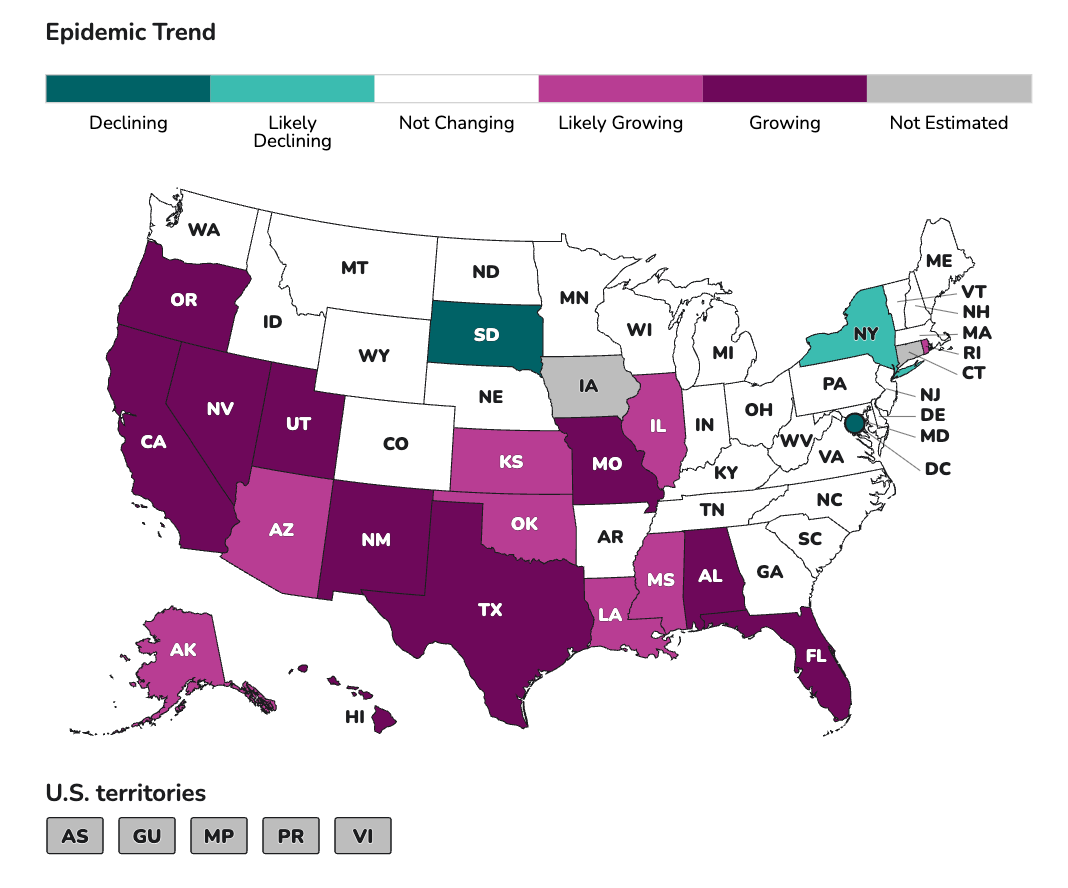
How big will this wave get? That’s the biggest question. Each successive wave has been smaller than the last, which is good news. But that trend isn’t guaranteed to hold, especially since it’s been a while since our last wave and a lot of people’s immunity has had time to fade.
What this means for you: If you’re over 65 and never got your spring Covid-19 vaccine, the time is now.
Measles milestone coming up
As of July 19, 2026, the U.S. has reported 2,278 measles cases this year—already nearing the total for all of 2025 with five months still to go. At this pace, 2026 is on track to set a new 33-year record. Expect headlines soon.
The outbreaks peppered across the U.S. include:
Pennsylvania has the fastest-growing outbreak (111 cases), which began in April.
Utah: is in its 12th month of ongoing spread. At this point, measles is endemic in the state.
Arizona: a small but new cluster of cases after they just declared the last outbreak over.
Wyoming: Very small but expanding outbreak.
What this means for you: 96% of measles cases continue to be among the unvaccinated. If you’re up to date on vaccines, you’re very protected. If you have an infant under 12 months and are near an outbreak, ask about getting them vaccinated early.
Cyclospora cases continue to increase
The United States now has over 11,000 cyclosporiasis cases across 46 states, which is close to triple the number of cases in a typical year. You can easily see how insane this outbreak is compared to previous years, with a massive spike in diarrhea complaints at doctor visits.
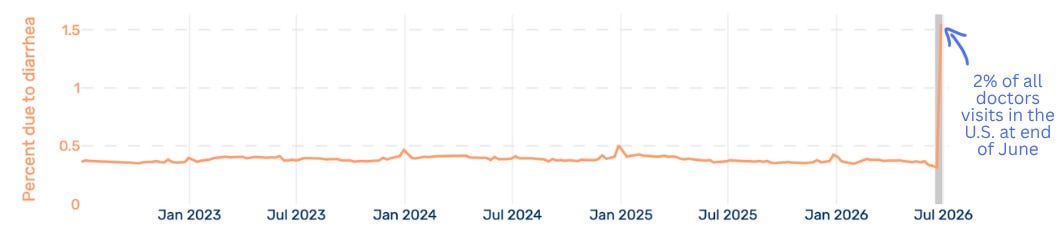
Several outbreaks are running at once. Some states are seeing a low simmer from travelers picking it up abroad and bringing it home, like in California. New York seems to have traced its above-normal case counts to cilantro (which seems to be over, but it’s honestly very unclear).
The Midwest is its own beast. Michigan hit 6,148 cases as of yesterday (over 1,000 added just this weekend, 102 hospitalized) compared with a typical year of ~50 cases total. I was hoping the daily Michigan update would show this outbreak slowing down, but it’s not yet. Ohio’s past 2,000 and climbing, which is similarly unusual.
The recall for iceberg lettuce is far wider, with 27 states named. This is due to a combination of the complexity of food distribution networks and continued uncertainty around where people are most impacted. (See more below.)
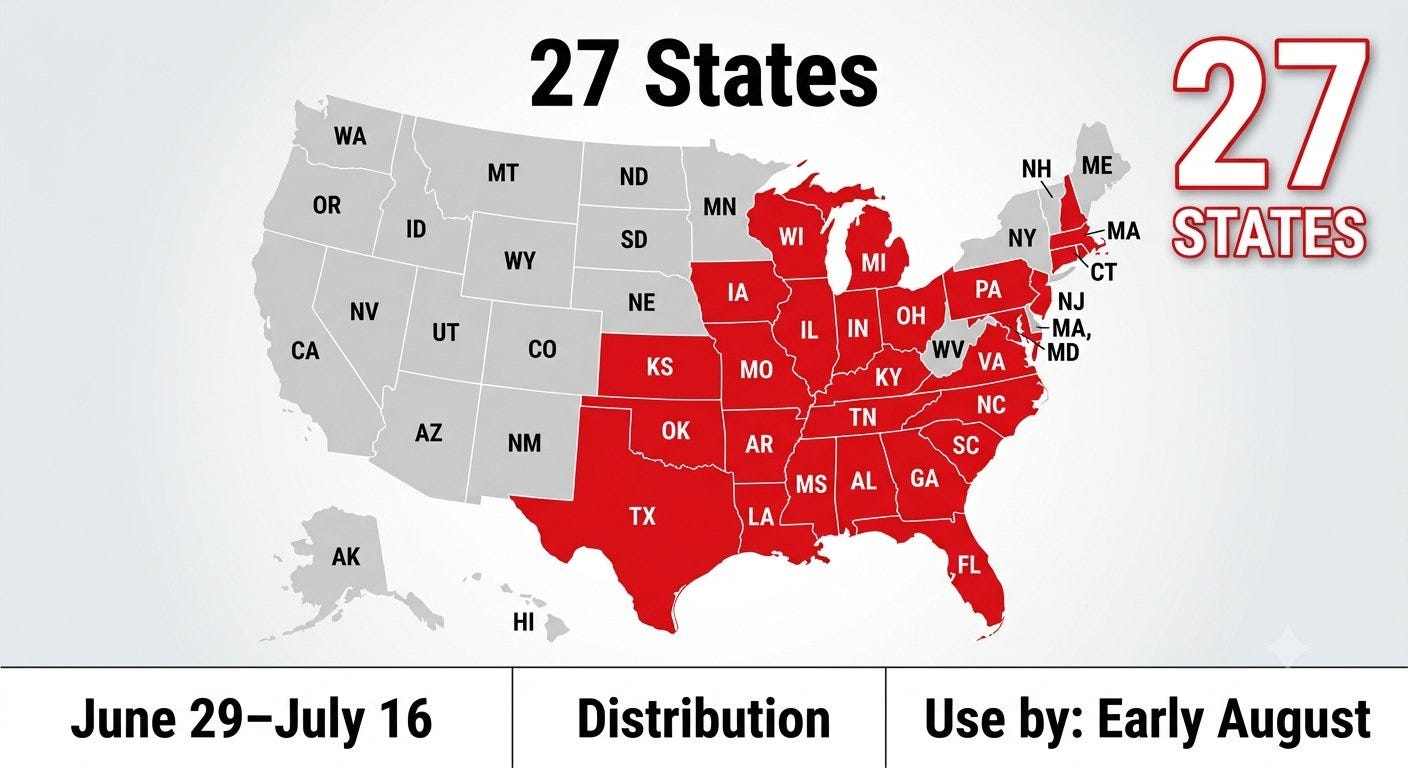
When will this end? No one knows. Either the contaminated food works its way out of circulation, or it takes a few weeks, the temperatures get cool, and the parasites no longer mature on produce (basically killing themselves off.) It’s hard to tell from the data alone if this outbreak is coming to a close given that it’s significantly delayed.
What this means for you: If you’re in the 27 states, avoid all shredded iceberg lettuce. If you’re high-risk (pregnant, over 65, or immunocompromised), I would remain careful around produce with crevices (like raspberries).
Spotlight: This Cyclospora outbreak is a real mess
If you feel lost trying to follow this story, and are confused about what’s actually been impacted, where, and how, you’re not alone. This is one of the most opaque, confusing, and unclearly communicated outbreak responses I’ve ever seen. Most of what we know has come out through press releases or leaks, leaving us to piece things together and read between the lines.
Taylor Farms is still the likely source of the outbreak
You probably heard that the FDA’s initial finding linked to a Taylor Farms product was a “false positive.”
Over the weekend, the FDA announced that a lettuce sample from Taylor Farms tested positive for Cyclospora. Within 24 hours, the FDA reversed itself, calling the result a false positive. This is rare, but it can happen. Taylor Farms quickly deleted its own social media posts about its bagged lettuce and boasted the FDA had apologized to them.
But the FDA still says Taylor Farms is “overwhelmingly” linked to the outbreak. There are two reasons for this:
The false positive was on lettuce coming from Mexico that was NOT part of the recall. If that was a true positive, then we would need a larger recall.
Not finding the parasite in one lab sample doesn’t mean it isn’t there.
To find the culprit, investigators don’t rely on a single lab test. They look at all sorts of data sources. Interviews with hundreds of sick patients pointed clearly to Taco Bell (more than 90% of interviews mentioned Taco Bell). And the FDA’s traceback, using invoices, shipping records, and receipts, narrowed the source down to one farm in central Mexico that supplies Taylor Farms de Mexico. Taylor Farms said it provides less than 1% of the iceberg lettuce sold in the U.S., yet it’s linked to far more than 1% of the cases. This is very strong data suggesting it’s Taylor Farms, and specifically, shredded lettuce.
A positive lab test would have been the nail in the coffin. But finding this parasite is like finding a needle in a haystack. It’s microscopic, contamination levels are often very low, and scientists usually can’t grow more of it in the lab to confirm what they find. A false positive is a small setback, but not a reversal of how scientists got us here for the past few weeks.
We know that this farm doesn’t just supply Taco Bell
Distribution networks are complex, and suppliers don’t just serve one fast-food chain; they supply grocery stores and food service operations in bulk, too. Taylor Farms provides up to 160 million servings of produce to stores and restaurants every week.
Buried in Taylor Farms’ own recall notice was a list of the retailers and outlets it distributed to, written in coded language, leaving everyone else to decode it themselves. Below is a table someone put together from that. It’s still unclear whether this list is complete, or whether Taylor Farms lettuce ends up in other bagged salads that don’t carry the Taylor Farms name. Given that uncertainty, the safest move right now is to avoid iceberg lettuce altogether.
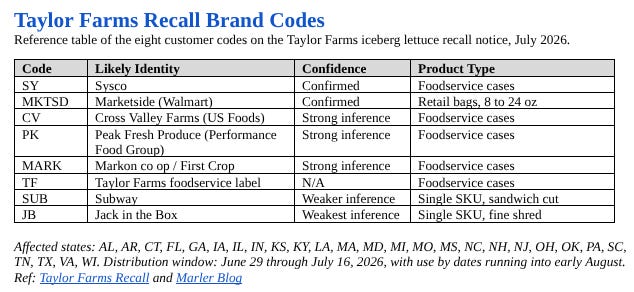
We also don’t know how this outbreak started yet. This information is helpful for accountability and fixing systems in the future, but more immediately, it will help us know if it’s just lettuce or cross-contaminated with other produce.
Why is this so hard?
Watching this unfold has been like watching a train wreck. What we are all experiencing is a perfect storm with a few factors colliding:
Cyclosporiasis is a hard-to-investigate parasite. Symptoms can take up to 2 weeks or more. (Can you remember what you ate 12 days ago?) This work is laborious, and confirming it requires specialized lab testing. Often, a source is never identified.
Federal food safety agencies are stretched thin. Neither the FDA nor the CDC has a permanent director right now, and both agencies have lost staff and lab capacity and undergone major reorganizations, some actively happening when the largest outbreak in history occurred. Their centralized role is critical to help stitch together what is happening in the states.
The private company linked to the outbreak is muddying the waters with its PR approach. For example, in the Taylor Farms voluntary recall, they listed customers where this lettuce was sent, but in coded language. Typically, this information would have been shared with lot numbers, source names, and much more clarity on where else this lettuce went, beyond Taco Bell. There have been questions about Taylor Farms linked to this administration and Trump White House officials as well.
What this means for you: If you’re in the 27 states, avoid all shredded iceberg lettuce. If you’re high-risk (pregnant, over 65, or immunocompromised), I would remain careful around produce with crevices (like raspberries) until we are sure there is no cross-contamination happening, too.
Good news
Big thanks to Ms. Lillian Pollack, a summer YLE intern, for helping keep track of all the good things that happen in public health, too. We can’t forget about this. Here is the latest:
The Ugandan Ebola outbreak is ending. Ugandan hospitals discharged their last Ebola patient on July 16th. They are currently in a 42-day waiting period before the outbreak can officially be declared over, but there are no known cases of Ebola in Uganda anymore. (BBC)
New cholesterol-lowering prescription received FDA-approval. The FDA just approved a new and highly effective drug for cholesterol management. Instead of treatments that can require lifestyle or dietary restrictions or come in an injectable format, this new prescription, called enlicitide or brand-name Lipfendra, is an easier-to-manage pill. (NYT).
Bottom line
This world often feels random, but public health is predictable, and when it’s predictable, it’s preventable. Stay healthy out there.
Love, YLE
Your Local Epidemiologist (YLE) comprises a team of experts, ranging from physicians to immunologists to epidemiologists to nutritionists, working together with one goal: to “translate” ever-evolving public health science so that people are well-equipped to make evidence-based decisions. The YLE suite of newsletters reaches over 475,000 people across more than 132 countries. This newsletter is free to everyone, thanks to the generous support of fellow YLE community members.





.jpg)
No comments:
Post a Comment