"Getting sick with the flu or COVID-19 raises the risk of heart attack
or stroke in the following weeks, according to a new analysis that maps
how viruses can affect heart health.
"Researchers have long known that viruses such as human papillomavirus
(HPV) and hepatitis B can cause cancer, but links to other health
problems, such as heart disease, are more of a mystery.
"The latest analysis drew data from 155 studies. It indicates there
are heart health risks tied to infections as wide-ranging as influenza,
coronavirus, HIV, hepatitis C, and varicella zoster virus, which causes shingles and chickenpox.
“Our study found acute and chronic viral infections are linked to
both short- and long-term risks of cardiovascular disease, including
strokes and heart attacks,” Kosuke Kawai, the study’s lead author and an
epidemiologist at the University of California, Los Angeles, said in a
statement.
"In the month after a flu diagnosis, people are four times as likely
to have a heart attack and five times as likely to have a stroke,
according to the study, which was published in the Journal of the American Heart Association.
"They are three times as likely to have a heart attack or stroke in the
3.5 months after getting COVID-19, with risks remaining higher for a
year after infection, the study found.
"Meanwhile, the elevated risks were lower but persistent for people with chronic infections.
"Heart attack risks were 60 per cent higher for people with HIV, 27
per cent higher for those with hepatitis C, and 12 per cent higher for
those with shingles at least five years later.
"Kawai said the findings are “clinically relevant” given the number of people affected by these chronic viral infections.
"Globally, there were about 1.3 million new HIV infections in 2024 and
about one million new hepatitis C infections are reported annually.
Meanwhile, estimates published in 2021 found that across Europe,
there are approximately six to 10 new shingles cases per year for every
1,000 people.
That means “the elevated risk associated with that virus translates
into a large number of excess cases of cardiovascular disease at the
population level,” Kawai said.
Viral infections trigger the immune system, prompting it to release
molecules that increase blood flow to fight off the virus. That causes
inflammation – visible as redness, swelling, and warmth – and blood
clotting.
"However, inflammation and blood clotting can also hinder the heart’s
functioning, which could help explain why heart attack and stroke risks
remain higher after infections, the researchers said."
Elder of Ziyon posts about this disturbing poll that shows that the "Palestinians" still support Hamas. Let's also stop promoting the fallacy that Hamas wants peace as much as we do. They don't. All they want to do is kill Jews and destroy Israel. Hamas and the "Palestinians" deserve each other.
"Even among the devastation of Gaza, the "genocide" and the
"famine," Palestinians think it was all worth it for the privilege of
killing 1,200 Israelis.
"Either there is no genocide and famine, or Palestinians really, really hate Jews.
"Or both.
"The latest PCPSR poll shows that 53% of Palestinians say that Hamas' decision to attack Israel on October 7, 2023 was the correct decision.
"In
Gaza, the percentage has increased since the last poll, from 37% in May
to 44% today. This is despite the fact that 87% of them said they have
been displaced by the war, nearly all of them multiple times. This is
despite the fact that 72% of them claim that at least one of their
family members were killed or injured during the war.
"They still think Hamas attacking kibbutzim and a music festival was the right decision.
"These
supposed victims of mass starvation and genocide also aren't very keen
on ending the war permanently. When asked whether they support or oppose
disarming Hamas in the Gaza Strip in order to permanently end the war, an overwhelming majority of 69% (87% in the West Bank and 55% in the Gaza Strip) said it is opposed to that; only 29% support it.
"Can you imagine the victims of any real genocide saying that they would prefer not to end it?
"At
the same time they deny that Hamas did any atrocities on October 7.
Hamas' own videos showing them shooting civilians don't convince them, even the ones who have seen the videos claim
that Hamas did not do any war crimes. Given that the previous poll
showed that a majority agreed that attacking civilian families is indeed
a war crime, the only conclusion is that either they do not believe
there are any civilians in Israel - or they do not believe that Jews are
human to begin with.
"Hamas is a death
cult, and the majority of Palestinians enthusiastically support a death
cult - even at the cost of their own families' lives.
"And the same brainwashing techniques that cause such a warped vision of reality is steadily spreading in the West."
Never forget that these are sadistic terrorists, not decent human beings, and they need to be destroyed, now. That's the Israeli response the world needs.
"A casket handed over by Hamas on Monday night to Israel contained the partial remains of Ofir Tzarfati, a hostage whose body was recovered by the military in early December 2023, Israeli officials said.
"In addition to not returning the bodies of any of the 13 dead
hostages still held in the Gaza Strip, Hamas staged a fake “discovery”
of Tzarfati’s remains in eastern Gaza City in front of the Red Cross.
"Israel has said Hamas has access to many of the remaining bodies and
is dragging its feet in returning them, which it is required to do under
the terms of the US-backed ceasefire agreement.
"On Monday afternoon, Hamas brought the remains of Tzarfati out of a
building and placed them in a large hole it had dug in the ground in the
Shejaiya neighborhood of Gaza City. It then covered the body bag in
dirt and pretended to uncover it for the first time in front of the Red
Cross.
"The entire incident was filmed by a military drone. The full footage
was published by the IDF later on Tuesday, after Tzarfati’s family was
notified by military representatives that additional remains of his body
were returned by Hamas.
"Voices from across the political spectrum called on Israel to halt or
pause its own commitments under the agreement in response, and Prime
Minister Benjamin Netanyahu was set to convene an emergency meeting on
Tuesday to discuss possible Israeli reactions."
Notice how the writer of this article insists in referring to this MALE powerlifter as "her". Do the people actually believe what they're writing? Can't these politically correct fools take a "normal" pill? It's still hard to believe that this sort of pretense is still going on.
If anyone is being discriminated against, it's real women!
"In an opinion published Wednesday, the Minnesota Supreme Court is
largely siding with a transgender weightlifter who sued USA Powerlifting
after the organization banned her from competing in its women’s
division. (HE can't win as MALE, so he has to cheat and pretend he's a woman.)
"The decision comes after a lengthy legal battle.
Athlete JayCee Cooper alleged that USA Powerlifting, a national
governing body also known as USAPL, violated the Minnesota Human Rights
Act when it prohibited her from competing as a woman. (That's because HE is a MAN!)
"In a
December 2018 email, the group’s committee chair told Cooper
“Male-to-female transgenders are not allowed to compete as females in
our static strength sport as it is a direct competitive advantage.”
"In
early 2021, Cooper sued USA Powerlifting, alleging multiple violations
of the Minnesota Human Rights Act. In 2023, a Ramsey County judge ruled in Cooper’s favor. But in a split decision, the Minnesota Court of Appeals partly overturned Judge Patrick Diamond's ruling, so Cooper took her case to Minnesota’s highest court."
RSV season is here. Here’s what you need to know. Plus measles, monkeypox, the expiration of SNAP benefits, some good news on mRNA vaccines, peanut allergies, and more
Katelyn Jetelina and Hannah Totte, MPH, Oct 27, 2025
Happy Halloween week! I’ll have a little witch and ghost running
around. To all the parents out there: may the force be with you during
this chaotic week.
While diseases have been quiet (and oddly, any
RFK Jr. drama, but let’s not jinx it), signs point to a ramp up. RSV is
on the rise, and SNAP benefits are set to expire November 1, putting
millions of families at risk. You may also see headlines about
monkeypox, but your risk remains extremely low. And yes, there’s plenty
of good news, too.
Here’s what you need to know to stay ahead.
RSV season is here, while other respiratory viruses remain low.
After an unusually quiet October for respiratory viruses, an RSV wave is starting to take hold. Flu remains remarkably low, and Covid-19 transmission is at one of the lowest points we’ve seen in months.
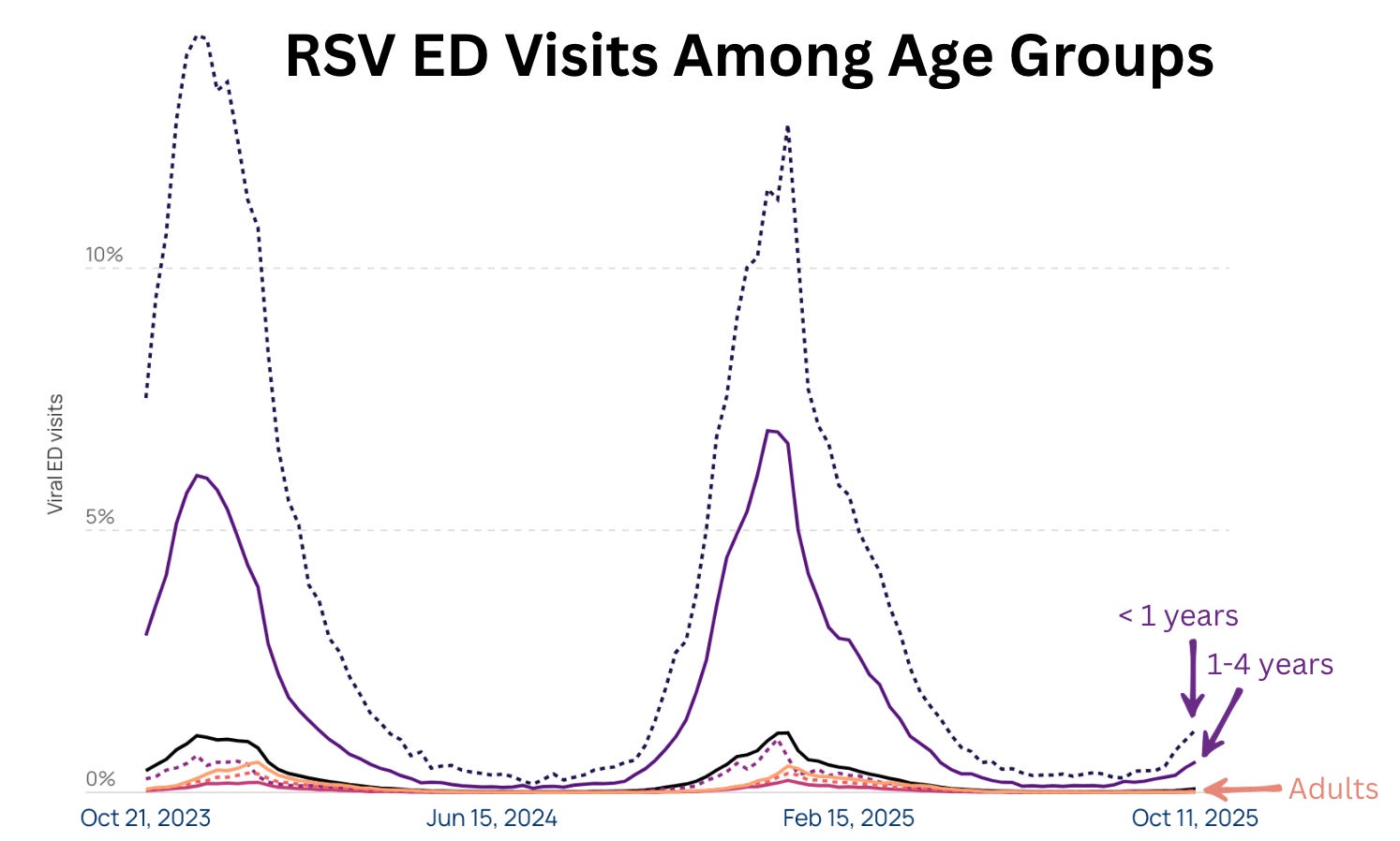
Although CDC data remain paused because of the federal government shutdown, emergency department records compiled by PopHIVE
show RSV activity is starting to climb, especially among children under
four. This follows a familiar pattern: the virus first hits the
youngest children (particularly those under one year) before spreading
to adults, often about a month later.
Data pro tip: Don’t rely on wastewater yet to gauge RSV spread—infants wear diapers, so RSV trends appear much later in wastewater data.
RSV activity by age in the United States. Source: PopHIVE; Annotated by Your Local Epidemiologist.
RSV places a massive burden on families and health systems every year. The youngest children are hit hardest—about five in every 1,000
kids under five are hospitalized each year, a rate much higher than for
flu or Covid-19. The younger the child, the greater the risk, as tiny
airways struggle to move air when inflamed.
RSV burden
tends to be less severe for adults, but it can still cause serious
illness for those with weakened immune systems or underlying heart or
lung conditions.
Each year in the U.S., RSV is responsible for an estimated:
3.6-6.5 million outpatient visits
190,000-350,000 hospitalizations
10,000-23,000 deaths
The
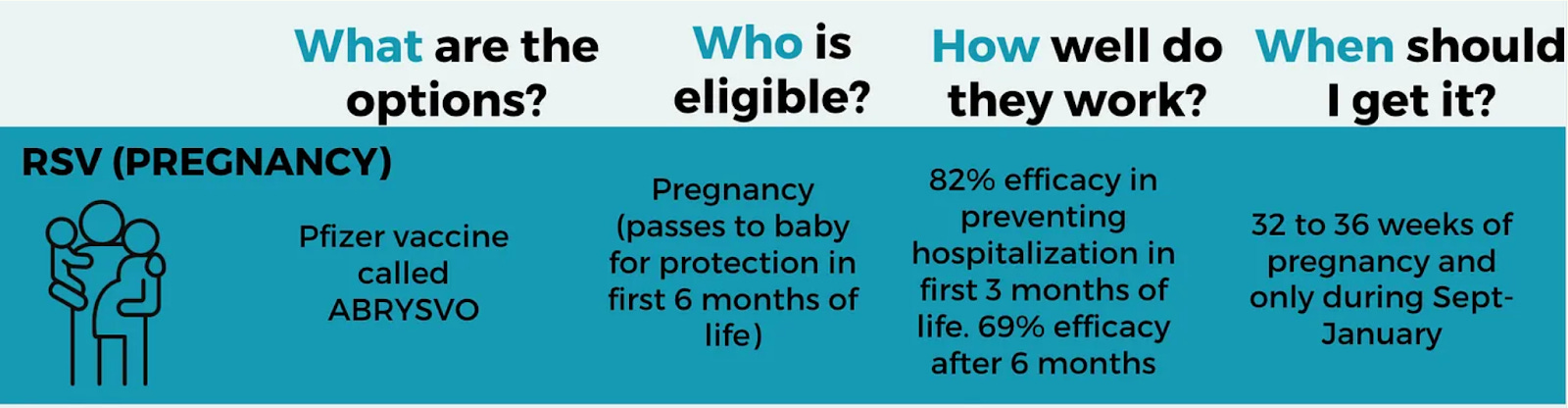
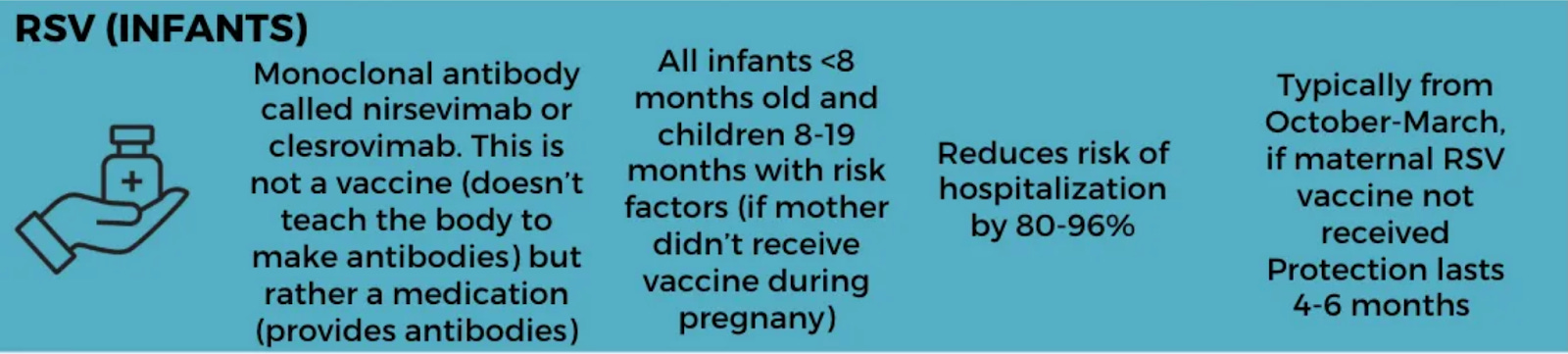
great news: we have several effective options for protection, something
scientists have been working toward since the 1960s. It’s not too late
to get vaccinated. Monoclonal antibodies (for infants) work essentially
immediately, and the vaccines take about two weeks to take hold.
Quick RSV FAQ:
How contagious is RSV? Each infected person spreads RSV to about three others (R₀ ≈ 3). So it’s less contagious than Covid-19, but more than flu.
How is it spread? Mainly through the air via the nose, so masking could help you, but unfortunately, it’s pretty inevitable for infants.
When are people contagious? Usually for about a week. People can be contagious a day or two beforethey start showing signs.
Is there an RSV test? Yes. There’s also one at-home test
that distinguishes between flu, RSV, and Covid-19, though it requires
mailing a sample to a lab. The recommendations are generally the same
for most respiratory viruses, though: Rest, hydrate, and reach out to
your healthcare provider for guidance.
Is there treatment? There’s no specific antiviral medication for RSV. Care focuses on symptom relief, like oxygen therapy in severe cases.
How long is someone protected after infection? Not long. RSV is adept at evading immunity, so reinfections are common, even within a single season. One long-term study found children didn’t experience milder cases until their third RSV infection. In adults, repeat infections tend to be milder until older age.
Should I worry about Guillain-Barré Syndrome from the older adult vaccine? There is a small but real safety signal for Guillain-Barré Syndrome (GBS)—about 10 additional cases per 1 million doses of Pfizer and GSK vaccines. This risk has not
been observed with Moderna’s RSV vaccine (mRESVIA). For most, the
benefits of vaccination far outweigh the risks, but it’s always worth
discussing with your doctor.
Measles continues to do what it does best: find unvaccinated pockets of people. The national counts exceeded
1,600 last week, the highest count in more than 30 years. There are
three active outbreaks: Utah/Arizona, South Carolina, and Minnesota. All
are among communities with low vaccination levels.
Mpox (or monkeypox). Two
years after the U.S. declared the emergency over, you may start seeing
headlines again. That’s because three unrelated, severe cases of a different strain—called Clade 1—recently appeared
in California. Epidemiologists are paying close attention, as these
cases suggest community spread (not linked to travel to Africa),
something the U.S. has never seen before. This strain has generally been
rare and quiet in Africa, but it’s begun spreading more rapidly. In the
U.S., the details of the three cases are surprisingly sparse, but they
were adults and are recovering. Your risk remains extremely low.
SNAP benefits expire November 1. How can we help our neighbors?
A major deadline looms this week: Supplemental Nutrition Assistance Program (SNAP) benefits are set to expire on November 1. A default on SNAP has never happened before.
The $8 billion needed to keep the program running in November has yet
to be secured, and the federal government has already notified states
that next month’s benefits cannot be issued.
If the government doesn’t act, the fallout will be a significant public health challenge. More than 40 million low-income Americans
(1 in 8 households) would lose funds they rely on to buy food, an
average of $190 per person per month. Grocery stores would feel it too,
facing both lost sales and frustrated customers.
The impact will go far beyond food, too. A 2015 study
found that SNAP benefits create ripple effects across the economy,
allowing families to pay rent, keep their cars, and cover other
essentials—often the very things people sacrifice when food runs short.
SNAP helps people move out of poverty.
Here are some ways to help your community, as outlined by Dr. Liz Marnik:
Donate money to your local food pantry. Every bit adds up.
Organize
a food drive at your work, school, or other community location. Be sure
to connect to your local pantry to find out what food items they
actually need and can accept.
Make a meal and deliver it to a family you know is in need.
Ask your child’s school if you can drop off extra snacks (if they don’t already provide free breakfasts and lunches).
Volunteer to cook for/at a local community meal.
Call your representatives and urge them to act on health care and food access. Here’s our guide to building relationships with your representatives.
Good news
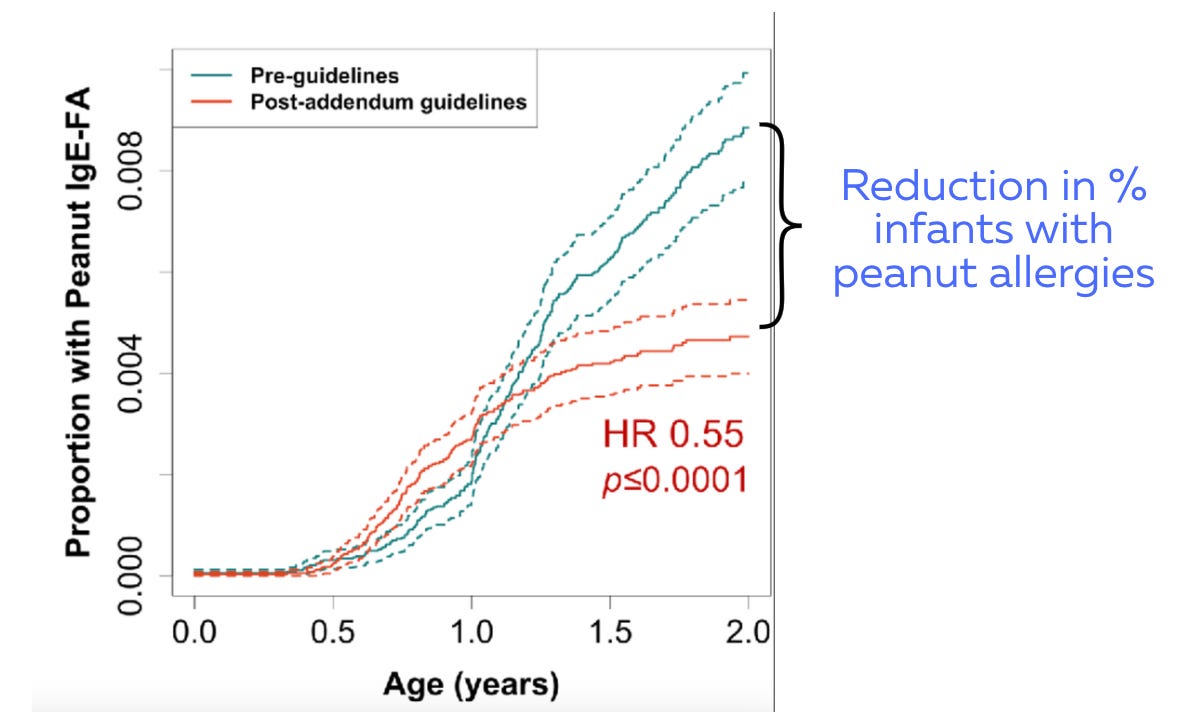
Peanut allergies are on the decline!
For years, pediatric guidance advised delaying exposure to common
allergens like peanuts until a landmark 2015 study showed that
introducing peanut products to babies could reduce their risk of
developing an allergy by 80%. By 2017, this approach became official
guidance, and it worked! Now, a new study finds food allergy rates have
dropped by 36%, primarily driven by a 43% decrease in peanut allergies.
Cheers to more kids enjoying PB&Js safely!
Figure from Pediatrics; Annotated by Your Local Epidemiologist.
Filling in federal holes. A new publication, NEJM Evidence,
will start sharing notes from the public health front lines. For
decades, CDC’s Morbidity and Mortality Weekly Report (MMWR) has been the
nation’s go-to source for data-driven updates on outbreaks and other
public health issues. But after recent layoffs (and some rehiring) amid
political turmoil, its capacity is uncertain, and trust in the
administration is shaky. NEJM Evidence is welcome
news for local and state health departments, ensuring critical,
uncensored information continues to be shared even as the federal system
struggles. Unfortunately, CDC scientists still face restrictions on
publishing there; they need administrative clearance.
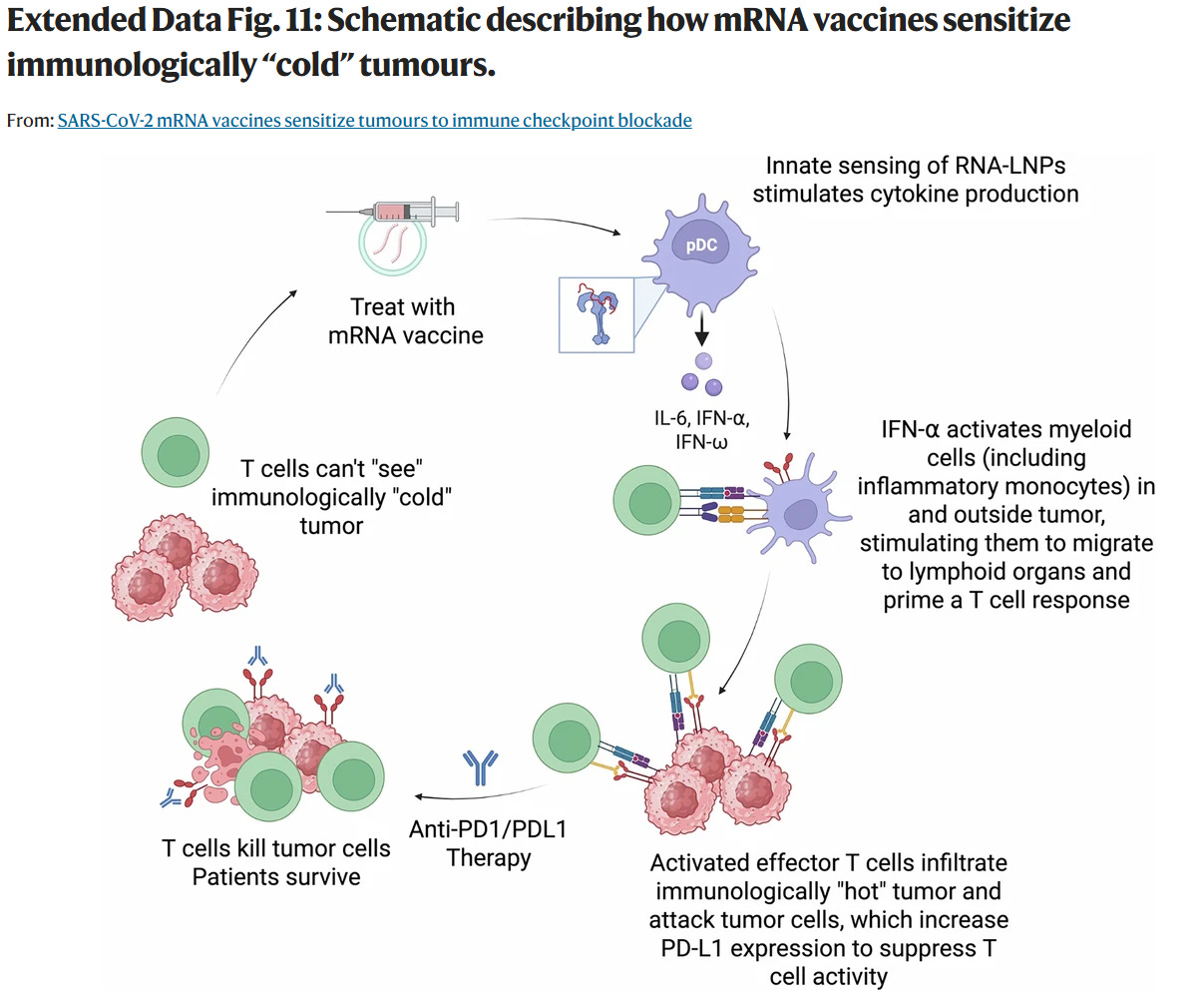
Scientists discovered how mRNA vaccines help take down tumors. Researchers from multiple academic medical centers
have identified a mysterious, potentially life-saving mechanism in
cancer treatment: Covid-19 mRNA vaccines. Patients who got one within
100 days of starting cancer immunotherapy survived much longer than
those who didn’t (37.3 months with recent vaccine vs. 20.6 months
without vaccine). This was even true for those with very advanced
cancers with poor prognoses, and after correcting for a bunch of other
factors (39!) that could explain the effect. If this holds, we could
vastly increase access and reduce the cost of treatment using something
that’s been shown to be safe in billions of people.
In case you missed it
YLE New Yorkcovered city-owned grocery stores last week and what it means for the NYC election.
YLE California was off last week, but Matt will catch you up this Thursday on a lot happening in the Golden State.
Over
the weekend, Joe Rogan claimed that measles was something “everyone
got” as kids—you’d feel sick for a few days, then have lifelong
immunity—and that people are exaggerating its dangers. I think he’s
mixing it up with chicken pox, but either way, here’s a YLE deep dive into the history of measles.
Have a wonderful fall week! I hope it’s filled with a lot of cute ghosts and witches.
The CDC data blackout continues, but WastewaterSCAN data is available. Biobot has
data through 10/18/25. Overall, SARS-CoV-2 levels have come down
significantly in many places, but WastewaterSCAN considers the South to be LOW and the rest of the country to be MEDIUM
for COVID right now. COVID hotspots include College Park, GA with 829
PMMoV; Dover, NH with 481 PMMoV; Lincoln, NE with 453 PMMoV; Wausau, WI
with 447 PMMoV; and S Burlington, VT with 406 PMMoV. JP Weiland believes
that overall, COVID transmission is at a multi-year low now and he expects this to be the case until Thanksgiving. Mike Hoerger predicts that 1 in 191 people are actively infectious with COVID in the United States at this time.
RSV and Influenza
virus wastewater levels are low now. It is important to prepare for the
upcoming respiratory virus season by getting your Flu shots, COVID
vaccines and RSV vaccinations if appropriate. Enterovirus D68,
which mostly causes cold symptoms, but can rarely cause a polio-like
disease in children called Acute Flaccid Myelitis (AFM), is being seen
in California, Nebraska, Iowa and the Chicago area.
Internationally,
COVID levels continue to decline in England, although some European
countries are close to peaking with this wave according to Bob Hawkins’ weekly COVID newsletter.
Acute COVID infections, General COVID info
In a Hungarian study of 99 COVID-19 patients, the nucleocapsid (N) protein of SARS-CoV-2 was found to trigger complement activation
even without antibodies. This suggests that the N protein may play a
key role in the inflammatory damage seen in severe COVID infections.
Researchers
from Rutgers used mass spectrometry and machine learning to identify
distinct protein signatures that can differentiate Multisystem
Inflammatory Syndrome in Children (MIS-C) from other conditions like
acute COVID infection, pneumonia, and Kawasaki disease. A diagnostic
panel of three proteins- VWF, FCGBP, and SERPINA3- identified MIS-C with 96% accuracy, offering a path to rapid diagnosis where timely treatment is vital.
A group from Austria and Germany discovered a non-invasive urinary peptide test called PASC195
that distinguished 50 people with PASC (Long COVID) from 50 healthy
controls and from 8 people with non-COVID related ME/CFS with high
accuracy. In Long COVID patients, there is a distinct signature of 195
peptides in urine that are mostly related to collagen. The finding
points to widespread collagen dysregulation in Long COVID, indicating ongoing damage to blood vessels and tissues.
In silico assessment suggests that certain drug classes (GLP1-RA, MRA)
may be effective by targeting these affected molecular pathways.
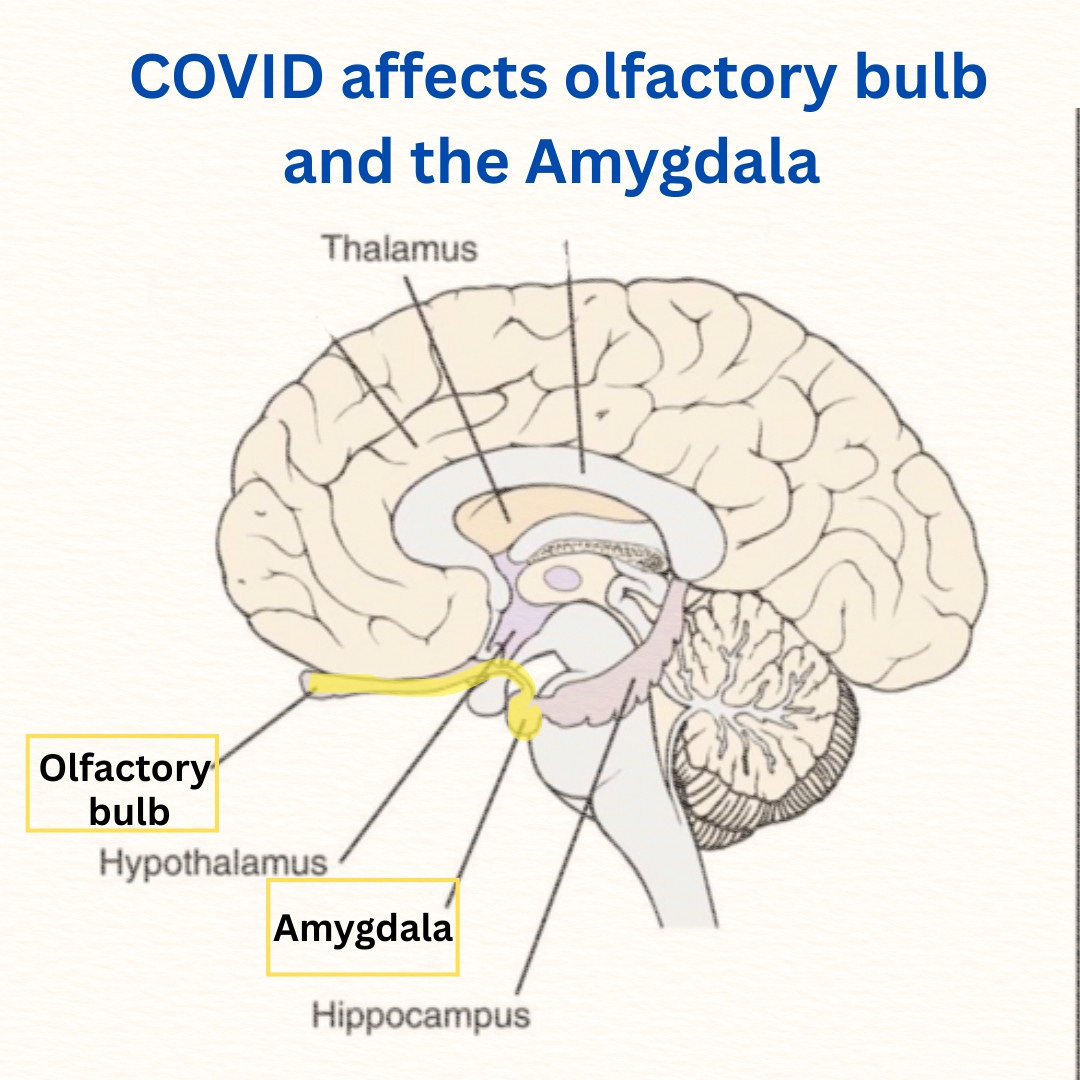
The amygdala is a region in the brain that helps regulate emotions. German researchers found that people with long-term COVID-related smell loss show microstructural changes in their amygdala,
as well as higher depression and anxiety scores. The SARS-CoV-2 virus
causes long lasting changes on the olfactory nerves that go into the
brain and it reshapes brain circuits that connect our sense of smell and
our emotions.
A clinical trial involving 346 adults with Long COVID across six states in India found that the anti-inflammatory drug colchicine was ineffective.
After 52 weeks, patients receiving colchicine showed no significant
improvement in key measures like physical function, respiratory
function, or inflammation markers compared to those on a placebo.
Measles
As of October 21, 2025, a total of 1,618 confirmed measles cases were reported in the United States, with 12% of cases hospitalized (198 of 1618), and 3 confirmed deaths from measles.
NBC news reports that measles cases are spreading from a Utah-Arizona border outbreak
to more touristy areas of Utah. MMR vaccination rates for those towns
are low (69% to 79%) which is well below the threshold of herd immunity
required to prevent outbreaks.
Other news
The British Dietetic Association issued new guidelines for the treatment of chronic constipation
based on a systematic review of 75 Randomized Controlled Trials (RCTs)
suggesting that foods like kiwifruit and rye bread, along with specific
supplements like psyllium and magnesium oxide, are effective treatments
for chronic constipation. They state that kiwifruit is a preferred option
because it does not cause bloating and pain like psyllium can, and is
also preferred over rye bread because of the sheer number of slices of
rye bread needed to be effective (6 to 8 slices per day). Another
clinical trial from 2021 showed that kiwifruit, prunes and psyllium can
be used to treat chronic constipation, but that patients much preferred
taking kiwi because of fewer gastrointestinal side effects like bloating and gas.
When I was formulating the VivaBiome LC-02 synbiotic
for my daughter, I wanted to use a low FODMAP prebiotic that could
increase F. Prau and Roseburia species. I chose green kiwi because it
increases these important butyrate-producing bacteria and because kiwi
is gentle on the gastrointestinal system.
A Stanford-led team developed the PRIMA wireless retinal prosthesis, which is a tiny implanted chip that works with high-tech glasses, and restored partial vision in people with advanced macular degeneration.
In clinical trials, participants were able to read books and subway
signs again- an unprecedented recovery for a condition that previously
caused irreversible blindness.
A new study in Nature Medicine revealed that the biological damage of Multiple Sclerosis (MS) begins silently in the brain about 7 years before the onset of clinical symptoms. Researchers used blood protein analysis to show that damage to the myelin sheath (nerve insulation) is the first injury, which then precedes axonal injury
(nerve fiber damage) by approximately 1 year. This discovery outlines
the precise sequence of the disease’s onset, identifying early blood
markers like MOG and IL-3 that could be used for a new blood test to detect MS years before symptoms appear and potentially allow for prevention.
After
their beloved dog Dakota passed away, a family in California looked
online for a new dog to join their family. They were not expecting to
see a photo of Dakota as a puppy next to her sister Ginger in one of the photos.
It turns out that Ginger had just been recently surrendered to the
Pasadena shelter because her owner was sick and could no longer take
care of her. Dakota’s family met 12-year-old Ginger and happily adopted
her in memory of their beloved Dakota.
Outbreak Outlook: Week 4 of DIY Surveillance; Unusually quiet autumn for respiratory infections
Caitlin Rivers, Oct 26, 2025
Week 4. Still no CDC data. Still checking all 50 states plus D.C.
ourselves. I’m starting to wonder what will come first: flu season or
the end of the shutdown.
I would like to extend a big thank you to my research assistant Anna, who’s been in the trenches with me, first working on Crisis Averted, now on Force. None of this would be possible without her.
If you’re just joining this newsletter, Force of Infection
publishes a weekly report on seasonal respiratory virus activity, food
recalls, and other public health updates. I share detailed data and
analysis year-round, including state by state information during the
winter months in regional editions.
However, the federal shutdown means the data provided by the CDC on
respiratory infections and norovirus are not being updated. To fill the
gap, Force of Infection has been visiting each state website plus
Washington, D.C. to get the latest on what’s going around.
Since the shutdown has made it harder to get high quality information, all reports will be free until the government reopens.
National Updates
Mother
Nature is cutting us a break. This is one of the quietest periods for
respiratory virus activity that I’ve seen in a long time. Here’s hoping
it stays that way for the duration of the shutdown (and beyond!).
COVID-19
activity continues to decline around the country, now at low or very
low levels in most states. There is very little in the way of influenza
activity yet, so there is still time to get your flu shot if you have
not already. RSV stirred in a few states, particularly in young kids,
but remains at very low levels overall.
One exception: norovirus is trending upward nationally. In the South,
activity is moderate but has actually decreased a bit over the past
week. Norovirus has passed from low to moderate activity and is rising
in the Northeast, and while it remains low in the Midwest, it is trending upward there as well. Activity remains low and stable in the West.
Food Recalls
The
following foods are being recalled because they are contaminated.
Please check your cupboards and throw out any of these items:
New:
Haetae (HT) Ground Cinnamon Powder due to potential lead contamination (more info)
Kenz Henz “Grade AA Large Pasture Raised eggs” sold in Houston, Texas (more info)
Yet
more shrimp due to possible cesium-137 contamination: shrimp sold under
a variety of brand names, including Best Yet, Waterfront Bistro,
AquaStar, and Publix (more info)
Ready-to-eat
breakfast burrito and wrap products containing eggs, including some
sold in bulk for institutional use, under a variety of brand names,
including: El Mas Fino, Los Cabos, and Midamar (more info)
In Other News
Mpox spreading in California. Public health officials in California have identified three recent, unrelated cases of mpox,
all with no history of international travel: two in Los Angeles and one
in Long Beach. This suggests that community transmission is occurring.
Notably, these cases are clade 1, which is different from the clade IIb
strain that caused the 2022 epidemic. Historically, clade 1 mpox causes
more severe illness; all three individuals had to be hospitalized. Mpox
can spread through physical and sexual contact and tends to transmit in
close social networks.
Common cause of cold-like symptoms is spreading. Parainfluenza is increasing nationally, per BIOFIRE Syndromic Trends. Parainfluenza can cause of a range of cold-like symptoms,
including fever, cough, runny nose, and sore throat. In children,
infection can also lead to more severe infection of the upper and lower
respiratory tract, including croup, bronchitis and pneumonia, causing
symptoms like a barking cough and wheezing.
State Data
Alabama:
COVID-19
continues to decline to low levels in Alabama; 0.28% of visits to the
emergency department were for COVID-19, down from 0.31% the week prior.
Influenza activity increased slightly but remains low. RSV activity remained very low and stable.
Alaska:
COVID-19
activity continues to decline in Alaska with 1.1% of visits to the
emergency department for COVID-like illness, down from 1.6% the week
prior.
Influenza and RSV activity remains at very low and stable levels as well.
Current activity for all three viruses remains well below what is typically seen in Alaska this time of year.
Arizona:
COVID-19,
influenza, and RSV activity are all low in Arizona as measured by
emergency department visits and hospitalizations. Wastewater
concentration is also low and stable.
Arkansas:
Arkansas data is sparse.
California:
COVID-19
activity is low and declining in California. 1.6% of visits, 0.4% of
visits to the emergency department were for COVID-19, down from a recent
high of 2.6% in late August. Current COVID activity is low compared to
this point in previous seasons. Hospital admissions are low as well, as
is test positivity.
Influenza and RSV activity are both very low and stable in California.
Colorado:
COVID-19
activity continues to decline in Colorado, with 0.3% of the visits to
the emergency department for COVID-19, down from a recent high of 1.1%.
Influenza
and RSV activity remain minimal, according to both emergency department
visits and wastewater concentration. Inpatient hospitalizations for all
three viruses are minimal.
Connecticut:
COVID-19
is low and activity continues to decline from the early fall wave.
Wastewater concentration is low and declining, and reported cases have
fallen by more than two-thirds since mid-September. Hospitalizations
have also declined by three-quarters since the end of September.
Flu remains minimal, with very low reported cases and hospitalizations.
RSV
remains very low, though activity has slowly picked up since September,
with cases moving from the single digits per week into the 10-20 cases
per week range.
Delaware:
COVID-19 is low, with declining hospitalizations and reported cases.
Flu is not particularly active yet: total reported flu cases
since the end of September are still <50. Delaware’s tracker also
follows flu vaccinations. In the past few weeks, about 12% of Delaware
residents have been vaccinated. I hope to see that number climb quite a
bit in the next several weeks.
RSV also remains minimal, with the number of ED visits so low that it is hidden on the state’s dashboard to protect patient privacy.
Wastewater activity tells a similar story: activity is very low for COVID-19, flu, and RSV in Delaware.
Florida:
COVID-19 reported cases
have fallen dramatically in the past two months, from a peak of over
14,000 in late August to roughly 1,500 this past week. (Of course,
reported case are far lower than actual cases, since most people are not
testing or reporting the outcomes of their tests so these should not be
taken as exact numbers, but rather given a sense of magnitude of
change).
RSV
remains low but is picking up. ED visits generally held steady—but
those for the youngest children, who tend to be among the most severely
affected by RSV— had an increase. Test positivity and hospitalizations
have also increased over the past few weeks.
Flu data had not updated for the past week as of time of writing.
Georgia:
“Due
to the lapse in federal appropriations and associated federal
government shutdown, some data required for the Georgia Influenza Report
are not available. As a result, the weekly report will be paused until
federal operations and data sharing resume.”
Hawaii:
COVID-19
activity has been declining in Hawaii for around two months now, but in
the most recent week there was a slight increase in activity. Test
positivity rose from 2.9 to 3.3%, and the percent of hospital admissions
that are for COVID-19 increased from 0.8% to 1.1%. However, emergency
department visits continued to decline. Overall COVID activity in Hawaii
is still low.
Influenza activity in Hawaii has increased
in recent weeks but remains at low levels. Emergency department visits
for influenza have risen to 0.9% from a recent low of 0.3%. Test
positivity has been rising as well. It’s a good time to get your flu
shot if you haven’t already.
RSV activity in Hawaii is moderate, according to the Department of Health’s assessment.
Idaho:
Test positivity and visits to healthcare providers for COVID-19 are both low and stable.
Influenza
activity is minimal with 1.4% of visits to the doctor for fever and
cough or sore throat and 1.3% of visits to the emergency department for
influenza-like illness.
RSV activity is minimal.
Illinois:
Activity
for all three major pathogens is minimal in Illinois. Visits to the
emergency department range from 0% to 0.2% depending on the pathogen.
Overall, 8.6% of visits to the emergency department were for any kind of
acute respiratory illness.
There has been a recent
increase in all-cause emergency department visits in the 0 to 4 age
group and a more modest increase in the 5 to 17 age group, but levels
remain low nonetheless.
Indiana:
COVID-19
activity is quite low in Indiana. Emergency department visits for
COVID-like illness are well below what is typically seen this time of
year, and there are very few hospitalizations. There has been a dramatic
increase in wastewater concentration, but given that other indicators
are so low and no other states are showing similar movements, I’m
inclined to think it’s a data blip. I will keep an eye on it.
Influenza
activity is minimal in Indiana. 1.3% of visits to the emergency
department or urgent care centers were for influenza-like illness (ILI),
which is defined as fever and cough or sore throat. A similar
percentage of visits to outpatient doctors was for influenza-like
illness. Current ILI activity is below what is typically seen this time
of year in the state.
Iowa:
Data has not been updated since October 11 as far as I can tell.
Kansas:
All-cause respiratory illness is stable in Kansas, constituting around 10% of visits to the emergency department.
COVID-19 activity has declined to 0.2% of visits to the emergency department, down from a recent high of 1% of visits.
RSV activity is minimal. Influenza activity is minimal as well.
Kentucky:
The
Kentucky data is confusing to me as I’m still not seeing the 2025-2026
season, but the dashboard says it was updated on October 22nd. If what
I’m seeing is accurate, then COVID-19, influenza, and RSV activity are
all low or minimal and stable.
Louisiana:
COVID-19
activity is low and declining in Louisiana with 1.1% of visits to the
emergency department, down from a recent high of 3.9% in late August.
Influenza-related
emergency department visits have been drifting up, now at 1.9%. The 2-
to 4-year-old age group is most affected, followed by the 5- to
11-year-old age group.
RSV activity is minimal overall,
but there have been noticeable increases in the 0 to 1 age group and the
2 to 4 age group. RSV activity peaks in the state during the November
to January time frame, so I expect continued increases.
Maine:
As
of October 12th, both COVID-19 and influenza-related visits to the
emergency department were low at around 1%. Wastewater data is not
currently available for the state.
Maryland:
COVID-19 cases and hospitalizations continue to fall, and are back down to fairly low levels.
Flu
remains minimal, with very low wastewater activity, and ILI outpatient
visits still well below baseline. Maryland seems to be doing pretty well
with their flu vaccinations so far this year. As I prepared the
newsletter this week, I noticed that many of the states that reported
vaccination data had reached about 12% of the population so far (I
expect this to increase substantially in the coming weeks). But in
Maryland, that number is already 16%. My family got ours so we’re doing
our part!
RSV hospitalizations remain low and stable (and in the single digits for the state).
Massachusetts:
Using estimates to account for reporting delays, Massachusetts Department of Public Health calculates that all-cause acute respiratory disease is very low, accounting for 8.1% of ED visits between October 12-18.
COVID-19 is estimated to be very low, with declines in reported cases and ED visits over the past few weeks.
Influenza-like illness (ILI) is minimal and stable in Massachusetts, and remains below baseline for the start of flu season.
RSV remains minimal as well.
Michigan:
COVID-19, RSV, and flu are all causing minimal trips to the ED and hospitalizations in Michigan.
Minnesota:
COVID-19 is back down to low levels following the small late summer/early fall wave. Wastewater activity has decreased dramatically, and the proportion of trips to the ED and hospitalizations due to COVID was a very low 0.3% last week.
ILI activity remains minimal and stable, with no clear signs of an increase yet.
RSV test positivity remains very low, but it has been gradually increasing over the past couple weeks. However, hospitalizations remain minimal.
Rhinoviruses (a common cause of colds) are spreading widely in Minnesota right now, with higher case rates than the state has reported in over a year.
Mississippi:
COVID-19 activity is low and declining. Trips to the ED for COVID-like illness are very low, as is wastewater concentration.
ILI activity increased slightly this past week, though it remains lower than average for this time of year.
RSV
is quiet. Wastewater activity is very low, as are trips to the ED and
urgent care due to RSV (though they have increased slightly over the
past few weeks). I was not able to find other RSV indicators.
Missouri:
Influenza-like illness remains minimal and flat. Just 0.8% of ED visits were due to ILI last week.
I was not able to find data on COVID-19 or RSV.
Montana:
COVID-19 cases are lower than their peak at the end of September, but they did increase slightly this past week.
Flu and RSV remain minimal and flat.
Nebraska:
COVID-19
is low and decreasing. COVID-like ED visits are currently at a low
1.1%; test positivity and hospitalizations are also low and trending
down.
Flu remains very low, though there were slight increases in test positivity and ED visits. ‘
RSV remains minimal and stable. No signs of an increase in ED visits and only a slight uptick in test positivity.
Nevada:
Several public health dashboards are back online
in Nevada after the network outage this summer; unfortunately, the ones
for COVID-19 and respiratory surveillance still have not been updated
since August.
New Hampshire:
Not all data was updated yet for this week at time of writing.
Acute respiratory illness remains very low or low in all New Hampshire counties.
RSV and flu are at non-detectable levels in the wastewater
at all wastewater sites in the state. COVID-19 wastewater concentration
ranges from low to moderate across the various wastewater sites in the
state.
New Jersey:
COVID-19
is low – wastewater activity is very low, ED visits are low and
continuing to fall, accounting for just 0.3% of all ED visits this past
week. Hospitalizations are also low and declining.
Flu
remains very low. Wastewater activity is very low and ED visits for
influenza are minimal and stable, accounting for 0.2% of all ED visits.
Outpatient visits for ILI remain well below the regional baseline for
the start of flu season, however, they have been slowly—and
jaggedly—increasing over the past few weeks and are up to 3%. Case rates
are also showing small, but persistent increases.
RSV is minimal and stable across all indicators.
New Mexico:
Acute respiratory infection is minimal, and below normal for this time of year. COVID-19, flu, and RSV are all minimal in New Mexico: just 0.62% of all diagnoses at discharge from the ED were for one of these diseases this past week.
COVID-19 cases and hospitalizations are quite low and continue to decline after the small wave that peaked last month.
Both flu and RSV are close to zero.
New York:
COVID-19 continues to decline after the peak in mid-September. Trips to the ED
for COVID-19 accounted for 1% of all ED visits this past week. While
this is a bit higher than the lows that were reached over the summer,
rates continue to steadily decline. Hospitalizations are similarly on the decline. Case rates
are also falling for the New York population as a whole; however, for
the oldest age groups, cases have actually increased a bit over the past
few weeks.
Flu data reporting has not yet started for the state for this season.
In NYC, respiratory illness is on the rise. Last week, respiratory illness accounted for nearly 8% of all ED visits.
Flu remains very low, but it did increase substantially this past week – doubling from 0.05% of ED visits to 0.1%.
RSV similarly remains at minimal levels, but is increasing.
COVID-19 is very low and continues to decline, with very few trips to the ED or hospitalizations.
North Carolina:
COVID-19
is declining in North Carolina. 1.5% of visits to the emergency
department were for COVID-19, down from a recent high of 4% in early
September. Inpatient hospitalizations and wastewater concentration are
low as well. The concentration is also low.
Influenza-like illness and RSV activity are minimal according to all metrics, including wastewater concentration.
North Dakota:
RSV
and COVID-19 activity all remain low in North Dakota. In fact,
influenza-like illness is minimal, with just 0.5% of visits to the
doctor for fever and cough or sore throat.
Ohio:
COVID-19
hospitalizations continue to decrease following the state’s peak in
mid-September. Flu and RSV activity remain minimal according to
inpatient hospitalization data.
In Montgomery County, which publishes more
information than the state, emergency department visits for
influenza-like illness have increased slightly to 1.9%, though this is
still below the activity seen at this time last year.
Oklahoma:
COVID-19 activity
is low and falling. Wastewater activity has declined, test positivity
is low, and hospitalizations have decreased by two-thirds since
mid-September.
Flu activity
remains minimal and stable. ILI accounted for 1.4% of outpatient visits
to sentinel providers, which remains below baseline for the start of
flu season. Flu test positivity is also very low, at 0.9%.
RSV activity
remains low and stable across much of Oklahoma. RSV test positivity is
far below baseline for the start of the season at a statewide level.
However, activity has spiked and is above baseline activity levels in
the northeast of the state.
Oregon:
COVID-19 activity has declined back to low levels in Oregon. Wastewater activity
is showing stable activity in about half of all sites in the state, and
a sustained decrease in another third, with no sites showing sustained
increases. Test positivity has decreased from about 21% in
mid-September, down to about 6%
Flu is low. Wastewater activity remains very low with only sporadic detections. Test positivity remains very low and flat.
RSV remains minimal. Just as for flu, wastewater activity
is very low with 91% of sites reporting non-detectable levels. Test
positivity remains very low, but has increased slightly in the past
week.
Oregon relies on federal government
reporting for emergency department visits and hospitalizations for
COVID-19, flu, and RSV, so no updates are available for these metrics.
Pennsylvania:
Respiratory
illnesses are pretty low right now, accounting for about 10% of all
trips to the ED in the past week. The big three (COVID-19, flu, and RSV)
are all very low in Pennsylvania right now, each accounting for
<0.05% of all ED visits.
COVID-19 wastewater activity
has fallen quite a bit over the past month, from high to very low
levels. Wastewater activity for flu remains minimal and stable.
Pennsylvania relies on CDC data for hospitalizations, and so no updated data on hospitalizations for COVID-19, flu, or RSV are available.
Rhode Island:
COVID-19 activity is on the decline in Rhode Island. Wastewater activity
has declined to very low levels. The proportion of ED visits due to
COVID-19 has been cut in half over the past month, and is down to 0.4%
of all ED visits. Hospitalizations have also been decreasing.
Flu
season has still not started, with the rate of outpatient provider
visits due to ILI still under the regional baseline for the start of the
season. Wastewater activity is also minimal.
RSV remains
minimal and stable, accounting for just 0.01% of all ED visits and with
very low wastewater activity. Nevertheless, wastewater activity has
been steadily increasing over the past several weeks.
South Carolina:
This is a quiet end of October.
The small late summer/early fall COVID-19 wave has fully receded, with ED visits for COVID-19 back down to ~0.5% of all ED visits.
Flu
remains very low, but activity may be increasing a bit. Test positivity
is rising, but visits to the ED for flu are low and stable, and
outpatient visits for ILI are at 1.4%, which remains below the baseline
for the start of flu season in South Carolina.
RSV is very low, but trips to the ED have increased slightly over the past few weeks.
South Dakota:
Flu remains minimal in South Dakota,
with only sporadic cases. Outpatient visits for ILI remain very low, at
0.58% of visits. Only 21 trips to the ED last week were due to ILI.
ED visits due to COVID-like illness are low and decreasing (26 total last week).
RSV is minimal and stable; zero visits to the ED last week were due to RSV.
Tennessee:
COVID-19, flu, and RSV all appear to be very low right now.
Of all trips to the ED in Tennessee, just 0.3% were due to COVID-19, 0.2% were due to flu, and 0.0% were due to RSV this past week in the state.
Hospitalizations for COVID-19 are still a bit elevated following the small wave last month, but they are on the decline.
Flu
is minimal and stable, with ILI accounting for 1.3% of outpatient
visits. Rates are slightly higher in the Northeast region of the state,
but are still very low.
Texas:
COVID-19 activity continues to fall, as flu activity picks up. For the first time since early summer, there were more trips to the ED last week for flu (797) than for COVID-19 (563). However, hospitalizations due to flu remain low.
COVID-19 hospitalizations
have also decreased notably in the past several weeks, from 3.8 per
100,000 individuals at the end of August down to 0.7. The differential
impact of severe COVID-19 on those 65 and older bears repeating: during
that same time period, the hospitalization rate went from 15.5 down to
3.7 (that is, the ‘low’ they are now at is the same as the high for the
entire population back during the peak of the wave).
RSV
activity remains very low, but is also slowly increasing
week-over-week, having risen to 250 ED visits this week, from 195 the
week before. This increase is occurring, as expected, almost entirely
among the youngest children – most sharply among those under 1 year of
age, closely followed by those from 2-4 years of age. RSV
hospitalizations for those 0-4 years more than doubled this past week,
to 3.3 per 100,000.
Utah:
Things are really quiet in Utah. COVID-19 has dropped back down to very low levels, with very few ED visits or hospitalizations.
Emergency room trips for COVID-19, flu, and RSV combined is just 0.4% of all ED visits.
There are no clear increases in ED visits or hospitalizations for flu or RSV.
Vermont:
Flu remains minimal in Vermont,
with <1% of trips to the ED and urgent care for ILI or for diagnosed
influenza. There are no reported ILI outbreaks in places where you tend
to see spread early, such as long-term care facilities, schools, and
childcare centers.
COVID-19 is low and declining. Wastewater activity is low, and ED visits continue to decline from their mid-September peak.
Virginia:
COVID-19, flu, and RSV are all at minimal levels, and combined account for 0.5% of all ED visits in Virginia. The youngest children, those aged 0-4, account for the highest proportion of ED visits for all three diseases.
Emergency department and urgent care visits
have declined notably for COVID-19 over the past month, are holding
steady for flu, and are slowly but steadily increasing for RSV.
Washington:
COVID-19 continues to decline. Trips to the ED have fallen by half in the past few weeks, and hospitalizations have declined from 1.5% at the beginning of October to 0.6%.
Emergency department visits and hospitalizations for both flu and RSV remain minimal and flat.
Just under 14% of Washingtonians have already received their flu shot this season – anytime over the next couple weeks is just about the ideal time to go and get yours if you haven’t already.
Washington, D.C.:
COVID-19 is low and declining. The weekly case rate has declined substantially over the past few weeks and is back down to low levels.
Outpatient ILI is very low, at 1% it is still well below the regional baseline of 2.4% for the start of flu season.
West Virginia:
Influenza
activity is minimal in West Virginia, though there has been a small
increase in emergency department visits for influenza symptoms; 1.7% of
visits to the emergency department are for influenza-like illness, an
increase from 1.7% the week prior.
COVID-19 activity
remains low and continues to fall. 1.3% of visits to the emergency
department are for COVID-like illness. RSV activity remains minimal.
Wisconsin:
Since data dashboards are not loading properly, but the state has offered the following assessment: