-----------------------------------------------------
Outbreak Outlook - National - February 8, 2026
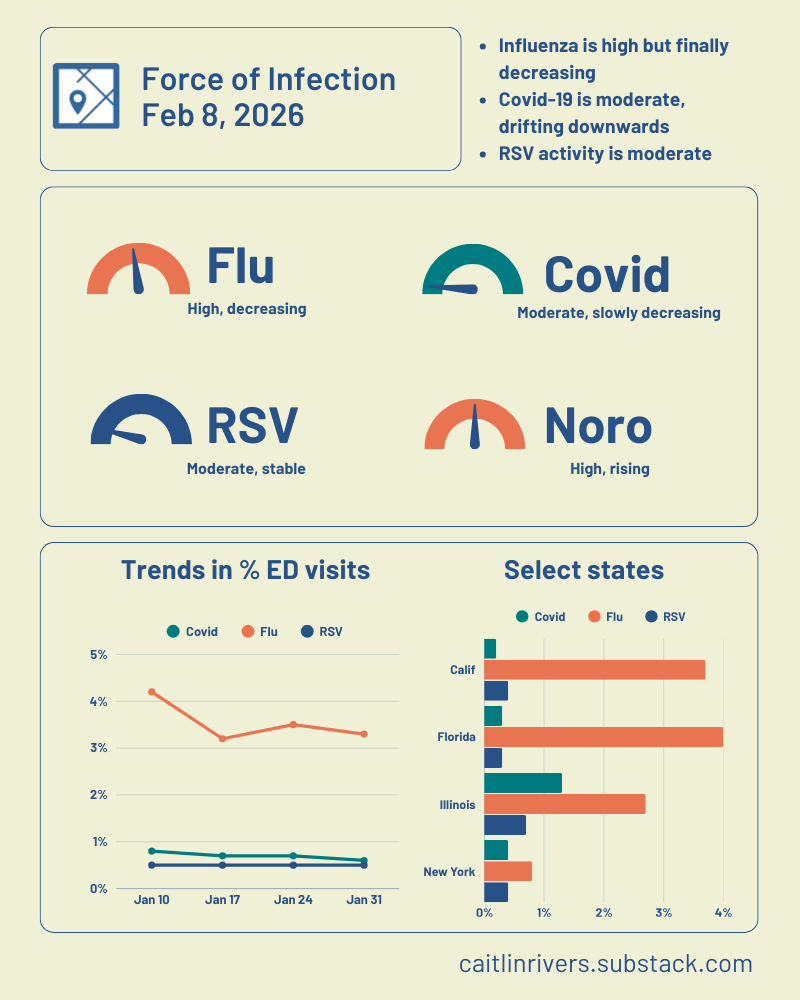
All three major respiratory diseases are hanging around stubbornly
Respiratory Diseases
Influenza remains quite elevated across most of the country, with most states reporting moderate, high, or very high activity. The Northeast is in the best shape with consistent declines. Other regions of the country are taking a little longer to turn the corner.
The youngest children, as usual, have outpatient ILI rates that are substantially higher than all other age groups, accounting for 12.2% of all trips to the doctor, but this represents a slight improvement over last week. Outpatient ILI was flat for those aged 5-24 (8.2%) and 25-49 (3.7%), but decreased slightly for older age groups (to 2.4% for those aged 50-64, and to 1.8% for those 65+).
Severe illness is continuing to improve. Emergency department visits decreased slightly to 3.3%. Hospitalizations have decreased to 2.2 hospitalizations per 100,000 people nationally, which is a marked decline from the end of December, when the rate spiked to 13.1 per 100,000.
Get detailed, state-specific public health updates by upgrading to regional editions, available to paid subscribers. Stay informed where it matters most to you.
Covid-19 is in a grey zone, neither increasing nor decreasing with any vigor. Wastewater activity increased to moderate activity nationally, but ED visits have dipped slightly to 0.6%. Hospitalizations have been consistently declining for the past several weeks, and decreased again this week to 0.8 hospitalizations per 100,000 people.
Activity is highest in the Midwest, where wastewater concentrations of SARS-CoV-2 are very high again, having risen for two weeks in a row. In the Northeast, activity is moderate and increasing. In contrast, activity is low and decreased slightly this past week in both the South and West.
RSV: RSV activity continues to be elevated across the country. Test positivity is up to 7%, higher than it has been all season. ED visits are highest in the South (~0.7%). The West and Midwest are tied for the lowest (~0.5%). Hospitalizations remain elevated, but have decreased slightly, down to 1.6 hospitalizations per 100,000 people.
Other bugs: Lots of respiratory bugs circulating right now.
Human coronaviruses are on a rapid ascent right now, and have nearly reached last season’s peak (which was in late February).
Human metapneumovirus is climbing as well, and adenovirus is elevated.
Rhinoviruses/enteroviruses are low but have been slowly increasing for the past few weeks.
Norovirus
Norovirus loves February. Activity is high and climbing across the country. While rates are not stratospheric like last season, we are at typical (high) levels for this time of year. Test positivity was 13.5% at the national level, with the Northeast in worst shape at 15.8%.
Food recalls
The following foods are being recalled because they are contaminated. Please check your cupboards and throw out any of these items:
New:
Dried Croaker Fish (more info)
Previously Reported:
Gerber(R) Arrowroot biscuits (more info)
IKM cookware products (primarily sold in California grocery stores) due to potential lead contamination (more info)
Organic chia seeds sold by Navitas Organics (more info)
Live it Up Super Greens powders and packets in Original and Wild Berry flavors (more info)
Canned yellowfin tuna in olive oil under the Genova brand name (more info)
In other news
FOI Clinical launches this Wednesday. It’s a weekly outbreak intelligence briefing for clinicians, covering reportable diseases, emerging outbreaks, and policy changes that affect patient care plus real-time health alerts for fast-moving events. Medscape and NPR have both covered FOI Clinical. The first edition will include detailed analyses of measles, pertussis, meningococcal meningitis, and more. Pre-launch pricing ($10/month) is still available. If you’re a clinician, or you would find this useful, now is the time: foiclinical.com.
Measles outbreak in Jalisco, Mexico — home to one of the host cities of the 2026 World Cup. So far this year, Mexico has had nearly 2,000 confirmed cases, and more than 5,200 suspected cases of measles. The epidemic started after a child infected in Texas returned home to Mexico. About 60% of confirmed cases (and about 40% of suspected cases) have been in Jalisco state. Just as in Canada and the United States, measles spread is linked to decreasing vaccination rates. Schools in parts of Guadalajara (where one of the World Cup stadiums sits) are requiring masks for the next month, and there were recently school closures elsewhere in Jalisco state to try to contain measles spread. There is a risk that, as international travelers come to the city for the World Cup, the outbreak could further expand.
Norovirus outbreak at the Winter Olympics. The Finnish women’s hockey team has reported a norovirus outbreak. With 13 players infected or in quarantine, the Finnish team postponed a game on Thursday, February 5th, against Canada; it has been rescheduled to February 12th. Norovirus spreads extremely well in tight quarters — such as among traveling athletes. The decision to postpone the game and quarantine those players will reduce the risk of norovirus spreading further among the athletes present for the Games.





.jpg)
No comments:
Post a Comment