-------------------------------------------
COVID probably killed 150,000 more people in its first two years than official U.S. tolls show. "We have severely undercounted the number of COVID deaths", scientists say.
By Meghan Bartels edited by Tanya Lewis
"COVID may have killed significantly more people in the U.S. in the first two years of the pandemic than official records indicate, with as many as one overlooked death for every five recorded ones. That brings the total to nearly one million deaths just in 2020 and 2021.
"That calculation comes from research published today in Science Advances that seeks to understand how many COVID deaths fell through the cracks of official reporting systems. The untallied cases show the burden of the pandemic in the U.S. fell most heavily on marginalized people.
“These vulnerable groups are just taking a higher risk at every step, and the accumulation of all of that is this disparity in COVID mortality at the end,” says Mathew Kiang, an epidemiologist at Stanford University and a co-author of the study.
"In the new research, Kiang and his colleagues analyzed official records published by the Centers for Disease Control and Prevention for deaths occurring from March 2020 through December 2021 for adults aged 25 and older—some 5.7 million records in all. First, they fed a machine-learning algorithm the records of deaths in hospitals, which at the time were testing most patients for COVID. They trained the algorithm to recognize hospital deaths in which COVID was formally identified as an underlying cause. Then they used the algorithm to flag potential unrecognized COVID deaths by identifying records that looked like hospitalized COVID deaths but occurred in other settings where testing was less likely.
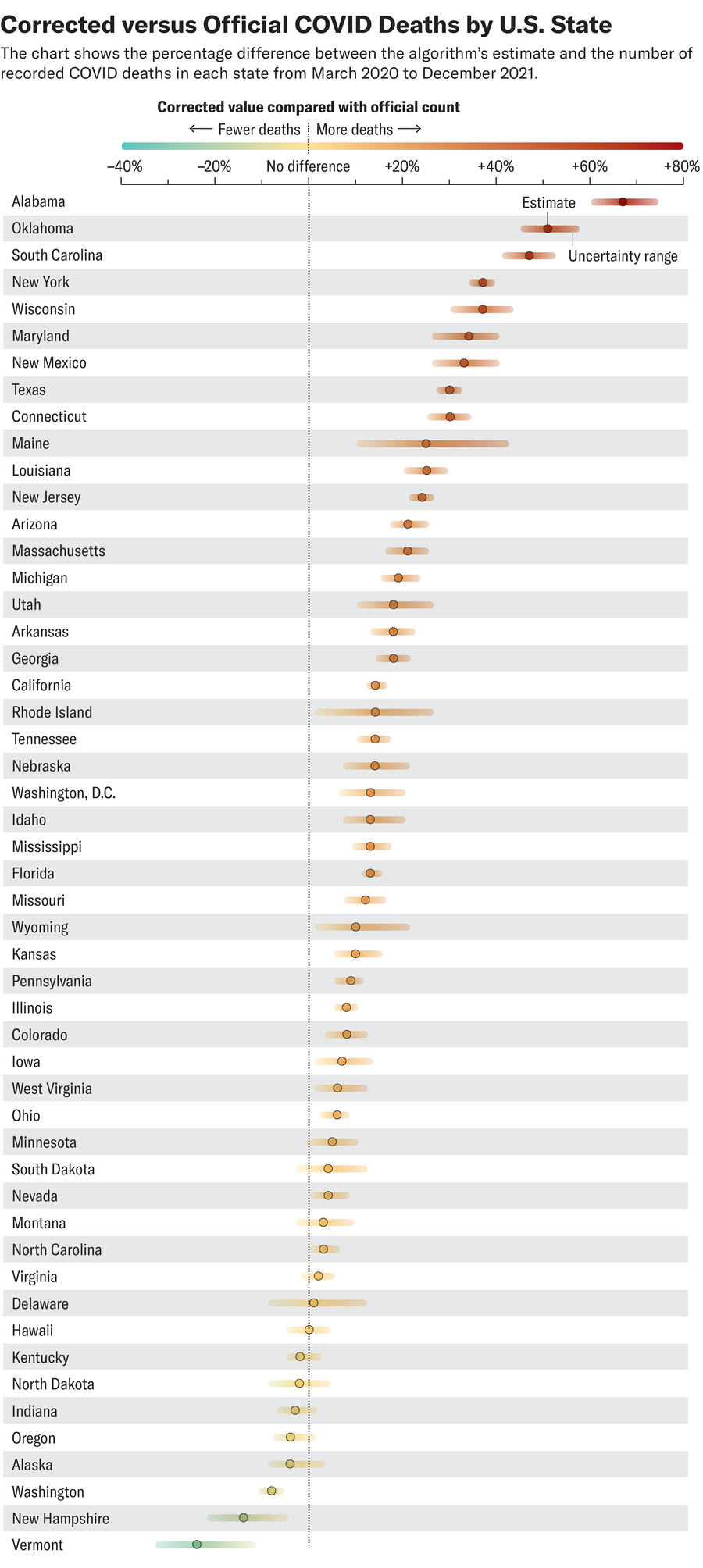
"All told, the algorithm identified between about 150,000 and 160,000 potential unrecognized COVID deaths on top of the 840,251 that were officially reported. Those numbers suggest that for every five recognized COVID deaths, one additional death went unmarked. That ratio is on par with other analyses that have simply compared the total observed number of deaths with the number of total deaths expected based on historical data, says Daniel Weinberger, an epidemiologist at the Yale School of Public Health, but the new method is both more sophisticated and more granular.
"Kiang says it isn’t surprising that deaths resulting from COVID were missed. “Death reporting in the United States is a fragmented infrastructure that’s underresourced,” he says. “During the pandemic, it was highly strained. We had more deaths than we’d ever had” in modern history.
"But what stood out to him were the patterns behind the unrecognized likely COVID deaths: they were most likely to have occurred among Hispanic people, at home, among less educated people, and among people with lower incomes. When analyzed by state, Alabama, Oklahoma and South Carolina had the highest ratios of such deaths.
"Those patterns tell an important story about how COVID unfolded within the U.S. and its fragmented health systems. “This underreporting that we found wasn’t random,” Kiang says. “Pretty systematically, what we found was that communities in areas that were most impacted by the pandemic were also the ones with the most unrecognized COVID-19 mortality.” By analyzing the dramatic case of the COVID pandemic’s early years, researchers can better understand how the same factors that made people vulnerable to COVID affect more routine health conditions, Kiang says.
"During the pandemic, “systems in our society, including barriers to accessing health care, kept desperately ill Americans from recognizing the need for care and getting to the hospital,” says Steven Woolf, a physician and social epidemiologist at Virginia Commonwealth University, who was not involved in the new research. He worries not only that those barriers remain but also that cuts to Medicaid and increasing health insurance premiums may be exacerbating them. “People on the margins continue to die at disproportionate rates because they can’t access care.”





.jpg)
No comments:
Post a Comment