-------------------------------
Outbreak Outlook: Week 3 of DIY Surveillance. Slow start to the flu and RSV seasons, COVID-19 quiet
Caitlin Rivers, Oct 18, 2025
For the third week in a row, the federal government shutdown has prevented the CDC from publishing data about seasonal respiratory virus activity like COVID-19 and flu.
Millions of Americans live with compromised immune systems, chronic illness, and plenty more simply don’t want to get sick. They rely on infectious disease updates to make decisions to keep themselves and their families safe. The absence of accessible data makes it harder to navigate whether and when to avoid crowds, mask, get vaccinated, and more.
To fill the gap, Force of Infection has been visiting all 50 state websites plus Washington, D.C. to get the latest on what’s going around. You’ll find those updates at the bottom of this report.
If you’re just joining this newsletter, Force of Infection publishes a weekly report on seasonal respiratory virus activity, food recalls, and other public health updates. I share detailed data and analysis year-round, including state by state information during the winter months in regional editions.
Since the shutdown has made it harder to get high quality information, all reports will be free until the government reopens.
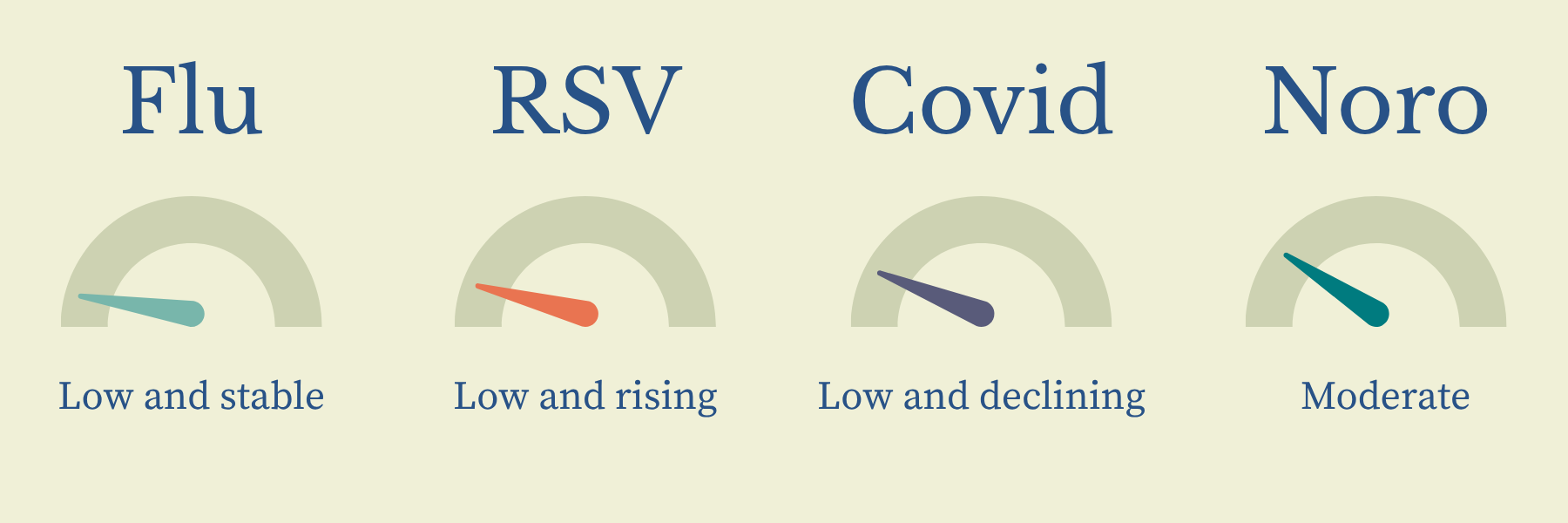
COVID-19 activity continues to fall around the country, with many states now entering low or even very low territory. All indicators, including emergency department visits, hospitalizations, and test positivity, are in agreement that the outlook is improving.
Influenza-like illness and RSV also remain low in all regions of the country. There has been a very slight increase in RSV activity in children under the age of five in some parts of the country, but we’re still at low levels.
Norovirus wastewater activity generally remains low, but increases are evident in several regions. In the South, activity is moderate. In the Midwest and Northeast, norovirus crept up slightly this past week and is just shy of moderate activity. Activity is low and flat in the West.
The following foods are being recalled because they are contaminated. Please check your cupboards and throw out any of these items:
New:
Ben’s Original long grain white, whole grain brown, and long grain & wild ready rice products (more info)
Sprouts Farmers Market Smoked Mozzarella Pasta Salad available at deli counters or in the ‘Grab & Go’ section (more info)
Raw Bistro Pet Fare Frozen Beef Entrée [for dogs]. This product may be contaminated with Salmonella, which can sicken both pets that consume, and humans who may handle such products or come in contact with surfaces that have been contaminated by them (more info)
Raw Dog Barkery, BellePepper Cats, and Kanu Pets freeze-dried pet treats [for dogs and cats] (same as above) (more info)
More brands of cinnamon have been added to the recall for elevated lead levels that has now been ongoing for over a year. The list now includes HAETAE-brand and Roshni-brand ground cinnamon (more info).
My family got our flu and COVID-19 shots this week. There is still plenty of time to get yours, if you haven’t already. I usually aim for before the end of October, but activity is off to a slow start this year, so there’s some wiggle room with timing.
President Trump suggests that aluminum will be removed from vaccines. Very small concentrations of aluminum salts are used in many vaccines as adjuvants—an ingredient that boosts the immune response, and therefore increases vaccine effectiveness. Vaccines that include aluminum salts include those for tetanus, pertussis, diphtheria, and hepatitis A and B, among many others. The aluminum salts used in vaccines have demonstrated safety records dating back decades. There is no credible link to autism.
Aluminum cannot be easily removed from existing vaccines, and attempts to formulate effective vaccines without them may take years. It is not clear what steps the federal government may take to respond to Trump’s statement. Options include revoking FDA approvals for vaccines that contain aluminum, adding a warning label, or altering CDC vaccine recommendations. However, it is clear that this move runs the risk of further undermining confidence in, and access to, lifesaving vaccines.
A look ahead to our flu season. In Japan and Malaysia, influenza activity is substantially higher than what is usually seen this time of year. This comes on the heels of Australia’s rough flu season, which takes place during our summer (their winter). These experiences could hint that the circulating flu strains this year might make for another worse-than-average flu season. On the other hand, the Center for Forecasting and Outbreak Analytics at U.S. CDC is expecting a typical year.
Alabama:
Respiratory illness continues to decline in Alabama; 0.7% of visits to the emergency department are now for any respiratory virus, down from a recent high of 2.6%.
Most of the decrease is driven by COVID-19, which has fallen to 0.3% of visits to the emergency department. Influenza-like illness has fallen slightly as well to 0.2%.
RSV activity remains very low but is increasing slightly.
Alaska:
COVID-19 activity is declining in Alaska. Activity remains well below what is typically seen this time of year. COVID-like illness has fallen to 1.6% of visits to the emergency department, down from a recent high of around 2%.
RSV activity remains minimal, well below what is currently seen this time of year.
Influenza-like illness activity is also low, currently constituting 1.6% of visits to the emergency department. ED visits are below baseline, which marks the beginning of the season.
Arizona:
COVID-19 activity is very low in Arizona with 0.5% of visits to the emergency department for COVID-19. Hospitalizations are very low as well.
Influenza activity is low in the state; 1.6% of visits to the doctor are for fever and cough or sore throat, which is below the 3% state threshold that marks the beginning of flu season. Visits to the emergency department for influenza are minimal.
RSV activity is minimal in Arizona.
Arkansas:
It looks like flu activity is still very low in Arkansas. The state only requires reporting of influenza hospitalizations, deaths, and outbreaks. They do not track other indicators, such as test positivity, wastewater data or trips to the doctor or emergency department. As the Arkansas Department of Health notes, this means that, while useful to get a sense of trends over time, the available data likely do not represent the true burden of disease in the state and also are not great at giving early warning of rising community spread.
No data on RSV.
California:
Not much is happening right now in California when it comes COVID-19, flu, or RSV.
COVID-19 activity is low across all indicators (test positivity, ED visits, and hospitalizations).
RSV and flu are both very low across all regions of the state.
Colorado:
COVID-19 activity is low and declining in Colorado. 0.4% of visits to the emergency department are from COVID-19, down from last week. Wastewater concentration is low and declining across the state as well. Test positivity has leveled out at 5%, down from a recent high of 13%.
Influenza activity is also low and stable. Just 0.1% of visits to the emergency department are for influenza, and test positivity remains low.
RSV activity is minimal.
Connecticut:
Following the late summer wave, reported cases of COVID-19 are back down to the low levels they were at for much of May-June. Wastewater activity is very low as well. Hospitalizations are still a bit elevated, however.
Over the past few weeks, the number of RSV cases has slightly ticked up but still remains very low. In numbers, reported cases have moved from single digits per week up to more around 15-20. To put this in context, at the last peak in January, there were over 1,000 per week. (Keep in mind that reported cases does not equal total cases — most cases of RSV are not reported. Nevertheless, reported cases are still useful to get a sense of community spread.)
Connecticut’s data on ED visits for respiratory illnesses appears not to have updated this past week, so nothing to add on that.
Delaware:
COVID-19 activity is low in Delaware. 1% of visits to the emergency department are for COVID-like illness, and inpatient hospitalizations have been falling as well. Wastewater concentration is low.
Influenza activity is very low with zero hospitalizations reported. Around 10% of the population has been vaccinated for influenza so far this year. Wastewater concentration of influenza is also minimal.
Wastewater concentration of RSV is minimal.
Florida:
RSV activity is minimal but increasing in Florida. The number of children under the age of five who were admitted to the hospital with RSV remains low but increased from around 100 to 150. Two outbreaks were reported in the southeastern part of the state. Emergency department visits for RSV are highest in the southeastern part of the state as well.
Influenza activity is minimal and stable in Florida, with around 2.5% of visits to the doctor for fever and cough or sore throat. Emergency department visits for ILI are low and stable as well. All regions of this state look good.
Georgia:
“Due to the lapse in federal appropriations and associated federal government shutdown, some data required for the Georgia Influenza Report are not available. As a result, the weekly report will be paused until federal operations and data sharing resume.”
Hawaii:
COVID-19 is down and flu is up in Hawaii — the lines on the charts for test positivity and ED visits for the two diseases have now crossed each other, with flu on top.
As COVID-19 continues to fall, trips to the ED are now down to 0.4% of all ED visits. Rates haven’t been that low in the state since March. Hospitalizations have also fallen substantially and now account for 1.1% of all hospital admissions (compared to 5.3% in late August).
For flu, test positivity remains fairly low, but it has more than doubled in the past two weeks, as have ED visits and hospitalizations.
RSV season has arrived, with moderate and increasing trips to the ED, and increasing test positivity.
Idaho:
COVID-19 is low and declining in Idaho with 1.4% of visits to emergency rooms for COVID-like symptoms. This is down from a recent high of 3% in late August. Test positivity is also declining.
Flu is low and pretty flat, accounting for 1.2% of visits to urgent care and the emergency department.
RSV remains very low but there has been a tiny little increase in test positivity this past week that likely heralds more increases to come. However, visits to urgent care clinics and emergency departments remain minimal and flat for the time being.
Illinois:
Overall, acute respiratory illness is low and declining in Illinois.
COVID-19 is pretty low and falling, with declining trips to the ED, hospitalizations and test positivity.
Flu and RSV are both minimal, with no signs of increase in ED visits or hospitalizations. However, there has been a very slight increase in test positivity for both diseases over the past few weeks.
Nevertheless, rhinoviruses/enteroviruses – a common cause of colds – continue to circulate widely in the state, with 22.3% test positivity, several magnitudes greater than for COVID-19 (2.4%) or flu (0.4%). A few other causes of cold and flu-like illness (mycoplasma and parainfluenza) are also circulating right now in the state.
Indiana:
Data from Indiana is one week behind. For the week ending October 4th, just 1.4% of visits to the doctor were for fever and cough or sore throat. This is a slight increase from the week previous, but is nonetheless very low. Rates are highest in children ages 0 to 4, with 5.8% outpatient ILI, a full point up from the previous week. This is expected this time of year, but does signal that flu is beginning to stir.
Activity is very low in Indiana, well below what is typically seen this time of year. Hospital admissions, emergency department visits, and wastewater concentration are all low and falling.
I also happened upon the state’s mpox dashboard. Ten cases have been reported so far in 2025, including one case in the last week. This is a decline from the high in 2022 of 285 cases. The vast majority of cases are male, ages 18 to 39. The virus is most commonly spread through sexual contact between men.
Iowa:
Respiratory surveillance for the fall has now started.
The late summer wave continues to recede. COVID-19 test positivity is low and has been on the decline over the past few weeks, though it remains quite a bit above the lows from mid-summer. Trips to the emergency department and hospitalizations for COVID-19 have also declined over the past month.
Trips to the emergency department for flu are very low, as is test positivity.
RSV test positivity, emergency department visits, and hospitalizations are also very low and stable, showing no signs of increase (yet).
Rhinoviruses/enteroviruses – a common cause of colds – are spreading widely right now in Iowa, higher than at any other point in the past year, with 33.6% test positivity.
Kansas:
COVID-19 activity continues to decline in Kansas with 0.3% of visits to the emergency department for COVID-19, down from a recent high of 1% in early September.
Both influenza and RSV activity remains minimal. There has been a very slight increase in pediatric visits to the emergency department for RSV, rising to 0.2%. This is far below seasonal peaks of around 5%, which often occur in the December to February time frame.
Kentucky:
COVID-19 activity is very low in Kentucky. ED visits and inpatient encounters for COVID-19 are near zero.
Influenza-like illness is also minimal in Kentucky, with around 0.6% of visits to the doctor for fever and cough or sore throat. This is well below what is typically seen this time of year in the state.
Louisiana:
COVID-19 is low and falling. ED visits are back down to the low levels they were at before the small late summer wave, as have hospitalizations. Test positivity is similarly quite low.
Flu is low. Test positivity is increasing steadily, but there are no clear increases in trips to the ED or hospitalizations yet.
RSV also remains very low and flat overall. However, trips to the ED for RSV for the youngest children – aged 0-1 and 2-4 – have been steadily increasing over the past few weeks. Test positivity is also rising.
Maine:
COVID-19 activity is low and declining/stable in the state following a peak in mid-September. Visits to the emergency department room for COVID-like symptoms have fallen to 1.2%, down from a recent high of 1.5%. Inpatient hospitalizations for COVID-19 are low and stable. There have been approximately 84 deaths from COVID-19 reported in Maine so far this year; 57 (68%) of those were in people over the age of 80.
Influenza-like illness is low and stable in Maine. 1% of visits to the emergency department are for influenza-like symptoms.
Maryland:
Things look pretty quiet in Maryland right now. COVID-19 is low, having rapidly declined after a peak at the beginning of September. Test positivity and hospitalizations haven’t quite reached the lows they were at in mid-summer, but they appear to be on their way there.
Flu activity remains minimal, with outpatient visits for influenza-like illness still well below the baseline for the start of flu season.
RSV looks quiet but Maryland is only reporting RSV hospitalizations. Since hospitalizations are a lagging indicator, activity might be picking up already, as it is in some several other states.
Massachusetts:
COVID-19 is low and declining in Massachusetts, with 0.5% of visits to the emergency department for COVID-19, down from a recent high of 1.2%. People over the age of 80 have the highest rate of emergency department visits, followed by children under the age of five. Current activity is below what is typically seen this time of year in the state.
Influenza and RSV activity are both minimal, although there has been an increase in RSV-related visits to the emergency department in children under the age of five. Still, RSV activity remains low.
Michigan:
COVID-19 activity is declining in Michigan, according to emergency department visits. Hospitalizations are also low and have remained stable for a couple of weeks. There have been 18 outbreaks reported across the state in the last two weeks, most in long-term care facilities. Approximately 4% of people have received their COVID-19 vaccine so far this season. Coverage is highest in Washtenaw County at 9%.
Influenza and RSV activity is minimal. Around 10% of people have received their influenza vaccine so far this season.
Minnesota:
COVID-19 is low and declining in Minnesota. Just 0.3% of visits to the emergency department are for COVID-like illness, down from a recent high of 0.9% in early September. Inpatient hospitalizations are declining as well. Just 5% of Minnesotans have received their annual COVID-19 vaccine so far this year. 17% of adults over the age of 65 have been vaccinated against COVID-19 this season. Children have the lowest coverage at around 1%.
Influenza-like illness is minimal and stable in Minnesota with just 0.1% of visits to the emergency department for fever and cough or sore throat. Inpatient hospitalizations for influenza are minimal as well. Approximately 12% of state residents have received their influenza vaccine so far this year. Older adults are leading with 27% of people over the age of 65 already vaccinated. Children ages 0 to 19 have lowest coverage at 6%.
RSV activity remains minimal in the state, but there has been a slight increase in test positivity, which is typical this time of year. RSV is usually the first seasonal respiratory virus to stir.
Mississippi:
COVID-like illness and influenza-like illness are both low in the state. Mississippi makes very little surveillance data available.
Missouri:
Influenza-like illness is minimal in Mississippi. 0.8% of visits to the emergency department are for influenza-like illness, well below what is typically seen this time of year. Test positivity for influenza is very low as well.
Montana:
COVID-19 cases have declined precipitously since mid-September and are down to low levels.
Flu remains minimal and flat, and well below the threshold the state uses to determine that there is statewide circulation.
RSV also remains very low, and is below the threshold the state uses for the start of RSV season.
Nebraska:
COVID-19 appears to be quite low and stable in Nebraska, with very low trips to the ED for Covid-like illness, test positivity, and hospitalizations.
Nevada:
“Due to the Nevada state-wide network outage, we are not currently able to update dashboards.”
New Hampshire:
Influenza-like illness remains low and stable and RSV shows no signs of increases yet. (Note: the report released this week includes information up through the week ending October 4, so does not fully capture any recent changes that may have occurred).
COVID-19 wastewater across the state is primarily in the low to moderate range, and is minimal for RSV and flu. I was not able to find any additional data for COVID-19 for the state.
New Jersey:
COVID-19 activity is declining in New Jersey with just 0.4% of visits to the emergency department for COVID-19, down from a recent high of 0.9% in September. Inpatient hospitalizations are low and declining as well. Wastewater concentration is very low.
Influenza and RSV activity are minimal. There has been a very small increase in visits to the emergency department from influenza, but only rising to 0.2%.
School absenteeism due to influenza and COVID-19 are minimal.
New Mexico:
COVID-19 activity in New Mexico is low and declining, with 0.7% of visits to the emergency department for COVID-like illness. This is down from a recent high of 1.3%. Test positivity is falling as well.
Respiratory virus activity is lower than what the state currently sees this time of year. Influenza and RSV activity are both minimal in the state.
New York:
Quiet fall in NY. Trips to the emergency department for COVID-19 are low and decreasing, though they remain a bit elevated above where they were in mid-summer. Hospitalizations remain moderately elevated.
Flu surveillance has not yet started for the state this fall.
In NYC specifically, COVID-19 is low and falling, and both flu and RSV remain minimal and flat.
North Carolina:
COVID-like illness continues to fall in North Carolina with 1.6% of visits to the emergency department for COVID-like symptoms, down from a recent high of 4.1%. Hospital admissions and wastewater concentration are declining in the state as well. Current activity is below what is typically seen this time of year.
Influenza-like illness and RSV are also very low in the state, both constituting less than 1% of visits to the emergency department. As in many other parts of the country, rhinovirus/enterovirus that cause the common cold are the most common respiratory viruses circulating right now.
North Dakota:
COVID-19 activity is stable in North Dakota. The number of reported cases remained about the same last week compared to this week. Hospitalizations have decreased to 13 from a recent high of 24 in late September. Test positivity is rising, but that may reflect a change in testing behaviors more so than increased activity.
Influenza and RSV activity are minimal.
Ohio:
Data not updated.
Oklahoma:
Test positivity for COVID-19 is at 3.9%, which is below the statewide baseline of 10% that marks elevated activity. Hospitalizations for COVID-19 have been declining since early September. Wastewater concentration is very low and stable.
Influenza activity is low with 2.2% of visits to the doctor for fever and cough or sore throat. Test positivity and hospitalizations are low as well.
RSV activity is minimal. Test positivity is 0.3%, well below the 10% threshold that marks elevated activity. Wastewater concentration is very low as well.
Oregon:
Test positivity for COVID-19 is falling in Oregon. 8% of tests are positive, down from a recent high of 21%. Wastewater concentration is declining as well. Five COVID-19 outbreaks were reported in long-term care facilities during the week ending October 11th, which is slightly less than the 8 to 14 reported in recent weeks. Wastewater concentration for RSV and influenza are very low as well.
I had a difficult time interpreting other data from Oregon because some of it seems to be drawn from CDC and is thus out of date.
Pennsylvania:
COVID-19 activity is very low in Pennsylvania. 0.3% of visits to the emergency department were for COVID-19, and wastewater concentration is low.
Influenza and RSV activity are minimal.
Rhode Island:
COVID-19 activity is declining in Rhode Island. 0.4% of visits to the emergency department were for COVID-19, down from a recent high of 1%. Hospital admissions rose slightly in the week ending October 11th, but remain at very low levels. Adults ages 65+ have the highest rates of hospitalization.
Influenza and RSV activity are very low in Rhode Island. Around 1.5% of visits to the doctor were for fever and cough or sore throat. There has been a slight increase in RSV activity according to ED data, but activity still remains minimal.
South Carolina:
COVID-19 is falling in South Carolina with 0.6% visits to the emergency department from COVID-19, down from a recent high of 2.8%. Current activity is below what is typically seen this time of year. I do note a slight uptick in the 18 to 49 and 0 to 4 age groups, but that comes after more than a month of steady declines.
Influenza-like illness and RSV are both low and stable. However, there have been three consecutive weeks of increase in RSV visits to the ED in the 0 to 4 age group. Nonetheless, activity remains very low.
South Dakota:
Influenza activity is low in South Dakota, with 26 visits to the emergency department for COVID-like illness, 15 visits for influenza-like illness, and zero for RSV. (South Dakota is one of the few states that reports data by counts.)
I did notice that during the 2024-2025 school year, 90% of South Dakota kindergartners had received their MMR vaccine, which is below the recommended 95% threshold. South Dakota has not reported any measles cases since June.
Tennessee:
COVID-19 activity is low and declining in Tennessee, with just 0.3% of visits to the emergency department for COVID, down from a recent high of 1.3%. Children 0 to 4 are most affected, followed by people aged 65+. Current activity is well below what is typically seen this time of year in the state.
Influenza and RSV activity are both low in Tennessee, with no notable increases across any age groups. Activity for both viruses is well below what is typical for this time of year.
Texas:
The late summer COVID-19 has fully receded. ED visits are back down to the same low rates Texas saw in mid-summer, and hospitalizations are low.
Flu remains minimal and flat.
RSV season is starting in Texas. Trips to the ED for RSV have more than doubled in the past few weeks. Hospitalizations have also increased slightly over the past few weeks for those aged 0-4.
Utah:
COVID-19 is quite low across much of Utah, with just 0.3% of ED visits due to Covid-19. Wastewater activity is low or very low in ~85% of wastewater sites in the state, and is increasing in just 2.9% of sites. Hospitalization data have not been reported for the past few months.
Influenza-like activity and hospitalizations for flu are minimal and appear stable, though data reporting just started for this season for the state and there are only two weeks of data points available.
RSV test positivity is minimal and stable, with no signs of an increase.
Vermont:
COVID-19 activity remains low in Vermont with around five visits to the emergency department per week, down from a recent high of around 10. Six COVID-19 outbreaks were reported in long-term care facilities between October 7th and October 13th.
Influenza-like illness is minimal in Vermont, with less than 1% of visits to the emergency room or urgent care due to fever and cough or sore throat.
Virginia:
All three major respiratory viruses are minimal in Virginia right now. Just 0.4% of visits to the ED for COVID-19, while influenza and RSV are both at 0.1%. This is well below what we currently see this time of year.
For COVID-19, children age 0 to 4 are most affected, representing 0.8% of visits to the emergency department.
Of note, RSV activity has risen for approximately four weeks in a row in the 0 to 4% age group, so further increases in RSV activity are likely in the weeks ahead.
Washington:
COVID-19 activity is low and declining in Washington, with 0.7% of visits to the emergency department for COVID-19, down from a recent high of around 2%. Adults age 80 plus have the highest rates of ED visits, followed by people ages 65 to 79. Hospitalizations and ICU stays for COVID-19 are declining as well and remain well below typical levels seen this time of year.
Influenza activity remains minimal.
Washington, D.C.:
COVID-19 activity is low in Washington, D.C., with very few hospitalizations or reported cases.
Reporting for flu has started for the fall. ILI activity remains well below the baseline for the region, and is well below where it has been this time of year for the past couple years.
West Virginia:
West Virginia notes that “Due to the federal shut down several sections of the dashboard will not be able to be updated.”
Covid-19 test positivity is coming down from the peak in mid-September, as are ED visits for Covid-like illness. Hospitalizations have declined to a low 0.61.
Flu test positivity is low and stable. ED visits for ILI were elevated about a month ago and have been on the decline for the last several weeks, but ED visits for ILI and Covid-like illness have near-complete overlay on the chart – suggesting that this was more due to the increase in Covid-19 than true influenza activity.
Wisconsin:
Covid-19 has decreased back down to minimal levels. Just 0.4% of all ED visits were due to Covid-19 in the past week and wastewater data is low or very low across most sites in the state. Hospitalizations are still a bit higher than they were before the late summer wave, but are on a declining path.
Flu and RSV remain at minimal levels, with no increase in trips to the ED.
A common cause of colds – rhinoviruses/enteroviruses – is spreading widely in the state right now, and parainfluenza cases are also rising.
Wyoming:
COVID-19 is still declining from its peak at the end of September.
Flu and RSV remain minimal, with no signs of the usual fall increase.





.jpg)
No comments:
Post a Comment