----------------------------------
Outbreak Outlook: Week 2 of DIY Surveillance; State by state disease surveillance of COVID-19, influenza and RSV amid federal public health cuts
Caitlin Rivers, Oct 11, 2025
Last night, the CDC was devastated by layoffs that eliminated whole offices. The Inform Division, which I helped to start at the Center for Forecasting and Outbreak Analytics, was among those affected. According to an unconfirmed report published by Inside Medicine, the list of layoff targets also includes a number of other offices focused on communication and disease surveillance (among other functions), which could be particularly disruptive to the public’s ability to get high quality information.
Meanwhile, for the second week in a row, the federal government shutdown has interfered with public reporting of surveillance. No new information has been published on disease activity since September 26.
I am furious and sad for my colleagues, and scared for public health.
Team Force of Infection is doing what we can to fill the gap. We once again visited all 50 state websites + DC to check on COVID-19, influenza, and RSV activity. The details of what we found are below. You may need to open the email in your browser to get the full report.
All reports during the shutdown will be free for everyone. Please share this post so others can find it.
P.S. My book, Crisis Averted, is on sale at Amazon for $14. One critic called it a “love letter to public health” so if you need something to hold on to, check it out.
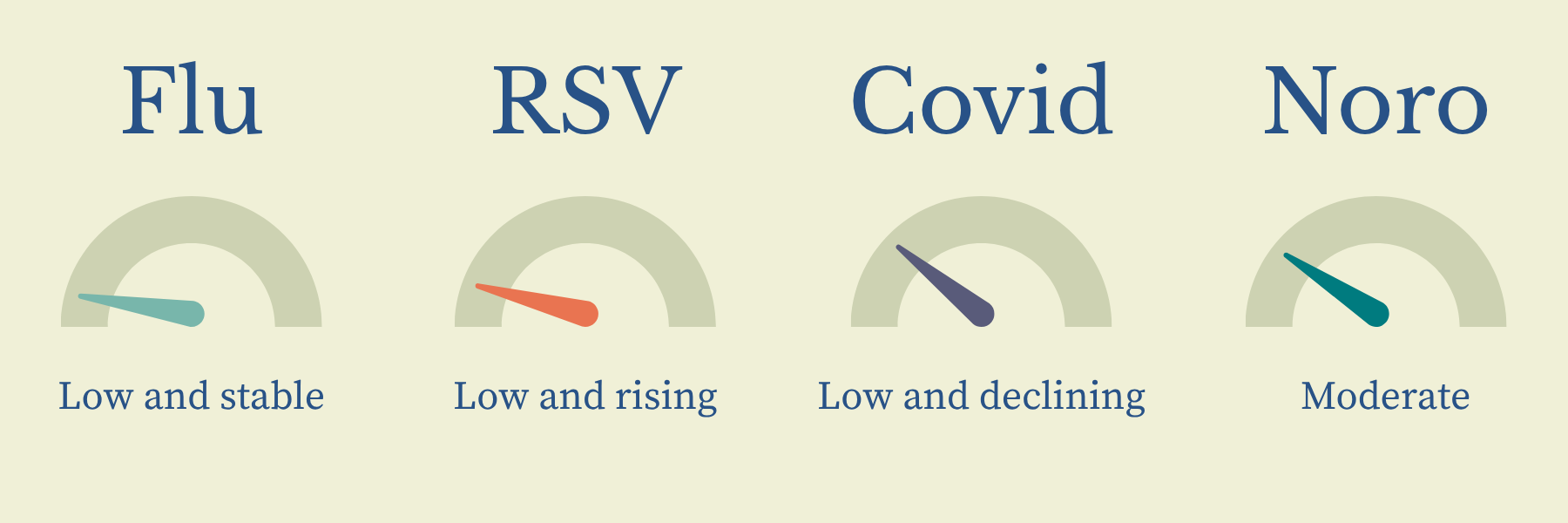
At the national level, COVID-19 activity continues its steady decline following the summer wave. Emergency department visits have fallen to very low levels across most of the country, with the majority of states now reporting between 0.3% and 1.8% of ED visits for COVID-19. Nearly all regions are showing improvement, with particularly strong declines in the Southeast (Tennessee at just 0.3%) and Midwest (Illinois and Kansas both at 0.4%). A few states remain slightly elevated, but the overall trajectory has been several weeks of decrease.
Influenza activity remains minimal nationwide, with all regions reporting rates well below seasonal thresholds. However, we’re starting to see the tiniest hints of movement. Oklahoma and South Dakota are showing small increases in influenza-like illness, and Texas ED visits ticked up slightly this past week, though all remain at very low levels.
And while RSV activity remains low overall, it is stirring in some regions. Louisiana stands out with test positivity jumping to 3.9% from 0.9% in mid-September, and emergency department visits are rising among young children in Louisiana, South Carolina, and Virginia. Texas is also seeing increases in both ED visits and hospitalizations for children ages 0-4. Other regions are showing subtler signs, but I do expect the season to begin in earnest in the weeks ahead.
The following foods are being recalled because they are contaminated. Please check your cupboards and throw out any of these items:
New:
Ready-to-eat meals containing riced cauliflower sold by Blue Apron and Marley Spoon (more info)
Ready-to-eat meals containing spinach sold under the Hello Fresh label (more info)
Durra ground cinnamon sold at stores in California and Michigan (potential lead contamination) (more info)
Del Mar bulk organic frozen spinach and Sno Pac organic frozen cut spinach (more info)
Basil Pesto Bowtie Salad and Smoked Mozzarella Penne Salad sold in Kroger Family of Stores, including, among others, Kroger’s, Baker’s, City Market, Dillons, Payless, Ralphs, and Smith’s (more info)
Dozens of CDC officials were fired late Friday night. Reportedly, the firings include the entire Washington office which works with Congress, the Epidemic Intelligence Service officers who track infectious disease outbreaks (sometimes called “disease detectives”), and the staff of Morbidity and Mortality Weekly Reports. While the exact details of the layoffs are still coming to light, and the firings are likely to be contested in court, it remains deeply troubling news. Public health infrastructure has suffered blow after blow to our ability of the county to prevent, prepare for, or respond to outbreaks and epidemics.
Lingering confusion over COVID-19 vaccination access for pregnant individuals. Months ago, HHS Secretary RFK Jr. removed the recommendation for pregnant individuals to receive Covid-19 shots, despite the substantive risks of Covid-19 infection during pregnancy and infants too young to receive the vaccination. However, in September’s meeting of ACIP (which advised adults to engage in shared decision-making with their medical providers about receiving the vaccination) appears to have included pregnant individuals. If so, this means that the move by ACIP may have (inadvertently?) overturned the HHS Secretary’s decision. There is uncertainty regarding whether the ACIP members intended to do this.
Alabama:
COVID-19 continues to decline in Alabama, with trips to the ED falling again this past week, down to 0.44% of all trips to the ED.
Both flu and RSV remain very low. However, both had teeny tiny increases this past week, and I expect rates to start increasing any day now.
Alaska:
COVID-19 activity is improving in Alaska, with the number of lab-confirmed cases having declined for five weeks in a row. COVID-like illness in emergency departments has also decreased and remains at low levels. Influenza and RSV also remain at very low levels according to both lab data and emergency department visits.
Arizona:
COVID-19 is continuing to decline in the state, with a decreasing number of laboratory-confirmed cases over the past few weeks.
Flu remains below the seasonal average for Arizona. Outpatient visits for ILI held steady at 1.4%, well below the 2.6% threshold for the official start of flu season in the state.
RSV is very quiet.
Arkansas
I was not able to find information for Arkansas. The state does have a dashboard for influenza, but it is either not working or there is nothing to report yet.
California:
Summer wave is nearly done. COVID-19 wastewater activity has decreased substantially over the past several weeks and is now low. Test positivity shows similar declines, as do hospitalizations. Activity remains moderate in the northern part of the state.
RSV and flu continue to have very low test positivity and ED visits.
Colorado:
COVID-19 activity in Colorado is falling. The percent of visits to the emergency department that are COVID-19 is now 0.5%, down from a recent high of 1.1%. Test positivity and hospital admissions are declining as well. Influenza and RSV activity remain at very low levels.
Connecticut
COVID-19 seems to be declining in the state: wastewater concentration is declining, and both reported cases and hospitalizations are down. However, trips to the emergency department for COVID-19 have been steady at 1.4% of all trips to the emergency department for the past month in Connecticut. This is elevated over the lows it hit over the summer (~.30%), and is close to the peak of the (relatively small) winter wave last year (1.8%).
Flu and RSV are still very low, though in the past few weeks we have started to see a very small signal for flu in trips to the emergency department.
Delaware
Only wastewater data is available right now for respiratory illnesses in the state – other data should become available as the fall respiratory season gets underway.
COVID-19 wastewater activity has decreased notably in the past few weeks, and is now low.
There is very low flu and RSV wastewater activity.
Florida:
Florida’s COVID-19 data is a little thin but activity appears to be decreasing, consistent with declines seen across the country.
RSV activity remains low in Florida but increased slightly in four of five regions of the state. Last week, I was slightly worried at an increase in RSV activity among children ages 0 to 5, but that seems not to be developing further at this point. Overall though, there is little going around. Influenza activity remains very low and stable.
Georgia:
Influenza-like illness data for Georgia pulls from the CDC so it will not be updated during the federal shutdown.
I was not able to find information on COVID-19 activity in the state.
Hawaii:
Hawaii is back down to the low levels of COVID-19 activity it was at before the summer wave, with 0.9% of all ED visits last week due to COVID (compared to 4.6% at the wave’s peak).
Flu and RSV continue to both be at very low levels of activity, but there are slight increases in activity (increase in test positivity for flu, and an increase in ED visits for RSV). I expect activity for both illnesses to pick up steam any day now.
Idaho:
COVID-19 activity is declining in Idaho with 1.7% of visits to the doctor, including emergency departments and urgent care for COVID-19. Test positivity is also declining.
Influenza and RSV activity is low and stable.
Illinois:
COVID-19 is fairly low and declining. Trips to the ED declined further last week, down to 0.4% of ED visits.
Neither flu nor RSV have started their typical fall rise yet.
Although COVID-19, flu, and RSV are pretty low, other respiratory infections are spreading (nearly 7% of all ED visits were for acute respiratory infections last week that were not due to these three viruses). It seems like most of these infections may have been due to rhinoviruses/enteroviruses (common causes of colds), which are showing nearly 30% test positivity in the state.
Indiana:
Influenza-like illness remained minimal in the state for the week ending September 27. ILI accounted for 1.24% of visits to the emergency department and urgent care clinics, well below the 2.3% threshold for the start of the flu season. Rates are, as usual, highest among the youngest children, those aged 0-4, with an ILI of 4.8%. Other age groups
COVID-19 is quite low in the state as well, with decreasing ED visits, and low wastewater activity.
I could not find any data on RSV for the state.
Iowa:
The first report of the season was due to be released October 10, but I think it may have been delayed a few days, since I was unable to find it posted.
Kansas:
COVID-19 activity has declined by 2.5-fold since the beginning of September – ED visits for COVID-19 have declined to 0.4% of all ED visits, down from 1.0%. They aren’t quite back to baseline, but they are getting there.
RSV and flu both remain very low and stable; I expect this to change in the coming weeks.
Kentucky:
Respiratory disease activity in Kentucky is declining. COVID-19 constitutes 1% of visits to the emergency room, which has been stable for several weeks now. Influenza and RSV circulation remains minimal. Influenza-like illness activity remains below what the state normally sees this time of year. There is a slight increase in positive laboratory tests for RSV, which is consistent with signs I’m seeing from other states that we are in the very earliest days of RSV season.
Louisiana:
COVID-19 is low and continuing to decline in Louisiana. ED visits for COVID-19 are back down to 1.3%, after reaching 3.9% at the end of August.
Flu is low and stable.
I see some clouds on the horizon, however: children aged 2-4, and 5-11 both saw increases in ED visits for respiratory illnesses this past week - while the data is not separated out like this, I would bet that this is due at least in part to a rise in RSV. This is because RSV test positivity (which is not available disaggregated by age) has increased sharply in the state in the past few weeks, though it remains low overall. It is up to 3.9% test positivity, from 0.9% in mid-September.
Maine:
COVID-19 is on the decline after a small late summer wave, with decreases in new cases and trips to the ED for potential COVID-19.
Influenza-like illness remains low in the state, with low and stable trips to the ED.
Maryland:
COVID-19 cases have declined about 3.5x fold in the past month, and are almost back down to the lows they were at in early summer. Hospitalizations are also decreasing.
Flu remains minimal, with 1.22% of trips to the doctor due to influenza-like illness, well below the 2.7% threshold for the start of flu season in Maryland.
RSV is showing the beginning signs of an uptick – as expected for this time of year – though it remains very low overall.
Massachusetts:
COVID-19 activity is declining in Massachusetts. The state’s very small summer wave peaked in early September and has been declining since. Hospital admissions are also declining. Activity remains below what is currently seen in the state at this time of year. People ages 80 plus have the highest rates of emergency department visits for COVID-19, followed by children under the age of five.
Influenza and RSV activity are both very low and stable. There may be an increase in RSV activity in children under the age of five, but there is some uncertainty in the most recent data.
“Westfield Public Schools is dealing with an outbreak of chickenpox…As of Thursday, there were at least five confirmed cases across four Westfield schools.”
Michigan:
COVID-19 activity in Michigan is declining. The most affected age groups are children ages 0 to 1 and adults over the age of 65 as measured by visits to the emergency department. Activity in this state peaked in mid-September and has been declining since.
Influenza and RSV activity are very low and stable.
The number of COVID-19 immunizations administered in the state is low compared to this point in previous seasons. Around a quarter million COVID-19 vaccines have been given so far compared to 375,000 to 435,000 during the previous two seasons. Coverage of influenza vaccines seems about on par with previous seasons.
Minnesota:
The rate of COVID-19-associated hospitalizations is decreasing in Minnesota, as is the proportion of inpatient and emergency department visits for COVID-like illness. Covid-19 currently constitutes 0.5% of visits to the emergency department, down from a recent high of 0.9%. Wastewater concentration of SARS-CoV-2 was declining as of October 1st, the latest available data.
Influenza-like illness remains low and stable in all seven regions of the state. RSV test positivity is low as well.
Mississippi:
Mississippi does not provide a ton of data on COVID-19, but from what I can tell, activity peaked in August and has been declining since, now reaching levels slightly elevated compared to the offseason. Influenza-like illness in the state is also low and stable.
Missouri:
Influenza-like illness Missouri remains minimal, with just 0.8% of trips to the ED due to ILI.
I was not able to find recent data on COVID-19 in the state, but while looking for recent data, I found a report of the mortality due to COVID-19 in the state from 2020-2022. It was a reminder of just how severe the impact of the pandemic was across the country – 21,621 Missourians died from COVID-19 related deaths in the first three years of the pandemic, making COVID-19 the third leading cause of death in the state in 2020 and 2021 and the fourth in 2022 (after vaccines were widely available).
Montana:
Montana’s data has not been updated since early September.
Nebraska:
COVID-19 activity is declining in Nebraska. Test positivity is falling, as are visits to the emergency department and hospitalizations for COVID-19. COVID activity is low in Nebraska compared to the same point during previous seasons. Children ages 0 to 4 have the most visits to the emergency department for COVID-like illness, followed by the 5 to 24 age group.
Influenza and influenza-like illness is very low and stable in Nebraska. Just 1.3% of visits to the doctor were for fever and cough or sore throat, which is low compared to the same point during previous seasons. School absenteeism is low at 2%.
RSV activity is also low in the state with very few emergency department visits and low test positivity.
Nevada:
“Due to the Nevada state-wide network outage, we are not currently able to update dashboards.”
New Hampshire:
Weekly ILI surveillance has not yet started. There is decreasing wastewater activity for COVID-19. Wastewater concentration for RSV and influenza are minimal. I was not able to find any other data for the state.
New Jersey:
New Jersey’s data was not updated this week. According to the most recent data, COVID-19 activity is declining, and RSV and influenza activity are minimal and stable.
New Mexico:
COVID-19 is decreasing in the state, the proportion of people leaving a doctor with a diagnosis of Covid-19 is down, as is wastewater activity and hospitalizations.
ILI activity is below average for this time of year. However, activity does seem to be picking up in Catron county.
RSV remains minimal with no signs of an increase yet.
New York:
COVID-19 peaked late September in the state. ED visits and hospitalizations remain a bit elevated, but both have been decreasing since late September.
In New York City, COVID-19 activity has also been decreasing over the past couple weeks.
Influenza reporting has not yet started for the state or NYC.
North Carolina:
COVID-19 activity is in line with what we normally see this time of year. Around 1.8% of visits to the emergency department are for COVID-like illness, down from a recent high of 4.1%. Wastewater concentration for SARS-CoV-2 has also declined markedly since a peak in early September. Wastewater concentration is now moderate.
Influenza-like illness is low and stable, with 0.6% of visits to the ED for fever and cough or sore throat. RSV activity is minimal.
North Dakota:
Influenza-like illness is low and stable at 0.5% of visits to the doctor for fever and cough or sore throat.
COVID-19 data was a bit hard to interpret as the state reports counts instead of percentages, but activity appears to have declined steadily since a recent high in September.
Ohio:
I am grateful to my readers for sharing a link to where Ohio is publishing hospitalization data and outbreak data for respiratory infections. Thank you.
Over the past month, hospitalizations for COVID-19 and flu have been increasing (with far more hospitalizations for COVID-19 (261 in the past week) than for flu (13 in the past week).
RSV hospitalizations have been stable over the past month.
In addition to hospitalization data, Ohio also reports “outbreak data” which it defines as “two or more epidemiologically linked cases of the same illness … occurring within a 7-day period in a shared setting (e.g., school, workplace, healthcare, congregate living).” This data suggests that COVID-19 is particularly concentrated in the northern part of the state at this time.
An outbreak of measles is affecting the New Albany school district in Franklin County. “Columbus Public Health listed specific exposure sites and dates related to the outbreak as Sept. 25, between 10:30 a.m. and 1:45 p.m. at the New Albany Early Learning Center and Sept. 25 between 11 a.m. and 2 p.m. at the Target on 6030 N. Hamilton Road.”
Oklahoma:
COVID-19 activity is low in Oklahoma. The state primarily uses test positivity, which is currently at 5.6%, down from a recent high of closer to 12%. COVID-19 hospitalizations have declined as well from a recent peak in mid-September. Adults age 65+ are at the highest risk of hospitalization in the state.
Influenza-like illness is low in Oklahoma, with 1.7% of visits to the doctor for fever and cough or sore throat. There has been a recent increase in outpatient ILI and test positivity, but levels remain very low nonetheless. Among positive tests, the majority of cases are in children. However, the hospitalization rate is highest in people ages 65 and older.
RSV activity is very low in Oklahoma with 1% test positivity, far below the 10% baseline. Activity below is typically seen this time of year, but there has been a very small increase in the most recent week.
Oregon:
Oregon relies on CDC to share most of its COVID-19 data, so there wasn’t much available, but I was able to confirm that test positivity for COVID-19 has declined steadily since mid-September.
Influenza activity is minimal in Oregon across all nine regions of the state. There are no influenza-associated hospitalizations, and laboratory test positivity is minimal.
Pennsylvania:
Around 0.4% of visits to the emergency department were for COVID-19, down from a recent high of 0.9%.
Influenza and RSV activity are minimal in the state. There has been a very small increase in ED visits for RSV among children ages 0 to 4, which is consistent with what I’m seeing in other parts of the country.
Rhode Island:
Looking pretty good. COVID-19 wastewater activity is decreasing, and ED visits and hospitalizations are low and stable.
Flu and RSV are minimal and stable. Slight uptick in RSV wastewater activity, but no increases in ED visits yet.
South Carolina:
COVID-19 activity has declined steadily in South Carolina from a peak in late August or early September. 0.6% of visits to the emergency department are for COVID-19, down from 2.8%. The most affected age groups are adults 18 to 49 and adults over the age of 65.
Influenza and RSV activity remain very low in South Carolina, though RSV activity in the 0 to 4-year-old age group is beginning to tick up a bit.
Two schools in Spartanburg County are affected by measles. The state has reported 10 cases of measles so far this year.
South Dakota:
Flu is minimal in the state, but there looks to be a tiny increase in ILI activity in the past couple weeks.
Covid-like illness activity had been slightly elevated and is now decreasing.
RSV activity remains minimal.
Tennessee:
Tennessee’s small summer COVID wave peaked in mid-August at 1.3% of visits to the emergency department. Activity has declined since, now reaching a very low 0.3%. Children ages 0 to 4 have the highest weekly percentage of visits to the ED at 0.7%, followed by ages 65 plus. I also see a recent increase in hospital admissions among people ages 65 plus, which is worth keeping an eye on in the weeks ahead. Overall, activity in the state is low right now compared to this point during previous seasons.
Influenza and RSV are both very low and stable in Tennessee.
Texas:
COVID-19 activity is declining. Trips to the ED have been on a decline since the beginning of September. Hospitalizations have also come down notably, particularly for those aged 65 and older; the hospitalization rate for that group reached 11.3 per 100,000 people in early September and has declined to 3.8.
Trips to the ED for flu and RSV both increased this past week, though they remain very low overall. Hospitalizations for RSV for the littlest kids aged 0-4 have also increased in the past couple weeks. Looks like the season is starting.
Utah:
Utah’s data was not updated this week. According to the latest available data, COVID-19 activity is declining following a peak in late August. Influenza and RSV activity are also minimal.
Vermont:
COVID-19 activity is low in Vermont with emergency departments seeing declining numbers of patients with COVID-19. There has been an increase in wastewater concentration for SARS-CoV-2 in Essex Junction, so that will be something to keep an eye on in the next couple weeks.
Influenza-like illness activity is minimal in Vermont, with 1.1% visiting the doctor for fever and cough or sore throat. Among patients who are experiencing ILI, the most common age group is 5 to 24.
Virginia:
COVID-19 activity is declining in Virginia with 0.5% of visits to the emergency department for COVID-19. This is down from a recent high of 1.7%. Despite notable increases, children ages 0 to 4 remain most affected, according to ED data. Influenza and RSV activity are very low. However, RSV is beginning to tick up in the 0 to 4 age groups, so that will be something to keep an eye on in the weeks ahead.
Washington:
Just 1% of visits to the emergency department in Washington are for COVID-19, down from a recent high of 1.9%. Hospitalizations are down as well and are currently well below previous years. Adults age 80 plus are at highest risk of visiting the emergency department and of being hospitalized for COVID-19.
Influenza activity is low and stable in the state, as is RSV.
Washington, D.C.
COVID-19 activity is low in the district, according to the DC health department. There are a few other details available.
Influenza-like illness is low with 1% of visits to the doctor for fever and cough or sore throat. This is below what is typically seen this time of year.
West Virginia:
COVID-19 activity is declining in West Virginia. Just 1.4% of visits to the emergency department are for COVID-like illness, down from 1.6% at the end of September. Influenza-like illness is also low and stable, and there is very little RSV circulating.
Wisconsin:
COVID-19 activity is declining in Wisconsin with 0.5% of visits to the emergency department from COVID-19, down from a recent high of 1.1%. Despite these improvements, ED visits remain elevated compared to the offseason. Children ages 0 to 4 and adults age 65+ are currently most affected, although they too are seeing improvements.
Influenza and RSV activity are both minimal.
Wyoming:
COVID-19 activity appears to be declining in Wyoming, though the state is unusual in that it reports only cases with no information on emergency department visits or hospitalizations.
Influenza-like illness is low in Wyoming, with 2.3% of visits to the doctor for fever and cough or sore throat. This is below the state’s baseline of 5.4% that marks the beginning of flu season. RSV activity is also minimal.





.jpg)
No comments:
Post a Comment