Weekend chaos at the CDC
And bird flu is back, patching together the disease "weather" report, measles continues to burn through, teen depression rates are falling, and more! The Dose (October 14).
This weekend was one for the books—though by now, it’s starting to feel like business as usual. Late-night firings. Mass confusion. Then a partial reversal. CDC has become a real-time experiment in how quickly a public health system can be dismantled before anyone realizes what’s been lost. Spoiler: the administration noticed. Sort of.
Meanwhile, bird flu is back, and with federal data updates frozen by the shutdown, we’re piecing together a disease “weather report” from Google Trends and good intentions.
We conclude with a poll and a glimmer of hope: depression rates among young people are falling, and public health scientists have just been awarded a few “genius grants” to advance the field.
This is The Dose. Let’s go!
Weekend at CDC: What we know, what we don’t know, and the real danger
On Friday, about 1,300 CDC employees received a surprising email: they were fired. No warning. No time to plan. Their badges were immediately deactivated. The justification was a “reduction in force”—a bureaucratic term now being used as a political pawn in the broader Congressional shutdown fight.
This wasn’t the first wave. For months, CDC employees have endured mass layoffs, political interference, the firing of top scientific leaders, a lack of transparency, and fear and uncertainty. But this round struck at the agency’s core. Senior leaders, including the incident manager for the national measles response, were let go. The entire MMWR team—the scientific backbone that translates CDC data into outbreak reports and public guidance—gone. So were epidemic intelligence service officers, the nation’s “disease detectives” who detect and track emerging threats before they spread.
It didn’t stop there. Cuts hit every corner of CDC’s operations:
Data office: the infrastructure that collects, connects, and analyzes data nationwide.
CFA INFORM: the “weather service” for infectious diseases.
CDC Washington Office: the bridge between science and policy.
Global Health Center: the front line that stops diseases abroad before they reach U.S. shores.
Chronic Disease Policy and Comms: connecting science to action on diabetes and heart disease.
Injury Prevention Policy and Comms: addressing gun violence, opioid overdoses, and suicide.
Ethics teams, human resources, the CDC library (it’s hard to do science without access to scientific literature), and more.
Then came the whiplash. Within 24 hours, 700 employees were reinstated. The administration called it a “coding error.” Maybe. Or maybe it was a scramble to reverse a catastrophic mistake. It’s hard to know precisely who remains fired, but it seems to include staff from ethics, congressional outreach, health statistics, nutrition surveys, and all of human resources. Oh, also, the scientists who work on biodefense, such as weaponized pathogens, remain fired.
For those keeping track, this now accounts for 1 in 3 CDC employees lost over the past few months. This doesn’t account for the 50% additional budget cuts coming in 2026.
What we’re testing in real time
The U.S. is conducting an uncontrolled experiment to see what happens when a public health agency is gutted with immense speed and without a vision beyond destruction. We are getting increasingly close to system collapse. As often attributed to Amit Kalantri: “Systems fail when people with ability don’t have authority and people with authority don’t have ability.”
The questions we’re testing are:
How much trauma can the workforce absorb? Scientists have been holding the ship together after surviving mass layoffs, working under political interference, getting 500 bullets aimed at them, and mourning colleagues who lost jobs overnight. Public health employees are there for the mission (certainly not the pay), and it’s unclear how much longer that trumps trauma. Of course, cruelty is the point. In February, the OMB said, “When they wake up in the morning, we want them to not want to go to work, because they are increasingly viewed as the villains. We want their funding to be shut down… We want to put them in trauma.”
How thin can CDC be stretched? One in three employees has now been lost—either fired or quit—within months. And this is before the 2026 budget, which will cut CDC by an additional 50%.
How political will CDC become? The fewer career scientists who remain, the more political appointees fill the void. Each round of cuts makes the agency less independent and more beholden to politicians.
What breaks first, and how will it be felt in American lives? The ultimate question haunting many in public health, including me.
Many of you have asked how MAHA (the movement I’ve been talking with for months) is reacting. It’s complicated. Some are cheering the cuts, seeing them as long-overdue accountability for institutions that failed them. Many have been harmed or dismissed by these very systems. They feel unseen, unheard, and hungry for change. Others, though, are uneasy and recognize that the pendulum has swung too far. And many simply don’t know this is happening, because echochambers continue to drive our information ecosystems. This shouldn’t be too big a surprise, given that MAHA isn’t a monolith.
The real danger
I welcome radical transformation of our systems. They need it. But the danger here isn’t just in what’s being dismantled and how cruelly it’s being done, but in what’s not being built to take its place.
There’s no plan. No rebuilding strategy. No vision grounded in American values of innovation, imagination, and hope, nor the kind of long-term vision that could deliver the health ecosystem Americans deserve. If we don’t fill this vacuum with credible leadership, imagination, and execution, it will be filled with noise, chaos, and ideology.
What this means for you: You won’t feel these latest cuts on the ground tomorrow or the next day, especially since some cores (like the measles lead) were reinstated. But this will continue to be a slow bleed. Eventually it will be measured in American lives.
Welcome back to bird flu season
Fall doesn’t just bring respiratory viruses for humans; it also brings them for animals. After a relatively quiet spring and summer, our old friend H5N1 (bird flu) is back. USDA has seen an uptick in H5N1 detections in backyard flocks, commercial flocks, and wild birds. More than 4.4 million birds have been sick in the past month. This isn’t enough to impact egg prices yet, but it may soon.
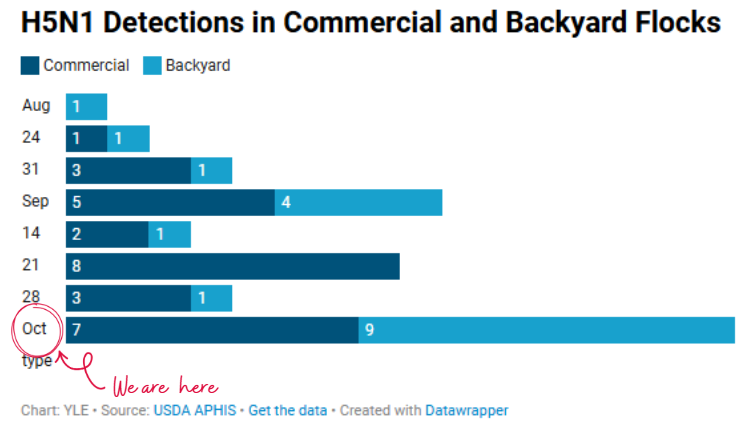
What this means for you: Overall, the health risk to the general public—and the risk of a pandemic—remains low. However, risk increases for anyone in close contact with infected or sick birds. Disease can be severe, as we saw in a few rare hospitalizations and deaths last year. So, as we move into this season:
If you have a backyard flock, you should take precautions to reduce the risk of spreading disease. For tips on how to do this, check YLE’s deep dive.
Bird feeders: Birds that gather at feeders (like cardinals, sparrows, and bluebirds) do not typically carry H5N1. The USDA does not recommend removing backyard bird feeders for H5N1 prevention unless you also care for poultry. The less contact between wild birds and poultry (by removing sources of food, water, and shelter), the better.
Hunters are at high risk for H5N1, especially if they don’t use PPE while handling dead birds. A Washington study showed that 2% (4/194) of hunting dogs tested positive for H5N1.
Domestic animals—cats and dogs—can get H5N1 if they contact (usually eat) a dead or sick bird or even its droppings. H5N1 can survive in bird droppings for up to 18 hours. Domestic animals can also get it from raw food, unpasteurized milk, and their humans. It’s very deadly to cats. (It doesn’t seem to be as dangerous to dogs.)
Infectious disease “weather report”
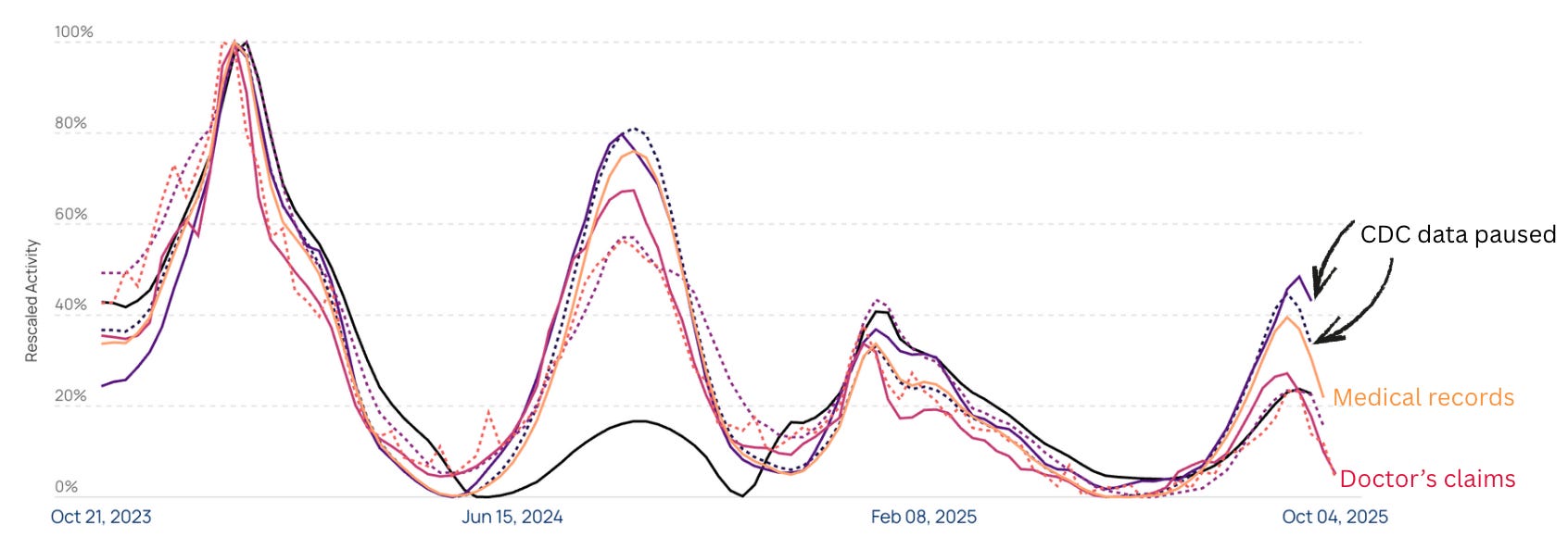
The government shutdown continues to stall federal data updates, including national flu, Covid-19, and RSV surveillance. So today we have a very fragmented picture. Still, we can piece together some insights by looking at alternative sources—like PopHIVE, which pulls from Google Trends and healthcare records—or by reviewing state-level data directly, as fellow epidemiologist Dr. Caitlin Rivers has been doing.
The rough picture shows this:
Covid-19 is still trending down
Flu activity remains low, though it’s increased slightly in Texas, Oklahoma, and South Dakota.
RSV in Southern states is growing, especially in Louisiana, South Carolina, Virginia, and Texas.
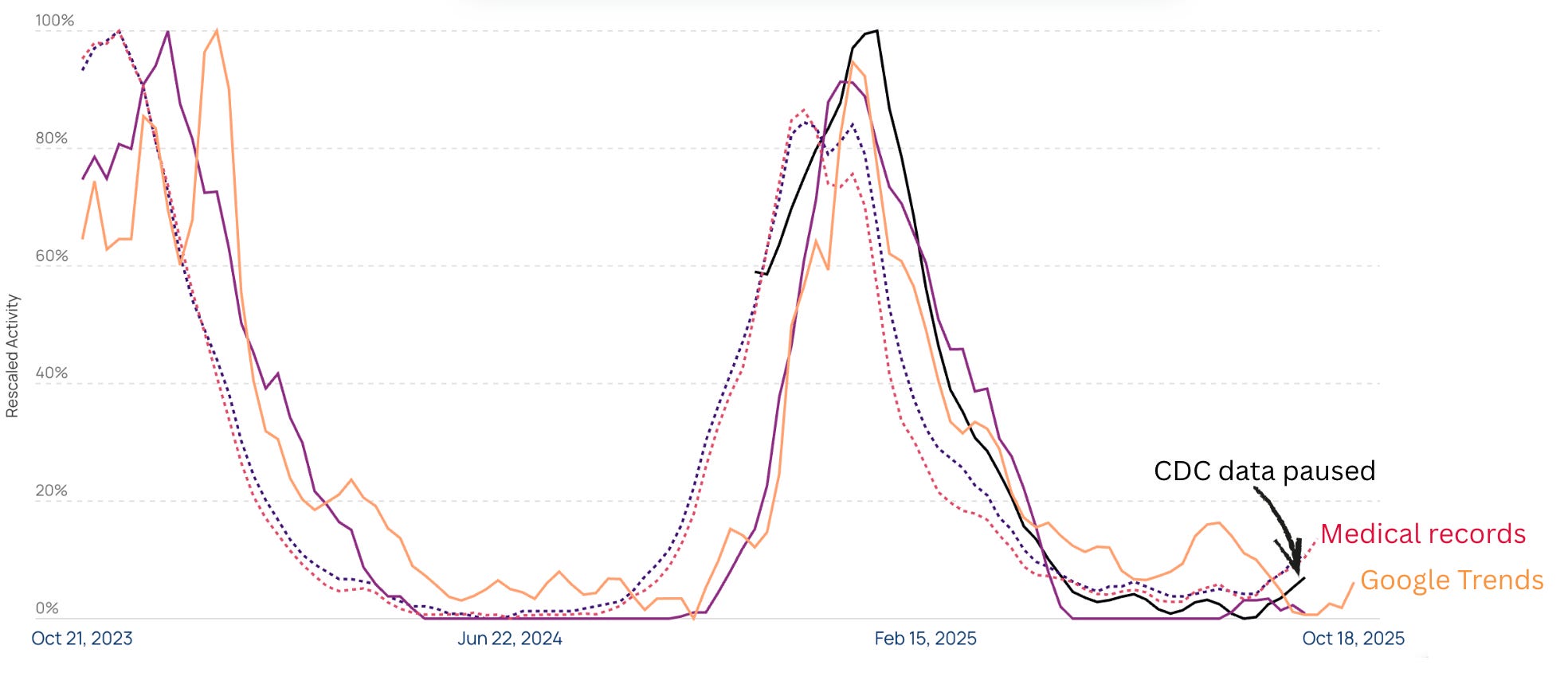
What this means for you: We’re still in a pre-flu season lull. This is expected in early October, but will change in the coming weeks. Now is a great time to get your vaccinations. Check out YLE’s Updated Fall 2025 Vaccine Guide for more information.
Measles cases now stand at 1,575, with a few outbreaks.
Utah/Arizona: More than 100 confirmed cases linked to this outbreak (59 in Arizona and 44 in Utah), and cases continue to increase.
South Carolina: Eighth confirmed case since mid-September. One hundred fifty-three unvaccinated schoolchildren are now under a 21-day quarantine.
Minnesota: More than 10 cases in the past few weeks.
What this means for you: If you’re vaccinated, you’re very well protected. If you’re in these areas with a child under 12 months, consider getting MMR early.
Good news!
This is becoming my favorite section now, given *waves hands in the air* everything. Two pieces of great news this past week:
1. Several MacArthur Fellowships go to public health researchers. The “genius” grants are typically given to diverse and eclectic fellows, which I love, but this year, public health was well represented:
Jason McLellan studies viral proteins with an eye toward vaccine development. He’s characterizing viral fusion proteins, which viruses use to bind to human cells (think of the spike protein in SARS-CoV-2).
Nabarun Dasgupta is an epidemiologist and harm reduction specialist who is creating practical programs to mitigate harms from opioid overdose deaths.
The MacArthur Fellowship will provide the funding, time, and space to continue work freely.
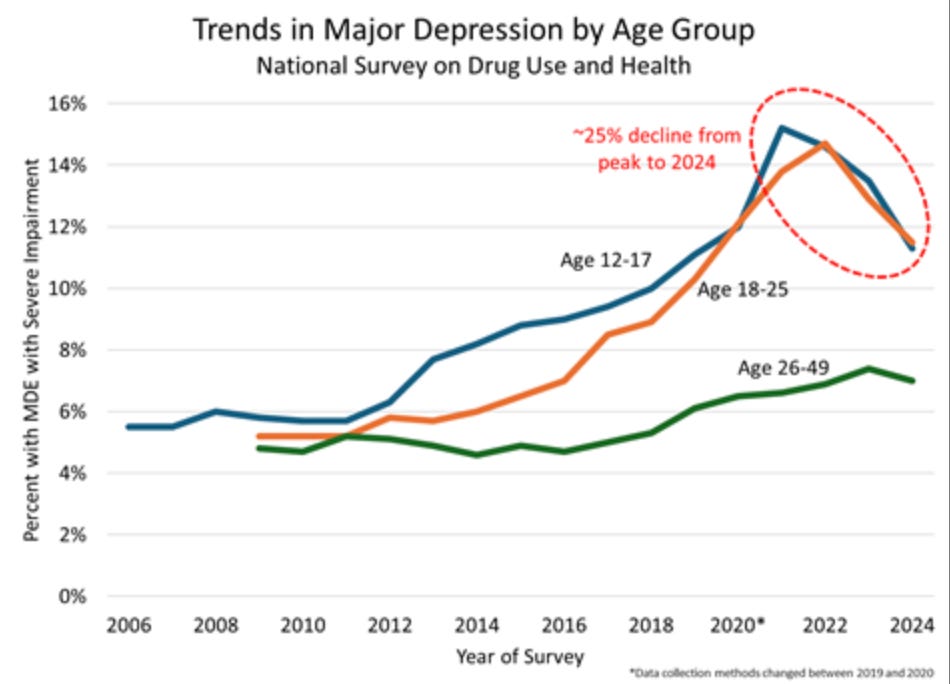
2. Mental health among teens and young adults is improving. After an alarming increasing trend over the years, the rate of depression among Americans aged 12-17 and 18-25 is falling quickly. We still have a long way to go in understanding causal effects, holding social media companies accountable, and improving the mental health of millions of teens. Still, this change is something to celebrate. (Shout-out to epidemiologist Dr. Thomas Farley for pointing out this fantastic news last week.)
Bottom line
This week showed us both the fragility and the resilience of public health in America. Our nation’s disease watchdog is being dismantled, data pipelines are going dark, and yet the work continues—from scientists holding the line to supporting teens’ mental health.
Have a wonderful week!
Love, YLE





.jpg)
No comments:
Post a Comment